

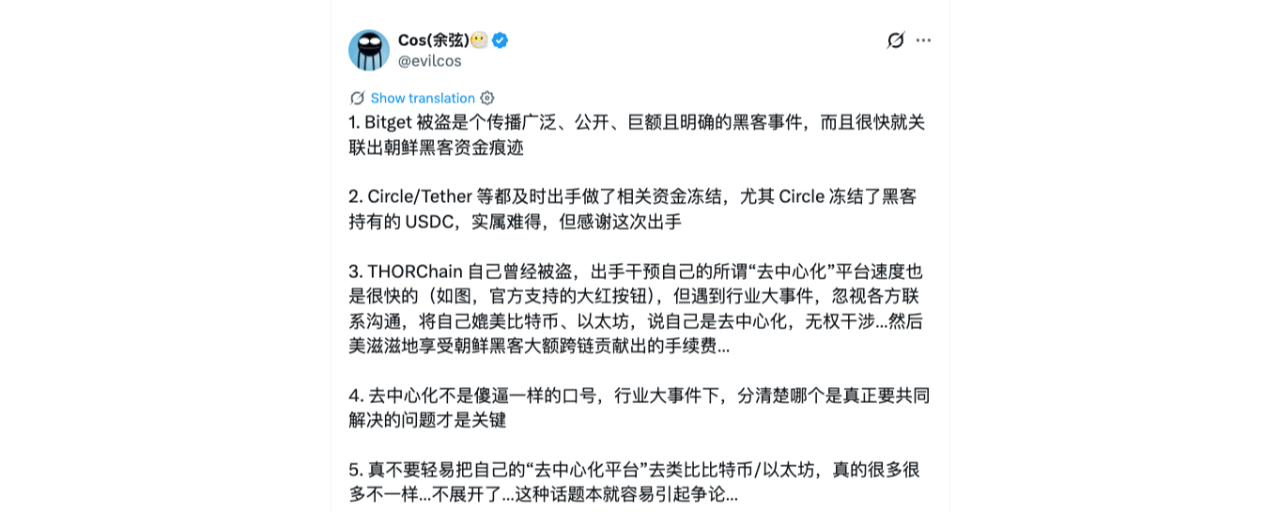


SlowMist co-founder Cosine said on X that the Bitget hack was a widely publicized, transparent, large-scale and unambiguous hack, and funds were quickly traced to North Korean hacker activity. According to Odaily, he said Circle, Tether and others stepped in promptly to freeze the relevant funds, singling out Circle's freezing of USDC held by the hacker as rare and welcome.
Cosine noted that THORChain, which itself was once hacked, had moved quickly to intervene on its own so-called "decentralized" platform in the past — pointing to an officially supported prominent red button. Yet when faced with a major industry incident, he said, it ignored outreach and coordination from various parties, likened itself to Bitcoin and Ethereum, and claimed that as a decentralized protocol it had no standing to intervene — all while comfortably collecting the fees generated by the North Korean hackers' large cross-chain transfers.
Decentralization should not be treated as an empty slogan, Cosine argued; when a major industry event occurs, what matters is distinguishing which problems genuinely need to be solved collectively. He cautioned against too readily comparing one's own "decentralized platform" to Bitcoin or Ethereum, saying there are many, many differences — a point he declined to expand on, noting the topic tends to invite dispute.