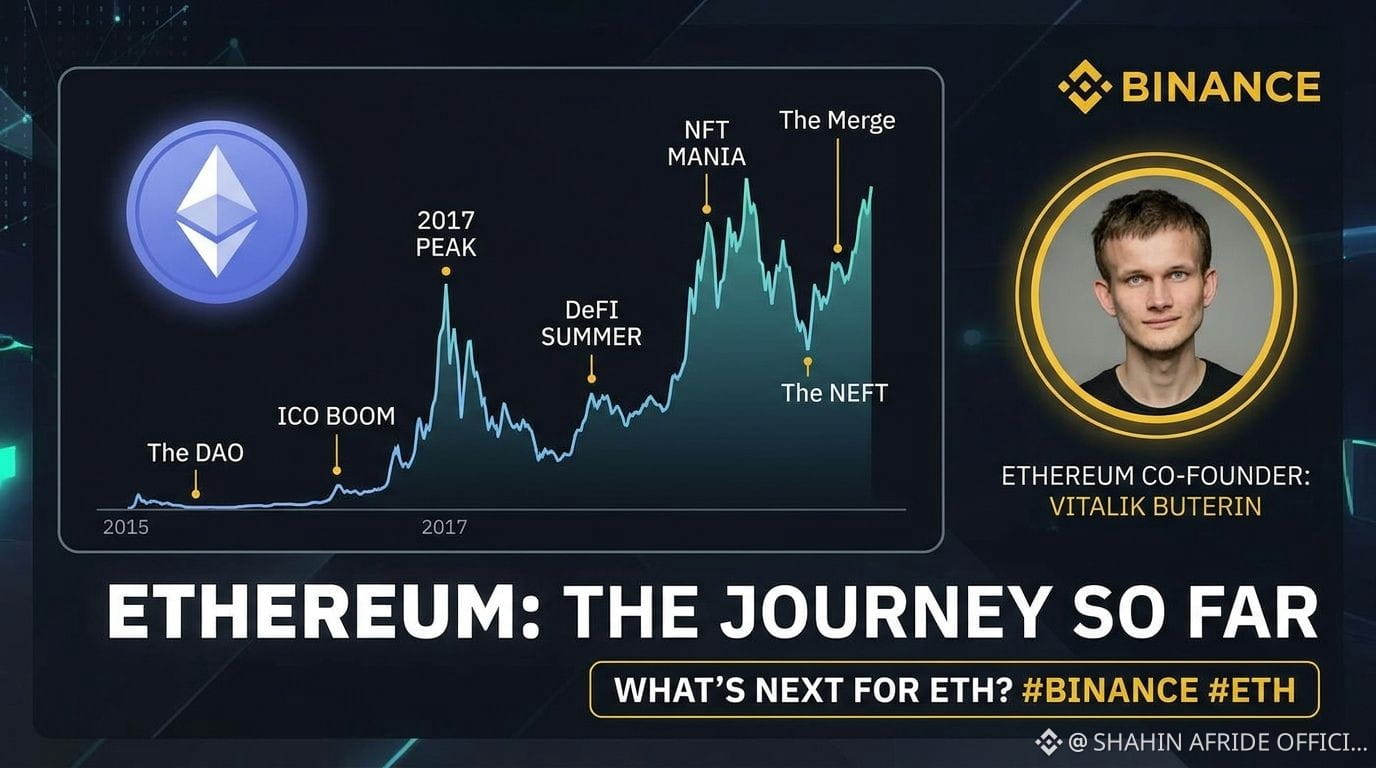
Ethereum ($ETH ) is a decentralized blockchain platform and the native cryptocurrency of the Ethereum network. Proposed by Vitalik Buterin in 2013 and launched in 2015, Ethereum was created to go beyond simple digital payments by enabling developers to build programmable applications through smart contracts.
From the beginning, Ethereum has evolved into a major infrastructure layer for the digital economy. Users can acquire $ETH through cryptocurrency exchanges and transfer it between wallets. When transactions or smart contracts are processed, $ETH is used to pay network fees, known as gas fees. Validators secure the network and help confirm transactions through Ethereum’s proof-of-stake consensus mechanism.
The Ethereum ecosystem supports a wide range of applications, including DeFi, NFTs, stablecoins, DAOs, gaming, tokenized assets, and decentralized applications (dApps). Developers can also create their own tokens and blockchain-based services using Ethereum’s smart-contract infrastructure.
Ethereum’s broader development focuses on improving scalability, efficiency, security, and transaction capacity, while layer-2 networks help process transactions more efficiently and reduce costs.
Overall, Ethereum functions not only as a cryptocurrency but also as a programmable blockchain infrastructure powering a large and diverse digital ecosystem.
📌 What do you think will be Ethereum’s biggest use case in the future? Share your perspective in the comments.
#CircleMints500MUSDCOnSolana #ETHETFsApproved #SECCommissionerPeirceToLeaveOct2
From the beginning, Ethereum has evolved into a major infrastructure layer for the digital economy. Users can acquire $ETH through cryptocurrency exchanges and transfer it between wallets. When transactions or smart contracts are processed, $ETH is used to pay network fees, known as gas fees. Validators secure the network and help confirm transactions through Ethereum’s proof-of-stake consensus mechanism.
The Ethereum ecosystem supports a wide range of applications, including DeFi, NFTs, stablecoins, DAOs, gaming, tokenized assets, and decentralized applications (dApps). Developers can also create their own tokens and blockchain-based services using Ethereum’s smart-contract infrastructure.
Ethereum’s broader development focuses on improving scalability, efficiency, security, and transaction capacity, while layer-2 networks help process transactions more efficiently and reduce costs.
Overall, Ethereum functions not only as a cryptocurrency but also as a programmable blockchain infrastructure powering a large and diverse digital ecosystem.
📌 What do you think will be Ethereum’s biggest use case in the future? Share your perspective in the comments.
#CircleMints500MUSDCOnSolana #ETHETFsApproved #SECCommissionerPeirceToLeaveOct2