

GRAM (Formerly Toncoin): How Telegram's Crypto Push Could Move the Market
## Introduction: Same Coin, New Name
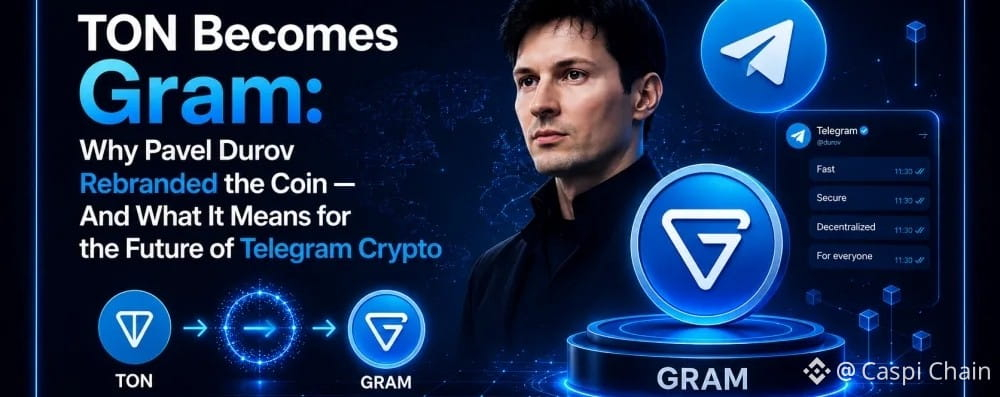
In the world of cryptocurrency, a project's name rarely gets talked about more than its identity. But GRAM's story starts exactly that way: on June 15, 2026, with 81.22% community support, Toncoin (TON) reverted to its original name and became Gram. This wasn't an ordinary rebrand — it was the return of the name Telegram founder Pavel Durov first introduced in the 2018 whitepaper, after six years of regulatory battles.
The blockchain itself is still called The Open Network (TON); only the token's name, ticker symbol (TON → GRAM), and logo changed. Balances, staking positions, and network operations were completely unaffected.
## Current Market Snapshot
At the time of writing, GRAM is trading with the following data:
- Price: Roughly $1.31–$1.43 (small variation depending on source)
- Market cap: Approximately $3.9 billion — ranked #30 globally on CoinGecko
- Daily trading volume: Between $38–$96 million
- All-time high: $8.25 (still about 83% below this level)
- All-time low: $0.52 (168% above this level)
- Circulating supply: About 2.8 billion tokens, max supply 5 billion
Price action over the past week has been fairly calm — around +2% — a far cry from the sharp spikes we've seen in coins like ZEC, UNI, or NEAR.
## The Real Story: The Gram Wallet Rollout
What sets GRAM apart from other coins right now isn't speculative hype — it's a concrete adoption catalyst:
On August 31, 2026, Pavel Durov announced the phased rollout of the Gram Wallet, a non-custodial wallet (where users control their own private keys) integrated directly into Telegram. Key features include:
- Fee-free transfers
- Planned to become the default option for Telegram's 1 billion+ users
- Full rollout expected to complete over the coming weeks
This directly connects GRAM to one of the world's largest messaging platforms. If even a small percentage of that user base begins using GRAM for payments or transfers, on-chain activity could rise significantly.
In parallel, projects like .gram domains (an identity system) and BTC Teleport (Bitcoin interoperability) are also in development — the goal being to build a comprehensive Web3 ecosystem within Telegram.
## The Technical Picture: Has the Market Bought In Yet?
Here's an interesting wrinkle: despite this major potential catalyst, price hasn't reacted strongly yet. As of September 5, 2026:
- Price remains stuck below the $1.40 resistance level
- Trading below key moving averages
- RSI sits around 38–39 — near oversold territory, but no strong buy signal yet
This can be read two ways: either the market hasn't "priced in" the wallet's real-world adoption yet, or investors remain cautious about how realistic that adoption will actually be.
## Scenario Analysis: What If Things Go Well?
Various forecasting platforms (notably CoinPedia) have laid out a tiered scenario structure:
| Scenario | Condition | Potential Target |
|---|---|---|
| Base adoption | Wallet rolls out successfully, user count grows | ~$1.80 (about +33%) |
| Expanding ecosystem | Decentralized storage/infrastructure services grow | ~$4.52 (about +235%) |
| Ad & payment integration | Telegram shares ad revenue, expands payment features | ~$8.20 (about +510%) |
| Long-term maturity (2030) | Fully developed Web3 ecosystem, global adoption | ~$25 |
Important caveat: These figures are speculative models from various forecasting platforms — not analyst consensus. For example, CoinCodex projects $2.62 by end of 2026, while WalletInvestor projects a figure below the current price ($1.39). Such large discrepancies show just how speculative these projections really are.
## Risks and Things to Watch
- "Sell the news" risk: During June's rebrand, short-term traders used the announcement as an exit opportunity — a similar dynamic could play out around the wallet launch.
- Uncertain adoption assumption: Having a wallet inside a messaging app doesn't automatically translate into active crypto usage.
- Regulatory risk: Durov's past legal troubles in France could create regulatory pressure on Telegram, and by extension, GRAM.
- Macro dependency: Bitcoin's direction and the broader market heavily influence GRAM's short-term performance regardless of its own fundamentals.
## Conclusion
GRAM stands out as one of the few crypto projects with a genuine catalyst right now — the Telegram Wallet integration offers measurable user-growth potential rather than pure speculation. That said, the current technical picture suggests the market hasn't fully priced in this story yet.
As a realistic framework: if the wallet launch is genuinely successful (meaning users actively use it rather than simply installing and forgetting it), the $1.80–$4.50 range is the most commonly repeated medium-term target zone for 2026–2027. Figures beyond that ($8+) are far more speculative, longer-term scenarios.
---
This article is for informational purposes only and does not constitute investment advice. Cryptocurrency markets are highly volatile; you should conduct your own research before making any investment decisions.
---