#dusk $DUSK @Dusk
I expected a DuskEVM withdrawal to work like a normal bridge:
send the transaction, get confirmation, wait for the DUSK.
That assumption lasted until I actually followed the withdrawal flow.
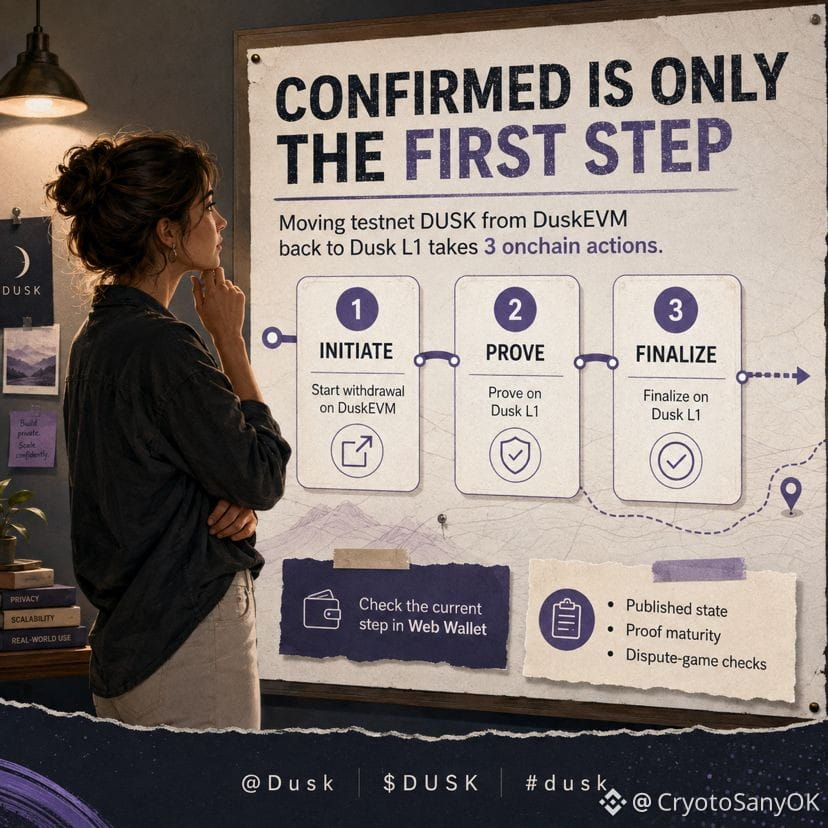
Moving testnet DUSK from DuskEVM back to Dusk L1 requires three onchain actions:
1. Initiate the withdrawal on DuskEVM
2. Prove it on Dusk L1
3. Finalize it on Dusk L1
So the first successful transaction does not mean the withdrawal is finished.
That was the part I would have checked wrong.
My instinct was to watch the clock and ask:
“Has enough time passed yet?”
But Dusk’s guide explicitly says not to calculate readiness from elapsed time alone.
The Web Wallet’s Withdrawal status is the check that matters, because readiness depends on published network state, proof maturity and dispute-game checks.
That gives me a much simpler user rule:
Confirmed is not the same as finished.
Check the current step before doing anything else.
For me, this is exactly the kind of thing a bridge UI needs to make painfully obvious.
A user should always know:
Where am I in the process?
What action is required next?
This is testnet today, but it is the UX I’ll be watching as DuskEVM develops.
I expected a DuskEVM withdrawal to work like a normal bridge:
send the transaction, get confirmation, wait for the DUSK.
That assumption lasted until I actually followed the withdrawal flow.
Moving testnet DUSK from DuskEVM back to Dusk L1 requires three onchain actions:
1. Initiate the withdrawal on DuskEVM
2. Prove it on Dusk L1
3. Finalize it on Dusk L1
So the first successful transaction does not mean the withdrawal is finished.
That was the part I would have checked wrong.
My instinct was to watch the clock and ask:
“Has enough time passed yet?”
But Dusk’s guide explicitly says not to calculate readiness from elapsed time alone.
The Web Wallet’s Withdrawal status is the check that matters, because readiness depends on published network state, proof maturity and dispute-game checks.
That gives me a much simpler user rule:
Confirmed is not the same as finished.
Check the current step before doing anything else.
For me, this is exactly the kind of thing a bridge UI needs to make painfully obvious.
A user should always know:
Where am I in the process?
What action is required next?
This is testnet today, but it is the UX I’ll be watching as DuskEVM develops.