
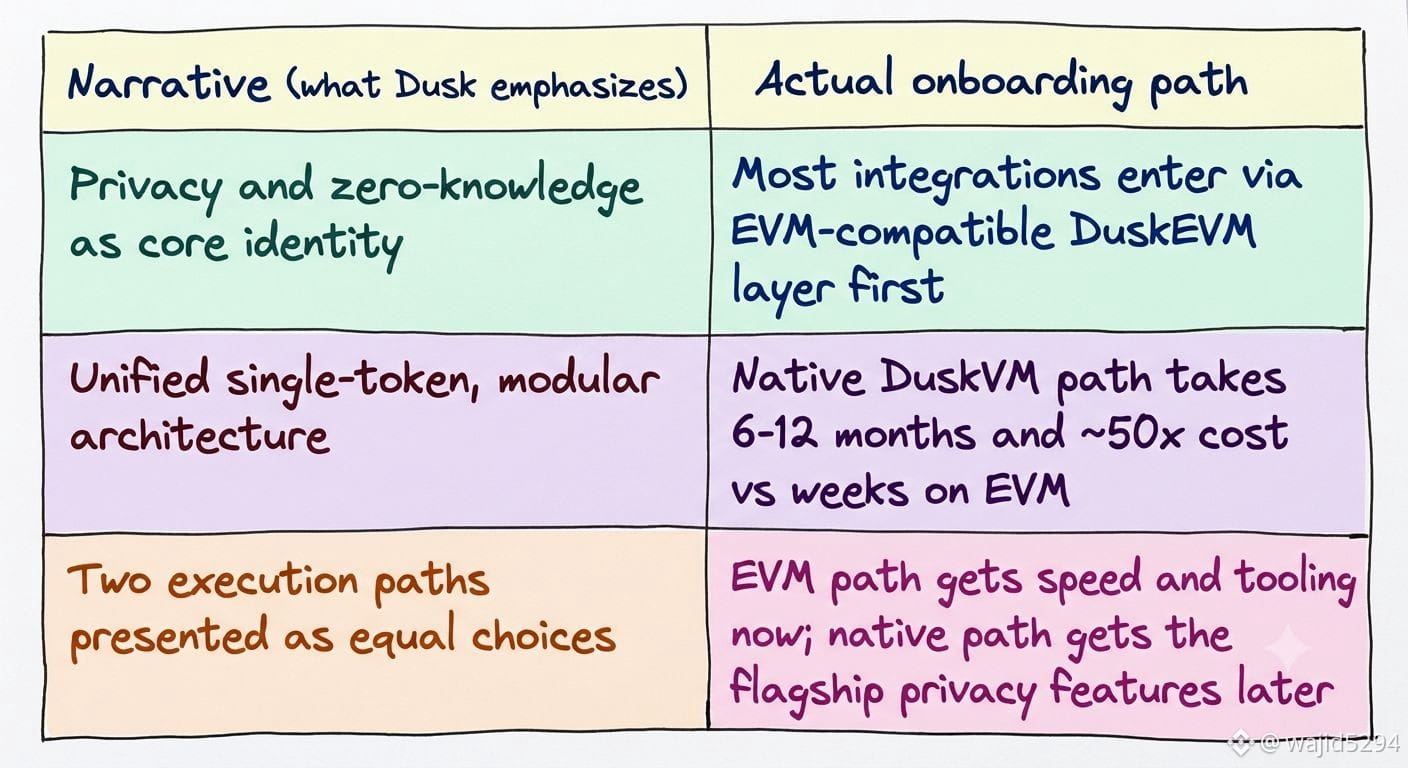
#dusk @Dusk $DUSK Watched Dusk's own migration notes longer than I expected to, because the number kept nagging at me: custom integrations on the native L1 reportedly take 6-12 months and cost roughly 50x more than deploying on the EVM path, while exchanges spent months adapting to native Dusk versus weeks for EVM integrations. #Dusk $DUSK @DuskFoundation splitting execution into DuskEVM and DuskVM/DuskDS isn't just a technical tidiness decision, it's an admission about sequencing. EVM builders get speed, familiar tooling, and near-immediate liquidity access. Native builders get the "real" privacy and zero-knowledge capabilities the project is actually known for, but they get there slower, through Rust/WASM, through more bespoke work, through a path the docs themselves describe as costlier. So the marketing centers privacy and compliance-grade confidentiality as the core identity, but the actual onboarding funnel routes most early activity through the layer that looks like every other EVM chain. It's a reasonable bet on adoption mechanics. It also means the thing that makes Dusk distinctive is, for now, the slower door. Wonder how long that gap stays a sequencing choice before it becomes the default shape of the ecosystem.


Publier
Avertissement : ce contenu inclut des opinions de tiers. Il ne constitue pas un conseil. Binance Ai peut être utilisée, sans garantie de résultat. Consultez les CG.