



La version courte
Le 24 juin, Micron a publié ses résultats deux minutes après la cloche de clôture. Sa version tokenisée sur Binance a revalorisé immédiatement. Dix-sept heures plus tard, l’action réelle a ouvert presque exactement au même niveau que celui où le token avait déjà été échangé.
Hyperliquid est parvenu en premier aux actions hors heures de cotation, mais une perp fait face à un oracle qui se fige à 16 h. Un token spot n’a aucun point d’ancrage pour se figer.
Nvidia publie le 26 août après la cloche, toujours dix-sept heures plus tard. Regardez ce qui se passe.
Mercredi 26 août, vers 16 h 20 (heure de l’Est), Nvidia publiera le chiffre le plus déterminant pour les cours des actions mondiales.
La Bourse de New York (NYSE) a fermé vingt minutes plus tôt. Le Nasdaq a fermé vingt minutes plus tôt. Des milliers de milliards de dollars de capitalisation boursière vont être réévalués, et les lieux qui le font officiellement restent obscurs jusqu’au lendemain matin, à 9 h 30.
Dix-sept heures. C’est l’écart.
Il vaut mieux être précis sur l’ampleur de cet écart. Les marchés boursiers américains sont ouverts six heures et demie par jour, cinq jours par semaine - soit environ 32 des 168 heures d’une semaine. Pour les autres 80 %, la classe d’actifs de référence du monde n’a aucun prix.
Les résultats tombent après la cloche. Les banques centrales s’expriment à des heures bizarres. La géopolitique n’observe pas le sabbat. Et, pour la majeure partie de l’histoire financière, la réponse à « combien ça vaut maintenant ? » était tout simplement : attendre.
Cette réponse expire. Nous avons déjà le reçu.
Micron l’a prouvé le 24 juin
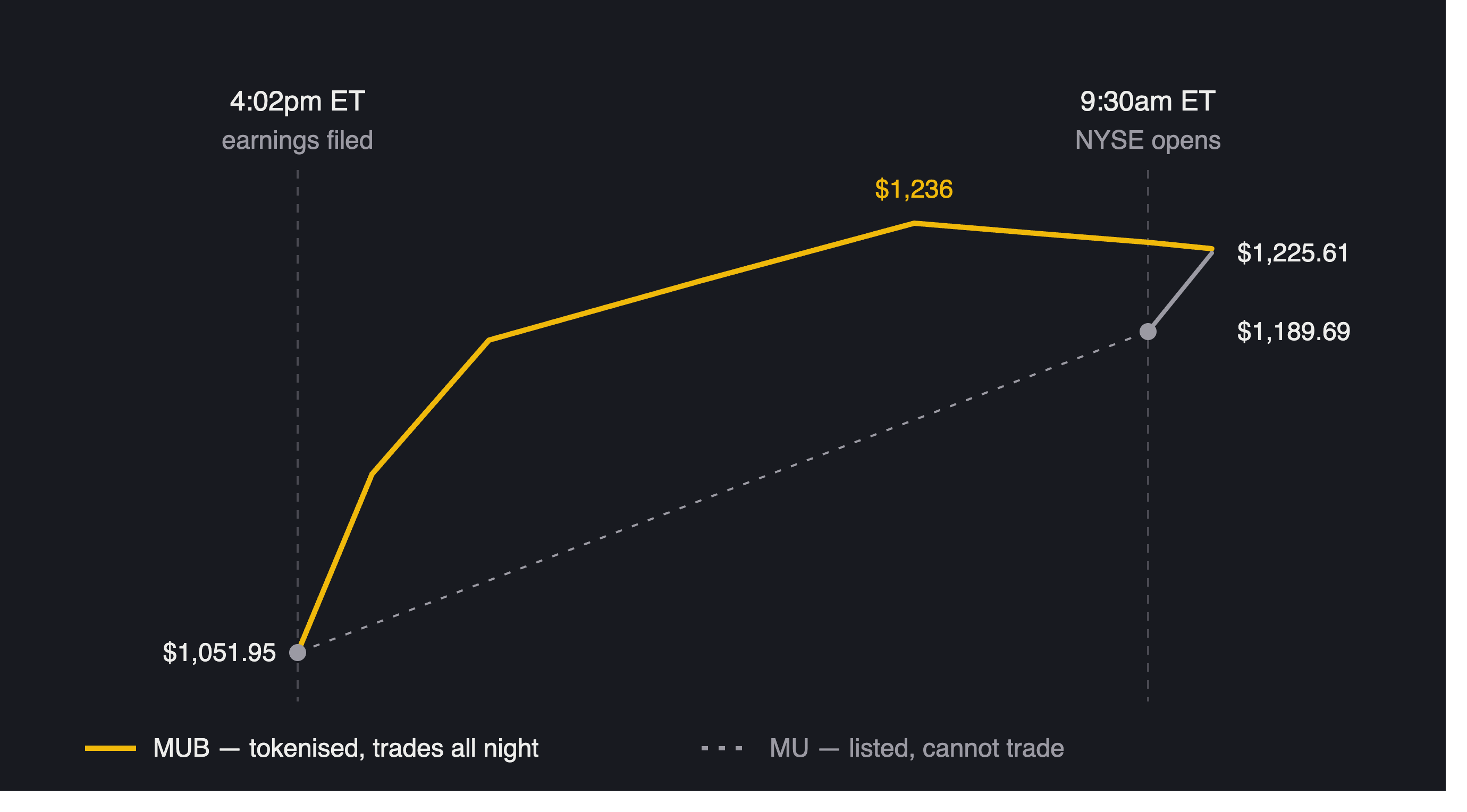
Micron a déposé ses résultats du T3 fiscal à 16 h 02, heure de l’Est - deux minutes après la clôture.
C’était une surprise réelle. Les revenus se sont établis à 41,46 milliards de dollars contre environ 35,84 milliards de dollars attendus, et l’action avait chuté de plus de 13 % lors de la séance précédente, à cause des craintes liées au trade sur l’IA. Personne n’avait anticipé ça.
Le marché coté n’a rien pu faire pendant dix-sept heures.
D’après la propre analyse de Binance Research, $MUB le produit Micron tokenisé est passé d’une référence de clôture de 1 051,95 $ à 1 128,95 $ dans les cinq minutes suivant le dépôt. Une heure plus tard : 1 185,87 $. À 4 h du matin, heure de l’Est, il se négociait autour de 1 236 $.
Puis l’action a rouvert. Micron a fait un « gap » à 1 189,69 $ - environ 13 % au-dessus de sa clôture précédente - dans une fraction de l’endroit où le token s’était stabilisé pendant la nuit - et a touché 1 225,61 $ dès la première minute. La journée s’est clôturée en hausse d’environ 15 %.
C’est le test qui compte, et il faut être clair sur le pourquoi. Une prime du week-end ne prouve rien ; un token peut dériver au-dessus de la clôture de vendredi sur un volume faible et ne vouloir absolument rien dire.
Micron est différent. Un véritable événement d’information est arrivé pendant que le marché était fermé. Le token s’est réévalué immédiatement. Il a donné la bonne direction, a à peu près donné la bonne ampleur, et l’action cotée s’est rapprochée de lui dans les soixante secondes suivant l’ouverture.
Les dix-sept heures n’étaient pas du temps mort. C’était là que le prix a été trouvé.
Les chiffres plus larges et leurs limites
Binance a publié un échantillon plus large. Sur sept week-ends entre le 12 juin et le 27 juillet, elle indique que les prix des bStocks du week-end ont capturé une médiane de 92 % de l’écart du lundi qui s’est finalement produit, avec une déviation résiduelle médiane de 0,19 % lors de la réouverture - et que, pour des mouvements supérieurs à 3 %, les 41 observations étaient correctes dans le sens.
Lisez-les avec une prudence appropriée. L’échantillon est court. Binance elle-même note que la période a été exceptionnellement riche en actualités. Et les chiffres sont publiés par l’émetteur - c’est l’entreprise qui mesure son propre produit. Ils sont cohérents avec le cas Micron plutôt qu’avec une confirmation indépendante.
Un datapoint structurel plus net : le 19 juin, les marchés américains ont fermé pour Juneteenth et les bStocks ont continué de trader pendant toute la fermeture. Binance Research rapporte que les spreads moyens, comparés à des équivalents de marchés régulés, ont atteint 0,13 % pendant le jour férié, puis se sont resserrés à 0,11 % à l’ouverture du lundi, les noms les plus liquides convergeant vers moins de 0,01 %.
Rien n’a cassé. Le marché a maintenu l’alignement malgré l’arrêt complet du site qu’il surveille.
Hyperliquid est arrivé le premier.
Là où il faut reconnaître : la première plateforme à montrer à grande échelle que des gens échangeraient des actions à 3 h du matin le dimanche, ce n’était pas Binance. C’était le marché des perpétuels on-chain.
Le cadre HIP-3 de Hyperliquid, introduit en octobre 2025, a permis à des constructeurs indépendants de déployer des marchés perpétuels sur un carnet d’ordres partagé. Les equity perps ont ensuite suivi, et ce n’était pas un geste symbolique : les marchés déployés par des builders tournent désormais dans les centaines de milliards de volume cumulé, les noms d’actions figurant parmi les plus importants en termes d’intérêt ouvert.
Quand SpaceX a listé, son perp a suivi le lancement avant, pendant et après - et c’était le seul short de détail réellement disponible, sans « locate » et sans emprunt.
C’est une vraie découverte de prix, et toute personne vous disant le contraire vend quelque chose.
Mais il y a un détail mécanique à l’intérieur de ces marchés que presque personne ne mentionne, et c’est toute la thèse.
Son prix a une ancre morte.
Un futur perpétuel n’a pas de prix qui lui soit propre. Il a une valorisation, ancrée à un oracle, avec des paiements de financement qui rapprochent les deux. Pendant la séance américaine, cet oracle lit le flux en direct, et perp et action restent serrés parce que des arbitragistes peuvent couvrir l’un contre l’autre.
Après la clôture, l’oracle se fige sur le prix de clôture.
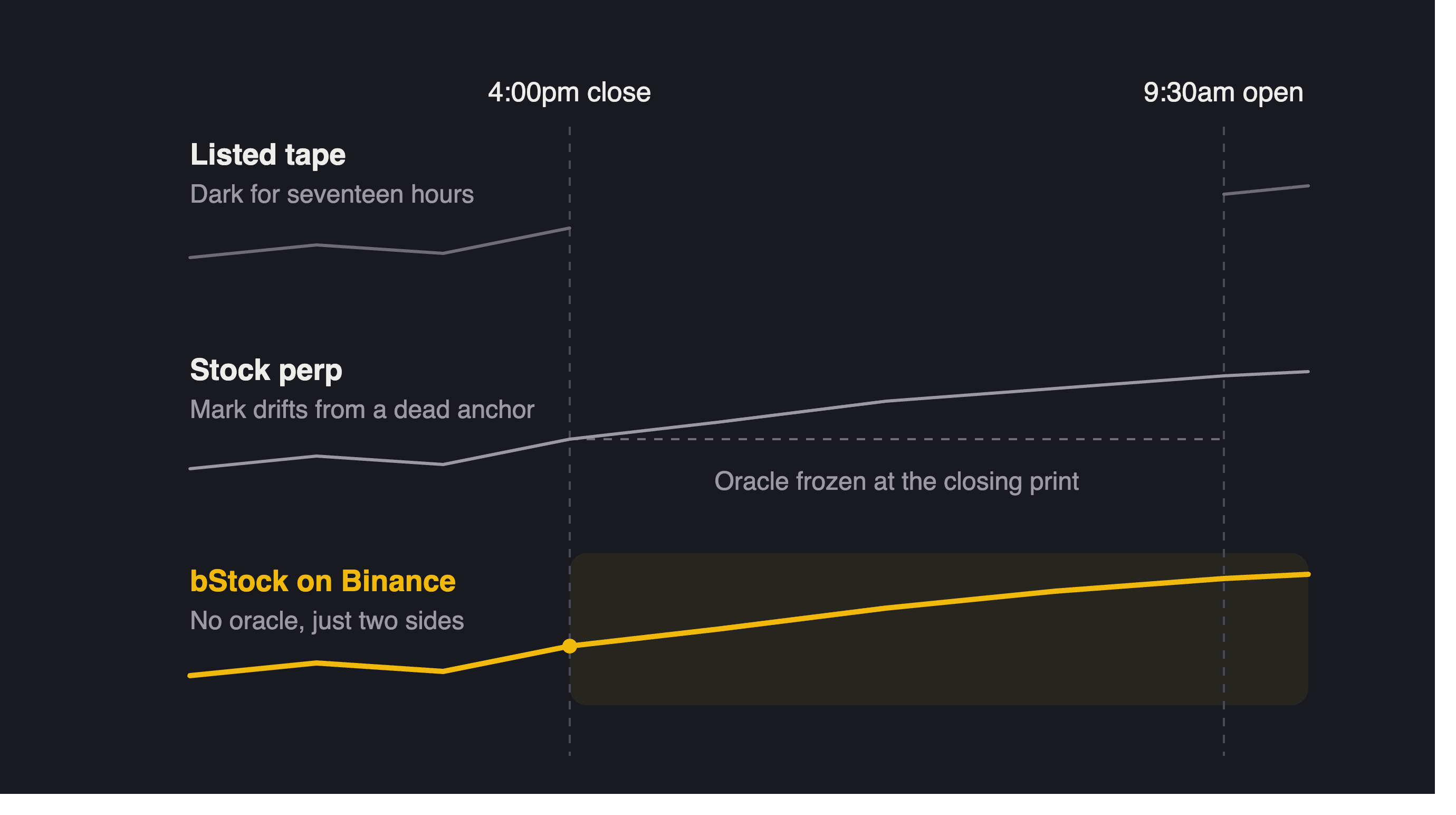
Le marché continue de trader. Le financement continue de se régler. Mais l’ancre est désormais un nombre périmé de 16 h 00, et ce que le marché découvre, c’est la distance par rapport à une référence morte, exprimée à travers un taux de financement.
Ça fonctionne. C’est malin. C’est aussi une dérivée d’un cadavre jusqu’à 9 h 30 - et quand l’oracle lui-même dysfonctionne, les conséquences retombent sur les traders plutôt que sur la référence.
Un bStock n’a pas d’oracle. C’est un carnet d’ordres au comptant avec deux côtés et un dernier prix exécuté, et ce prix est le prix. Le 24 juin, il n’y avait rien à geler.
Binance a construit l’autre moitié
Les bStocks ont été lancés le 11 juin 2026 - des titres tokenisés émis par BTech Holdings, une filiale de Binance enregistrée au Abu Dhabi Global Market, à la suite de l’approbation du prospectus par l’Autorité de régulation des services financiers de l’ADGM. Lancement avec cinq tickers : Circle, Micron, Nvidia, Sandisk, Tesla.
Ten weeks later, Token Terminal - un fournisseur indépendant de données on-chain, pas une source de Binance - a estimé que les bStocks atteignaient 672,2 millions de dollars de capitalisation boursière tokenisée le 7 août, sur 56 actifs suivis, en affirmant que c’était le plus rapide des émetteurs de stocks tokenisés sur les quatre-vingt-dix jours précédents.
Les plus grosses positions : Sandisk à 114,4 millions de dollars, SpaceX à 109,9 millions, Micron à 76,3 millions, Circle à 71,7 millions - avec un ETF Nasdaq-100, un ETF sectoriel des semi-conducteurs et un ETF sur la Corée du Sud tous dans le top dix.
La composition compte autant que la taille. Binance rapporte que 58 % du volume de trading lié aux actions sur sa plateforme intervient après la fermeture des marchés américains, qu’un seul week-end a généré 2 milliards de dollars de volume en bStocks, que la génération Gen Z représente 44 % de l’activité, et que 41,5 % des utilisateurs ont commencé leur parcours d’investissement traditionnel via des titres tokenisés.
Ce ne sont pas des traders de la TradFi qui migrent. Ce sont des gens pour qui un compte de courtage n’a jamais été le réglage par défaut : ils ont rencontré Micron pour la première fois en tant que ticker qui s’échange le dimanche.
Et il y a un pilier structurel qu’aucune plateforme perp n’a. Un perp sur action est un pari synthétique - pas de propriété, pas de dividende, et il peut vous liquider. Un bStock est un certificat adossé 1:1 à une vraie action détenue avec un dépositaire régulé, traitant les opérations sur titres et la réinvestissement des dividendes, convertible de et vers l’action sous-jacente à 1:1, sans frais dans aucun sens. Fractionné, à partir de 5 $. Auto-conservation sur BNB Chain.
Donc ce n’est pas une version meilleure ou pire de la même chose. Un site a construit le moyen le plus rapide d’exprimer une opinion sur une action à 3 h du matin. L’autre a construit un pont entre le prix de 3 h et le certificat d’actions lui-même.
Hyperliquid a prouvé la demande. Binance, c’est ce qui se passe quand cette demande rencontre la distribution.
Les bourses appellent ça un bug, pas une fonctionnalité
Tout le monde ne lit pas ces dix-sept heures comme un progrès.
La SEC a passé 2026 à préparer une « innovation exemption » pour les titres tokenisés sous la présidence de Paul Atkins - un cadre qui permettrait aux tokens d’actions d’être échangés en continu sur des rails blockchain. Bloomberg a rapporté le 11 août que cela pourrait ouvrir la porte à un trading 24/7 de tokens d’actions.
Ce n’a pas encore été publié. Un déploiement de mai a été retiré après que la direction de Nasdaq, NYSE et Cboe s’y soit opposée lors de réunions à huis clos.
Leur objection n’était pas une hostilité vague envers la crypto. Elle portait précisément sur l’exécution hors heures : le prix de référence coté n’est pas disponible pendant seize heures de la journée de trading tokenisée, et les ordres de détail exécutés pendant la nuit n’ont pas de meilleur bid et offer national à vérifier.
Selon cette lecture, les dix-sept heures ne sont pas de la découverte de prix. Ce sont plutôt une portion de la journée où les investisseurs échangent sans bénéficier des protections que le reste du marché tient pour acquises. Le commissaire Hester Peirce a résumé le principe sans détour : « Les titres tokenisés restent des titres. »
Les deux choses peuvent être vraies. Micron montre que le prix de nuit était informatif. Les bourses soulignent que le fait d’être informatif n’est pas la même chose que d’être supervisé.
La question à laquelle l’exemption doit répondre n’est pas de savoir si les marchés continus fonctionnent - les preuves disent que oui. C’est ce qu’un investisseur de détail doit recevoir à 2 h du matin. Cette question n’est pas tranchée, et c’est la raison pour laquelle les bStocks excluent actuellement les personnes des États-Unis.
Regardez maintenant Nvidia
Les prévisions de Nvidia pour le trimestre sont de 91,0 milliards de dollars de revenus, plus ou moins 2 % - les perspectives de la direction, pas le consensus des analystes. Le communiqué arrive à environ 13 h 20, heure du Pacifique, l’appel à 17 h 00, heure de l’Est, et le ruban ne rouvre qu’à jeudi matin.
Regardez $NVDAB . Regardez où cela s’installe pendant la nuit, et observez jusqu’où la publication d’ouverture de jeudi à New York va, par rapport à l’endroit où le marché 24/7 l’avait déjà amenée.
Si Micron est un indicateur, l’écart sera faible - et l’ouverture de la bourse sera ce qu’elle devient de plus en plus : une confirmation administrative d’un nombre que le marché a trouvé des heures plus tôt.
bLes actions sont des certificats qui suivent la performance des actions sous-jacentes, pas une propriété directe des parts. La disponibilité est limitée par la juridiction et exclut les personnes des États-Unis, du Royaume-Uni et de l’UE. Les titres tokenisés et les perpétuels sur actions comportent des risques distincts, notamment en matière de liquidité, de conservation, d’oracle et - pour les produits avec effet de levier - de risque de liquidation. Les données de trading attribuées à Binance Research sont publiées par l’émetteur. Les chiffres sont datés lorsqu’ils sont cités et évoluent rapidement. Rien de tout cela ne constitue un conseil en investissement.