I used to think a vault timelock was basically a brick wall: every sensitive change gets the same delay, whether it makes the vault safer or riskier.
Then I looked closer at TermMax, and that assumption started falling apart.
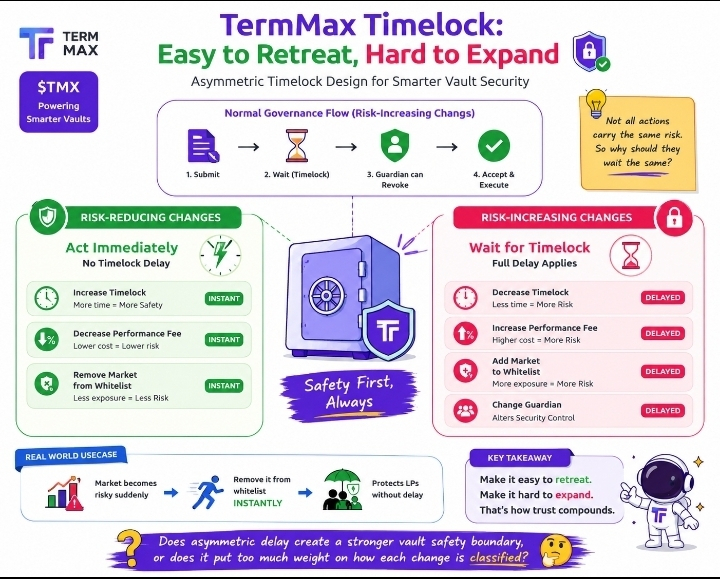
For important curator changes, the normal path is submit → wait → accept.
During that window, a guardian can still revoke the pending action. @TermMax .
But the interesting part is the asymmetry.
If a change reduces risk, it can move immediately: increasing the timelock, lowering the performance fee, or removing a market from the whitelist.
Move toward greater exposure, and the brakes engage: reducing the timelock, increasing fees, adding a market, or changing the guardian requires the full waiting period.
That makes sense to me.
Think of a bank vault with two buttons: “get out” opens quickly, while “put more money in” makes you stop and think twice. 😅
And this matters beyond governance theory. If a whitelisted market suddenly becomes questionable, the curator shouldn't have to wait before removing exposure.
But if they want to add a new market or weaken a safety parameter, users get time to notice, assess, and potentially react. #TermMax .
The tradeoff is what caught my attention.
Asymmetric timelocks don't determine whether a decision is actually good.
They only control how quickly that decision can take effect.
So the real security boundary isn't just the timer.
It's also the logic deciding which direction counts as “safer.”
That makes TermMax interesting to me: $TMX sits alongside a governance design question that many protocols still treat as binary.
Can asymmetric delays create a genuinely safer vault—or simply make the classification layer the new thing we have to trust?
Then I looked closer at TermMax, and that assumption started falling apart.
For important curator changes, the normal path is submit → wait → accept.
During that window, a guardian can still revoke the pending action. @TermMax .
But the interesting part is the asymmetry.
If a change reduces risk, it can move immediately: increasing the timelock, lowering the performance fee, or removing a market from the whitelist.
Move toward greater exposure, and the brakes engage: reducing the timelock, increasing fees, adding a market, or changing the guardian requires the full waiting period.
That makes sense to me.
Think of a bank vault with two buttons: “get out” opens quickly, while “put more money in” makes you stop and think twice. 😅
And this matters beyond governance theory. If a whitelisted market suddenly becomes questionable, the curator shouldn't have to wait before removing exposure.
But if they want to add a new market or weaken a safety parameter, users get time to notice, assess, and potentially react. #TermMax .
The tradeoff is what caught my attention.
Asymmetric timelocks don't determine whether a decision is actually good.
They only control how quickly that decision can take effect.
So the real security boundary isn't just the timer.
It's also the logic deciding which direction counts as “safer.”
That makes TermMax interesting to me: $TMX sits alongside a governance design question that many protocols still treat as binary.
Can asymmetric delays create a genuinely safer vault—or simply make the classification layer the new thing we have to trust?