#bstockscis @BinanceCIS
Dimanche matin.
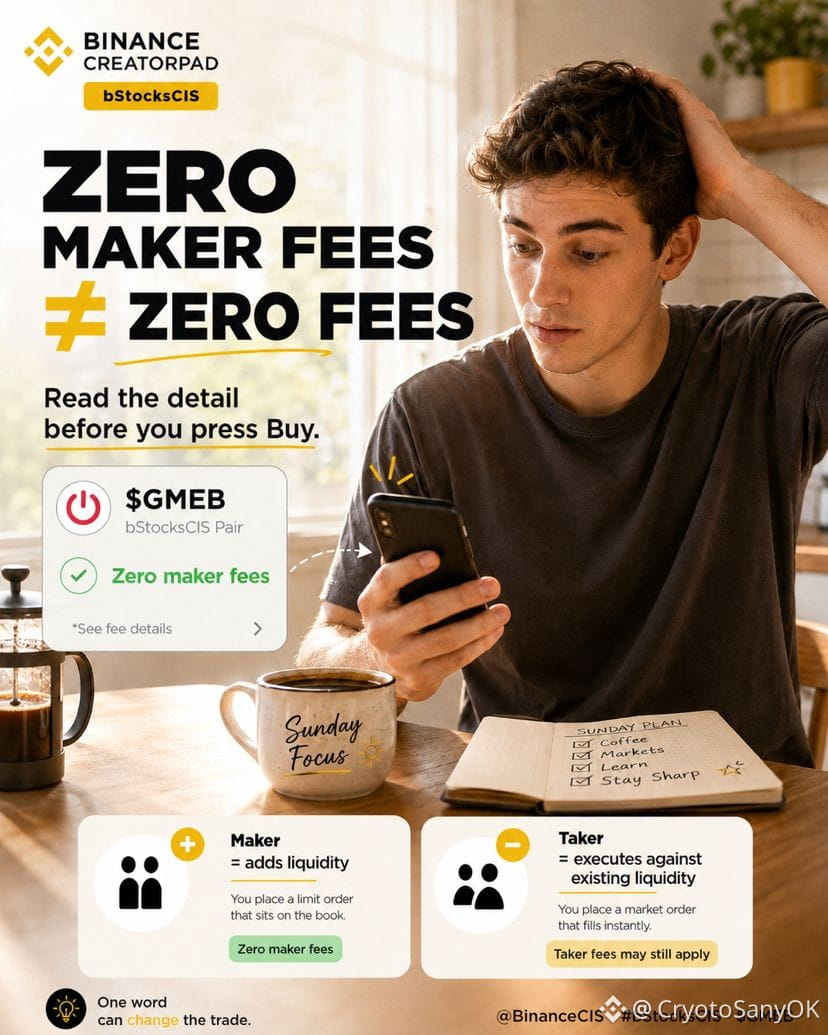
Mon café refroidissait pendant que je faisais défiler Binance et que je remarquais $GMEB .
Une phrase a attiré mon attention :
zéro frais de maker.
Et pendant une seconde, mon cerveau l’a traduite en quelque chose de beaucoup plus simple :
« Bien. Zéro frais de trading. »
Puis je me suis rendu compte que j’avais lu un mot trop vite.
Maker et taker ne sont pas la même chose.
Si mon ordre reste dans le carnet et ajoute de la liquidité, je suis le maker.
Si mon ordre s’exécute contre une liquidité qui est déjà là, je suis le taker.
Donc zéro frais de maker ne signifie pas automatiquement que chaque façon d’entrer dans une transaction est sans frais.
C’est une nuance infime.
Mais c’est exactement le genre de nuance que j’ai appris à ne pas sauter.
Parce que parfois, l’erreur coûteuse n’est pas enfouie au fin fond de la documentation.
Parfois, il s’agit juste d’un mot que l’on lit trop vite en buvant son café du matin.
Alors j’ai ajouté une autre petite règle pour moi :
quand je vois « zéro frais », je vérifie exactement quels frais sont à zéro avant de cliquer sur Acheter.
$GMEB
Dimanche matin.
Mon café refroidissait pendant que je faisais défiler Binance et que je remarquais $GMEB .
Une phrase a attiré mon attention :
zéro frais de maker.
Et pendant une seconde, mon cerveau l’a traduite en quelque chose de beaucoup plus simple :
« Bien. Zéro frais de trading. »
Puis je me suis rendu compte que j’avais lu un mot trop vite.
Maker et taker ne sont pas la même chose.
Si mon ordre reste dans le carnet et ajoute de la liquidité, je suis le maker.
Si mon ordre s’exécute contre une liquidité qui est déjà là, je suis le taker.
Donc zéro frais de maker ne signifie pas automatiquement que chaque façon d’entrer dans une transaction est sans frais.
C’est une nuance infime.
Mais c’est exactement le genre de nuance que j’ai appris à ne pas sauter.
Parce que parfois, l’erreur coûteuse n’est pas enfouie au fin fond de la documentation.
Parfois, il s’agit juste d’un mot que l’on lit trop vite en buvant son café du matin.
Alors j’ai ajouté une autre petite règle pour moi :
quand je vois « zéro frais », je vérifie exactement quels frais sont à zéro avant de cliquer sur Acheter.
$GMEB