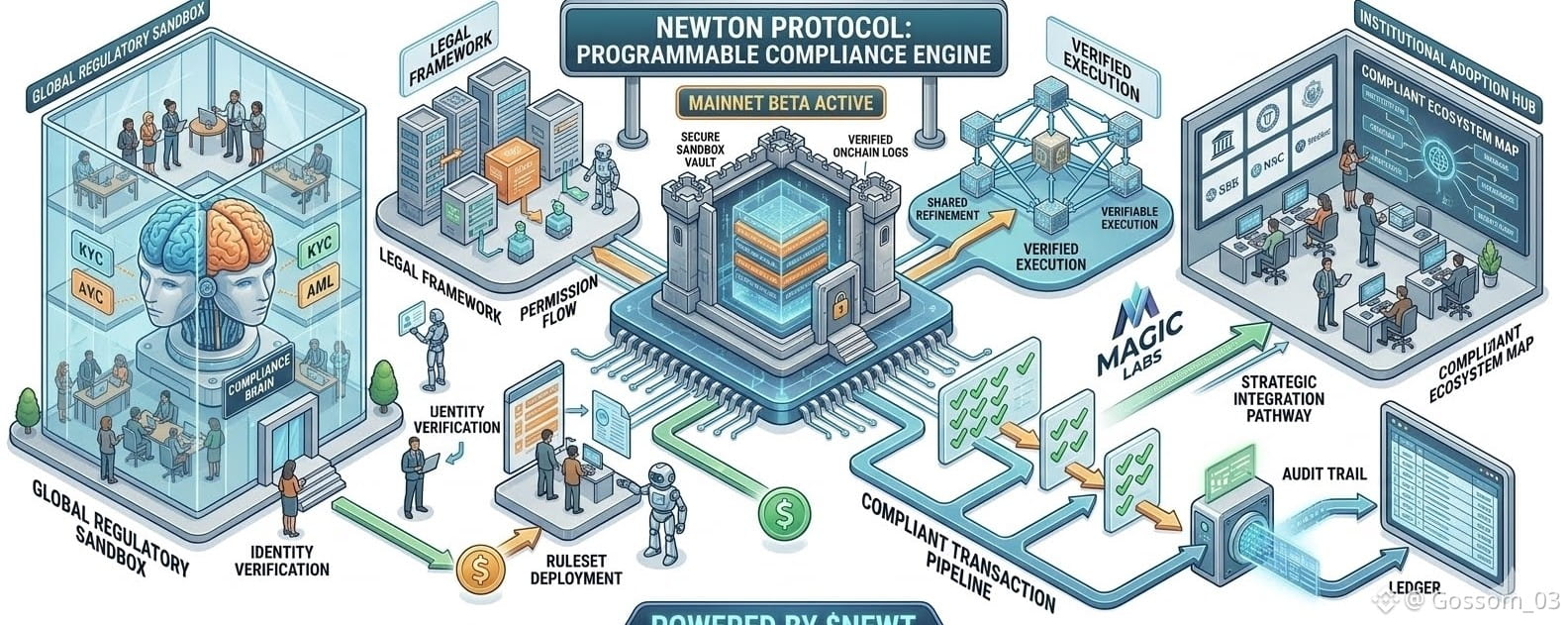

J’ai trouvé @NewtonProtocol par hasard en essayant de comprendre où vont les builders maintenant que l’engouement pour l’IA s’est un peu calmé.
L’attention pour la crypto évolue très vite. Un mois, ce sont les agents IA, le suivant les chaînes modulaires, puis le restaking, puis les RWAs. L’argent va là où ça devient tendance. Les builders ont tendance à travailler sur ce qui ne paraîtra important que des années plus tard. Newton n’était carrément pas dans ma liste.
Au début, ça ressemblait juste à un autre projet d’automatisation. La crypto en a un million. Rendez les portefeuilles plus intelligents, facilitez les transactions, faites en sorte que les applis soient plus fluides. La plupart corrigent de petites irritations. Très peu s’attaquent à la vraie raison pour laquelle les grosses sommes n’arrivent pas dans le secteur.
Ce qui m’a fait faire une pause, c’était la conformité.
Je sais, la conformité est probablement le mot le moins excitant dans la crypto. Mais c’est aussi l’un des plus difficiles à éviter si vous voulez que les institutions utilisent vraiment ces outils. Tout le monde parle d’adoption institutionnelle, mais personne ne veut parler des aspects ennuyeux que les institutions veulent examiner en premier. Les pistes d’audit. Les permissions. Qui peut faire quoi, et la preuve que c’est bien le cas.
Aucun trader de détail ne s’enthousiasme pour les journaux d’audit. Mais les banques, les fonds de pension, les entreprises de santé, et les équipes de logiciels d’entreprise, oui. C’est exactement ce qu’ils demandent avant toute autre chose.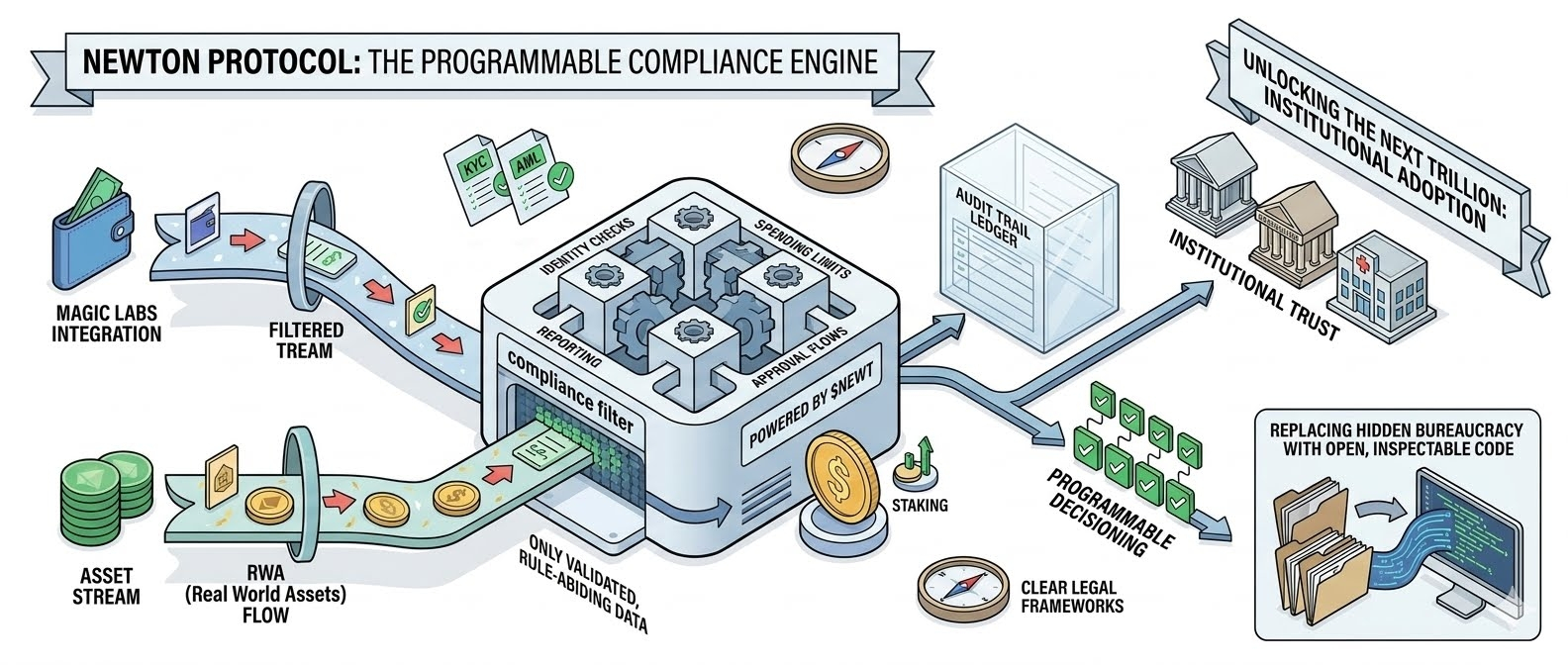
C’est l’espace que Newton poursuit.
Au lieu de traiter la conformité comme une paperasse qu’on dépose plus tard, ils essaient de l’intégrer directement au protocole. Contrôles d’identité, limites de dépenses, circuits d’approbation, reporting. Vous définissez les règles à l’avance, et l’application ne fait que les suivre. Si quelque chose enfreint les règles, il ne se passe rien. Si tout reste à l’intérieur des règles, ça tourne tout seul.
Ce n’est pas une question de rendre la crypto plus restrictive. Il s’agit de rendre la confiance plus facile à comprendre et à vérifier. Vous savez exactement ce qu’une application est autorisée à faire.
Le lien avec Magic Labs, c’est ce qui m’a donné l’impression que c’était concret. J’ignore généralement les posts sur les partenariats, parce que la plupart n’aboutissent à rien. Celui-ci m’a semblé différent. Magic Labs gère lauthentification et les portefeuilles pour plus de 200 000 développeurs et 50 millions de portefeuilles. C’est une vraie distribution. Vous ne demandez pas aux développeurs de tout reconstruire à partir de zéro. Vous vous branchez sur des outils qu’ils utilisent déjà.
Magic Labs est aussi soutenu par PayPal Ventures. Les entreprises qui servent les entreprises ne construisent des outils de conformité que si les entreprises demandent déjà ces outils. Ça m’a fait comprendre que la demande est probablement réelle.
Le token $NEWT semble aussi lié au produit réel. Vous l’utilisez pour exécuter des automatisations ou émettre des permissions. Les validateurs le mettent en jeu pour sécuriser le réseau et obtenir des récompenses. Les opérateurs doivent verrouiller des tokens comme garantie, et ils peuvent les perdre s’ils ne respectent pas les règles. La gouvernance est censée évoluer au fil du temps.
Tout ça ne veut pas dire que le token sera automatiquement précieux. La crypto a déjà plein de projets où l’« utilité » est écrite dans la documentation, sans usage réel. La grande question, c’est de savoir si des entreprises choisissent vraiment de construire dessus. Si oui, le token a un but au-delà de la spéculation. Si non, la conception ne changera pas grand-chose.
C’est là que ça devient délicat. Beaucoup de gens dans la crypto entendent « conformité » et pensent que cela va à l’encontre de la décentralisation. Une autre partie pense que la crypto ne passera pas à l’échelle tant que les entreprises ne pourront pas fonctionner dans des cadres juridiques clairs. Newton se construit exactement au milieu de tout ça. Il faut donc convaincre des sceptiques des deux côtés.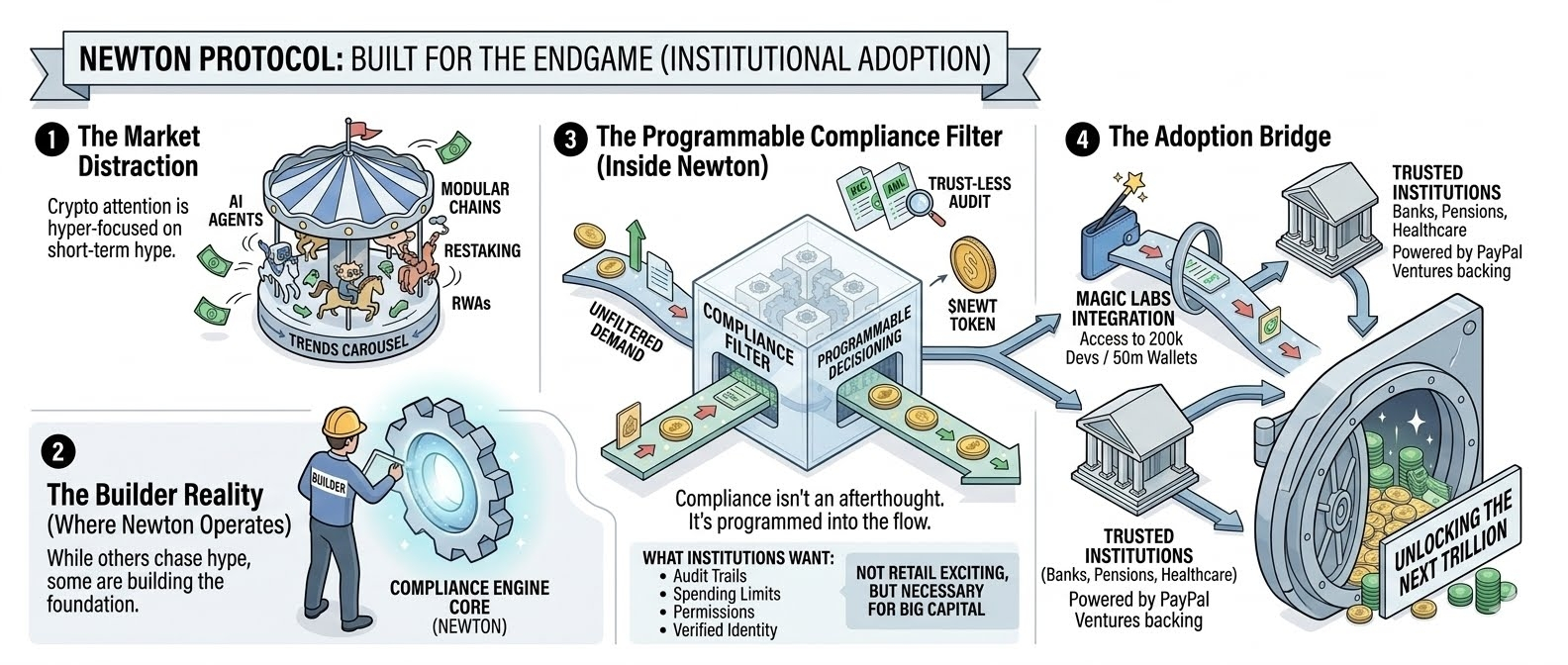
Il y a aussi la concurrence. Les écosystèmes plus grands ajoutent eux aussi des outils d’identité et de permission. Newton doit montrer pourquoi la conformité doit être son propre protocole, plutôt que de devenir simplement une autre fonctionnalité au sein d’une chaîne plus large.
La réflexion qui revient sans cesse, c’est celle-ci. La crypto adore l’idée de supprimer les intermédiaires. Mais les institutions n’ont jamais demandé de supprimer toutes les règles. Elles ont demandé des règles qu’elles peuvent vérifier, automatiser et auditer, sans devoir courir après des gens pour obtenir des validations.
Peut-être qu’on a pensé la décentralisation de la mauvaise façon. Peut-être que la prochaine étape n’est pas de supprimer toute structure. Peut-être qu’il s’agit plutôt de remplacer une bureaucratie cachée par un code ouvert et vérifiable.
Si c’est le cas, la conformité pourrait même réduire la centralisation au lieu de l’augmenter. Aujourd’hui, la confiance vit dans des bases de données fermées et dans des validations manuelles. Si les politiques deviennent un code public, la confiance devient plus facile à vérifier pour tout le monde.
Si Newton y parvient, reste un mystère. L’adoption par les entreprises est lente. Les cycles de vente ne se soucient pas des récits crypto. Les marchés tournent tous les quelques mois, tandis que les infrastructures réelles mettent des années avant que les gens ne s’en rendent compte.
C’est peut-être pour ça que des projets comme celui-ci sont faciles à sous-estimer. Au moment où tout le monde s’accorde à dire que la conformité est essentielle, les équipes qui ont démarré tôt n’auront plus à convaincre qui que ce soit.
La vraie question, c’est de savoir si la conformité programmable devient l’une de ces couches discrètes qui alimente la prochaine génération d’applications, ou si ce n’est qu’une autre idée réfléchie qui n’a pas réussi à se démarquer dans le bruit, ni à attirer l’attention et l’argent.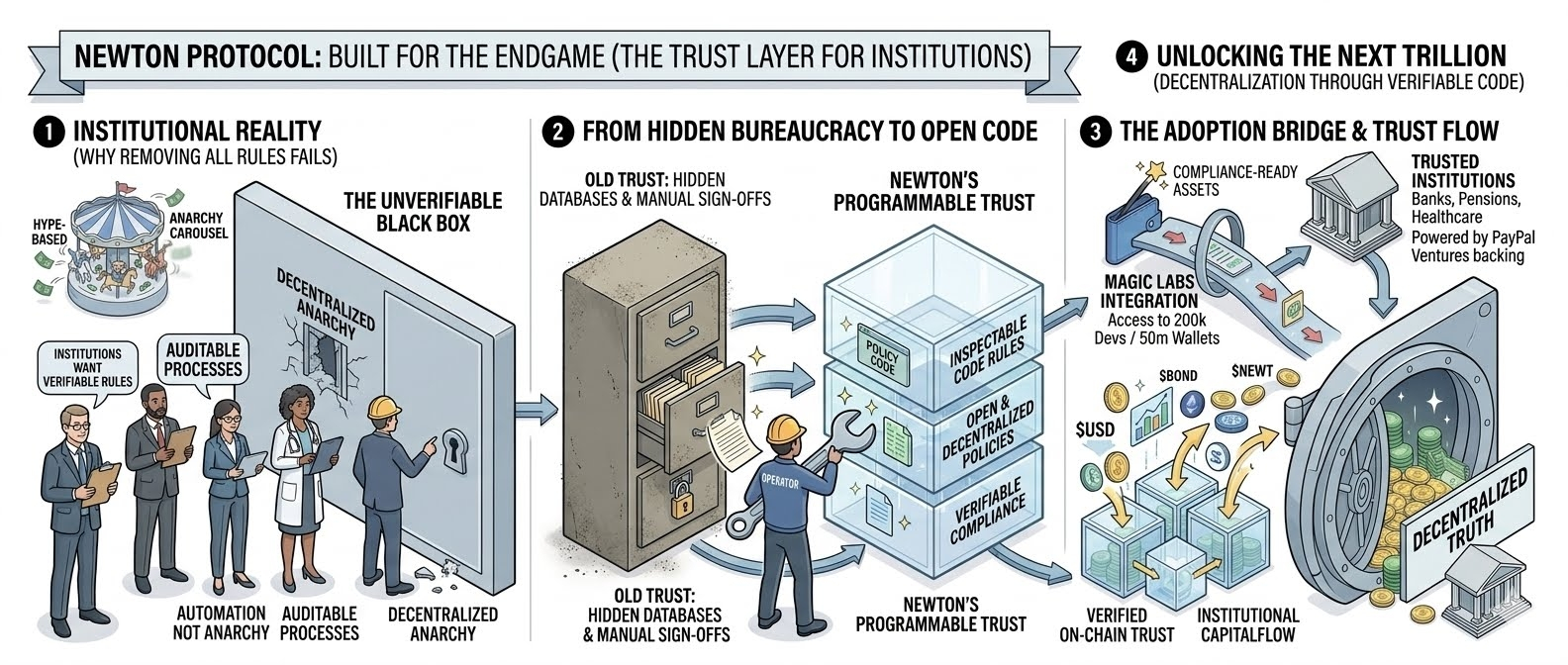
@NewtonProtocol #Newt $LAB $NFP