

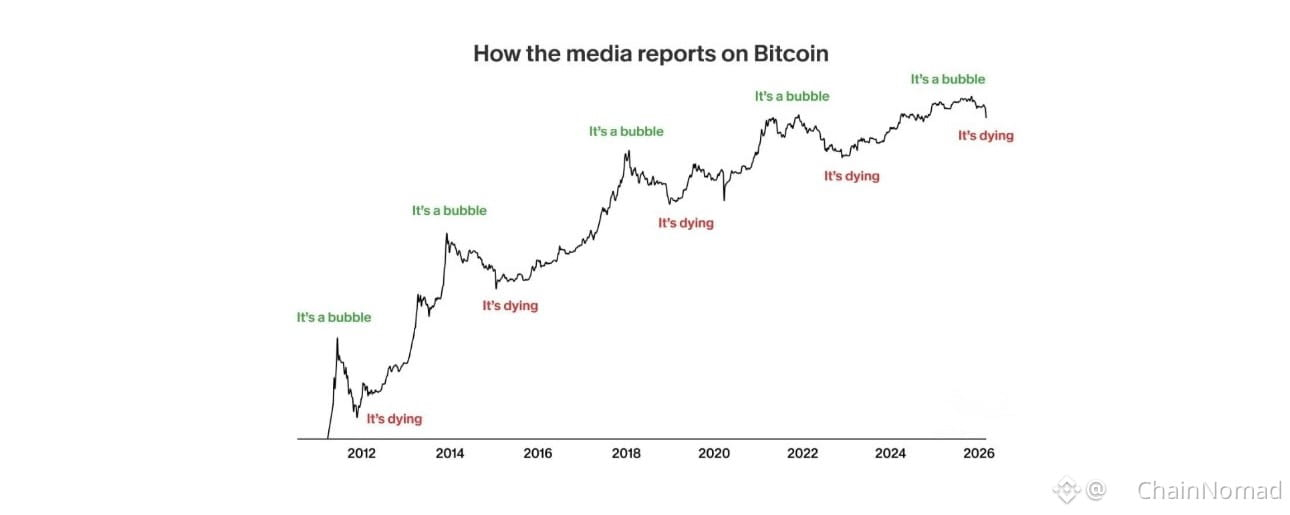

Every market cycle seems to repeat the same story. When Bitcoin reaches new highs, headlines scream: “It’s a bubble!” When it corrects by 30%, 50%, or 70%, the very same media outlets change the script: “It’s dying.” The pattern has become so recurrent that it is almost a caricature of how information interprets volatility.
From 2011 to 2026, the narrative has swung between euphoria and obituary: 2011 — bubble, dead. 2014 — bubble, dead. 2018 — bubble, dead. 2022 — bubble, dead. And now, in 2025/26, the story repeats itself: bubble, dead, once again.
Yet, if you zoom out, the perspective changes dramatically. Every “death” occurred at a higher price level than the previous cycle. Every “bubble” eventually became the foundation for the next rally. The chart showing how the media has portrayed Bitcoin over time — alternating between “It’s a bubble” and “It’s dying” — perfectly illustrates this emotional cyclicality.
The lesson is not that Bitcoin always goes up. The lesson is that short-term narratives are dominated by emotion, while long-term trends tell a story of resilience and evolution. Every cycle of fear and enthusiasm is part of a larger process in which technology, adoption, and trust gradually strengthen, even as headlines change their tone with every fluctuation.
Bitcoin is not immune to corrections, but it has survived every announced “death.” And each time, the market has found new reasons to believe in it again.