


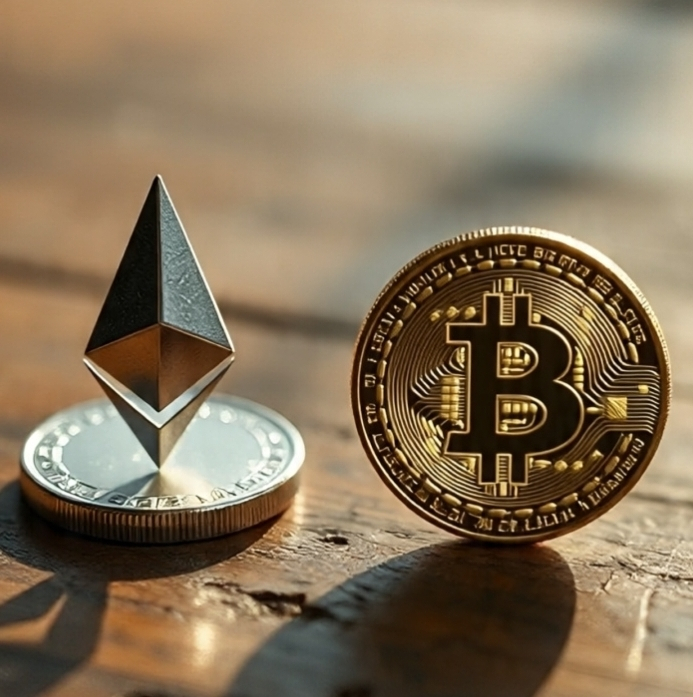
Bitcoin (BTC) and Ethereum (ETH) remain the two pillars of the cryptocurrency market, but they serve increasingly different roles as the ecosystem matures.
Here is a breakdown of their current status and core differences as of **April 2026**.
## **Market Snapshot (April 2026)**
| Metric | Bitcoin (BTC) | Ethereum (ETH) |
|---|---|---|
| **Current Price** | ~$71,000 | ~$2,315 |
| **Market Cap** | ~$1.4 Trillion | ~$278 Billion |
| **Market Dominance** | ~57% | ~10% |
| **Primary Use Case** | Digital Gold / Store of Value | Global Utility / Smart Contracts |
## **Core Differences**
### **1. Functionality & Purpose**
* **Bitcoin:** Built primarily as a decentralized alternative to traditional currencies. It focuses on security, scarcity (capped at 21 million coins), and simplicity. It is the "hard money" of the digital age.
* **Ethereum:** A programmable blockchain. While it has its own currency (Ether), its main goal is to be a platform for **Smart Contracts**—self-executing code that powers Decentralized Finance (DeFi), NFTs, and decentralized apps (dApps).
### **2. Network Evolution & Upgrades**
* **Bitcoin:** Values stability over speed. Changes are rare and slow-moving to ensure the network never breaks. Recent focus has been on Layer 2 solutions like the Lightning Network to make transactions faster and cheaper.
* **Ethereum:** Follows a roadmap of frequent, major upgrades. In 2025 and early 2026, updates like **Pectra** and **Fusaka** significantly increased data capacity and lowered "gas fees" (transaction costs) by over 90% compared to previous years.
### **3. Supply Dynamics**
* **BTC:** Has a strictly fixed supply. New BTC is created through "mining" at a rate that halves every four years, making it inherently deflationary in terms of issuance.
* **ETH:** Does not have a hard cap on total supply. However, since the "Merge," ETH uses a **Proof-of-Stake** system. A portion of every transaction fee is "burned" (destroyed). In periods of high activity, ETH can actually become deflationary as more coins are burned than created.
## **Recent Trends in 2026**
* **Institutional Staking:** Major financial institutions are no longer just holding ETH; they are actively "staking" it to earn rewards, treating it like a digital bond.
* **The Compliance Premium:** As regulations tighten, both BTC and ETH have seen a "compliance premium," where they are favored by big banks because they have clear legal standing and established Spot ETFs.
* **Layer 2 Dominance:** Most Ethereum activity has moved to "Layer 2" networks (like Arbitrum or Optimism), which use Ethereum for security but handle the actual transactions much faster.

