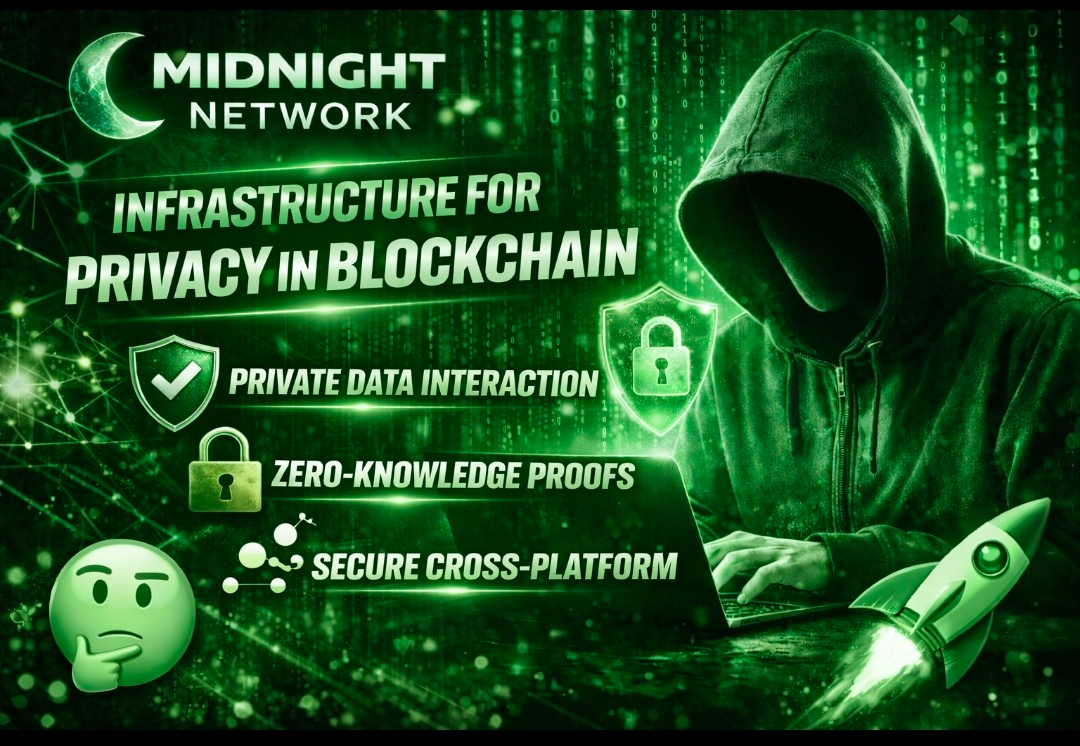
Most early blockchain systems were built around a single powerful idea: transparency. Anyone could view transactions, track wallet balances, and independently verify activity by running a node. This openness played a major role in building trust in decentralized networks. However, the same transparency also created a limitation. Many real-world activities involve sensitive data, and not every process can comfortably exist on a completely public ledger.
This tension between openness and privacy is where Midnight Network enters the discussion.
The core question Midnight attempts to explore is simple but important: Can a blockchain remain verifiable while protecting private information? To address this challenge, the network relies heavily on zero-knowledge proof technology, a cryptographic method that allows someone to prove that a statement is valid without revealing the underlying data.
In practice, this means the network can confirm that a transaction follows the correct rules while keeping key details hidden. Instead of exposing sensitive information to the public ledger, the system verifies mathematical proofs that guarantee the validity of the action.
Zero-knowledge cryptography itself is not new. Researchers have been studying it for decades, and several blockchain projects have already experimented with it. What makes Midnight interesting is that privacy is not simply an optional feature layered on top of an existing system. Instead, the network is designed from the beginning with privacy as a foundational principle.
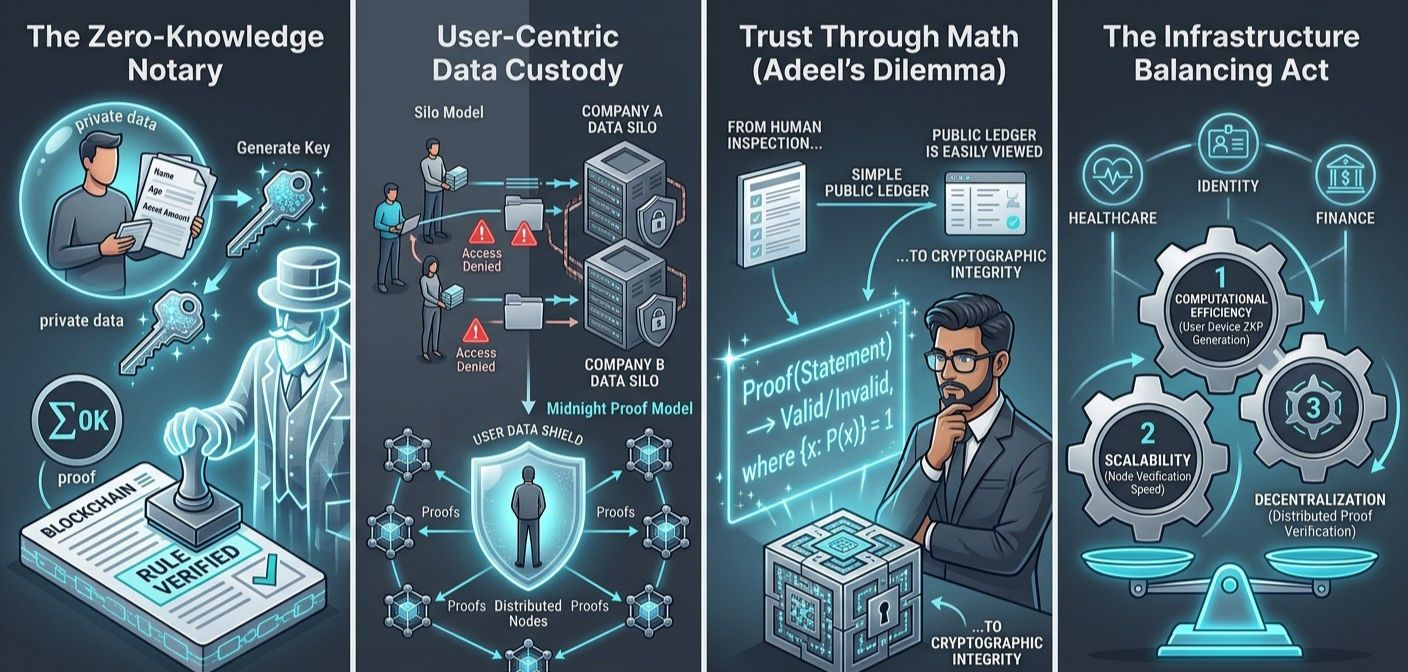
Another major aspect of the architecture revolves around data ownership. Traditional online platforms usually require users to hand over their data to centralized services, which then store and control that information. Midnight suggests a different structure. Users keep control of their own data while interacting with the blockchain through cryptographic proofs derived from that data. The system validates the proof rather than the raw information itself.
While this idea might seem subtle, it has significant implications for how digital systems manage information.
Developers also play a key role in this ecosystem. If Midnight functions as intended, it could allow developers to build applications where verification occurs without exposing private inputs. That possibility opens the door for industries such as finance, healthcare, and digital identity to experiment with blockchain infrastructure while protecting sensitive internal data. Of course, building such systems is not trivial, since privacy technologies often require more computational resources than standard transactions.
I was actually discussing this topic recently with a friend named Adeel who works in cybersecurity. As we talked about privacy-focused blockchains, he raised an interesting point: if too much information is hidden, how can outsiders still trust that the system is behaving correctly?
It’s a fair concern.
Public blockchains traditionally rely on transparency as a safeguard. Anyone can inspect the ledger and confirm that the rules are being followed. In privacy-focused systems, however, verification depends more heavily on cryptographic proof mechanisms rather than open inspection. In theory this approach works well, but it shifts trust toward the correctness of the mathematics and the implementation behind it.
Another challenge lies in scalability. Generating and verifying privacy proofs often requires additional computation compared to standard transactions. For Midnight to function effectively, the network must process these proofs efficiently without sacrificing performance. Balancing privacy with scalability is likely to be one of the most demanding engineering challenges the project faces.
Decentralization is another important factor. Even when transaction details are hidden, the network still needs a distributed group of validators that can verify activity independently. Midnight appears to rely on structured proof systems that allow nodes to confirm rule compliance without needing to see every piece of data directly.
From a broader perspective, Midnight Network seems less concerned with chasing short-term blockchain trends and more focused on rethinking how information flows through decentralized systems. Instead of asking how fast transactions can move across the network, the project is exploring a deeper question: how much information actually needs to be public for a blockchain to remain trustworthy?
The answer is still evolving. But projects like Midnight suggest that the next stage of blockchain infrastructure may involve a careful balance between transparency and confidentiality. The real test will be whether such systems can maintain trust while revealing far less data than traditional public ledgers.
Momentum around @MidnightNetwork continues to build as the ecosystem prepares for the upcoming mainnet phase.
A key milestone is Balance (@balance_canada) becoming the first digital asset custodian ready to support $NIGHT. From the Glacier Drop to early custody and now mainnet readiness, their commitment highlights growing institutional infrastructure for Midnight’s privacy-focused blockchain.