Binance Square

Bit_boy

|Exploring innovative financial solutions daily| #Cryptocurrency $Bitcoin
73 Suivis
24.3K+ Abonnés
15.2K+ J’aime
2.2K+ Partagé(s)
Contenu
PINNED
Bit_boy
·
--
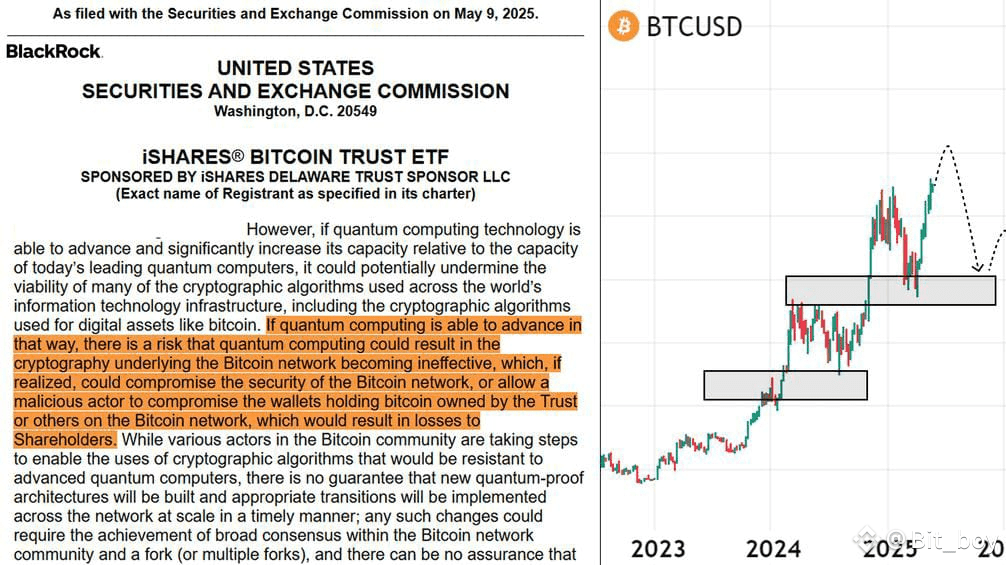
🚨BlackRock: BTC will be compromised and dumped to $40k!Development of quantum computing might kill the Bitcoin network I researched all the data and learn everything about it. /➮ Recently, BlackRock warned us about potential risks to the Bitcoin network 🕷 All due to the rapid progress in the field of quantum computing. 🕷 I’ll add their report at the end - but for now, let’s break down what this actually means. /➮ Bitcoin's security relies on cryptographic algorithms, mainly ECDSA 🕷 It safeguards private keys and ensures transaction integrity 🕷 Quantum computers, leveraging algorithms like Shor's algorithm, could potentially break ECDSA /➮ How? By efficiently solving complex mathematical problems that are currently infeasible for classical computers 🕷 This will would allow malicious actors to derive private keys from public keys Compromising wallet security and transaction authenticity /➮ So BlackRock warns that such a development might enable attackers to compromise wallets and transactions 🕷 Which would lead to potential losses for investors 🕷 But when will this happen and how can we protect ourselves? /➮ Quantum computers capable of breaking Bitcoin's cryptography are not yet operational 🕷 Experts estimate that such capabilities could emerge within 5-7 yeards 🕷 Currently, 25% of BTC is stored in addresses that are vulnerable to quantum attacks /➮ But it's not all bad - the Bitcoin community and the broader cryptocurrency ecosystem are already exploring several strategies: - Post-Quantum Cryptography - Wallet Security Enhancements - Network Upgrades /➮ However, if a solution is not found in time, it could seriously undermine trust in digital assets 🕷 Which in turn could reduce demand for BTC and crypto in general 🕷 And the current outlook isn't too optimistic - here's why: /➮ Google has stated that breaking RSA encryption (tech also used to secure crypto wallets) 🕷 Would require 20x fewer quantum resources than previously expected 🕷 That means we may simply not have enough time to solve the problem before it becomes critical /➮ For now, I believe the most effective step is encouraging users to transfer funds to addresses with enhanced security, 🕷 Such as Pay-to-Public-Key-Hash (P2PKH) addresses, which do not expose public keys until a transaction is made 🕷 Don’t rush to sell all your BTC or move it off wallets - there is still time 🕷 But it's important to keep an eye on this issue and the progress on solutions Report: sec.gov/Archives/edgar… ➮ Give some love and support 🕷 Follow for even more excitement! 🕷 Remember to like, retweet, and drop a comment. #TrumpMediaBitcoinTreasury #Bitcoin2025 $BTC {spot}(BTCUSDT)

🚨BlackRock: BTC will be compromised and dumped to $40k!

Development of quantum computing might kill the Bitcoin network
I researched all the data and learn everything about it.
/➮ Recently, BlackRock warned us about potential risks to the Bitcoin network
🕷 All due to the rapid progress in the field of quantum computing.
🕷 I’ll add their report at the end - but for now, let’s break down what this actually means.
/➮ Bitcoin's security relies on cryptographic algorithms, mainly ECDSA
🕷 It safeguards private keys and ensures transaction integrity
🕷 Quantum computers, leveraging algorithms like Shor's algorithm, could potentially break ECDSA
/➮ How? By efficiently solving complex mathematical problems that are currently infeasible for classical computers
🕷 This will would allow malicious actors to derive private keys from public keys
Compromising wallet security and transaction authenticity
/➮ So BlackRock warns that such a development might enable attackers to compromise wallets and transactions
🕷 Which would lead to potential losses for investors
🕷 But when will this happen and how can we protect ourselves?
/➮ Quantum computers capable of breaking Bitcoin's cryptography are not yet operational
🕷 Experts estimate that such capabilities could emerge within 5-7 yeards
🕷 Currently, 25% of BTC is stored in addresses that are vulnerable to quantum attacks
/➮ But it's not all bad - the Bitcoin community and the broader cryptocurrency ecosystem are already exploring several strategies:
- Post-Quantum Cryptography
- Wallet Security Enhancements
- Network Upgrades
/➮ However, if a solution is not found in time, it could seriously undermine trust in digital assets
🕷 Which in turn could reduce demand for BTC and crypto in general
🕷 And the current outlook isn't too optimistic - here's why:
/➮ Google has stated that breaking RSA encryption (tech also used to secure crypto wallets)
🕷 Would require 20x fewer quantum resources than previously expected
🕷 That means we may simply not have enough time to solve the problem before it becomes critical
/➮ For now, I believe the most effective step is encouraging users to transfer funds to addresses with enhanced security,
🕷 Such as Pay-to-Public-Key-Hash (P2PKH) addresses, which do not expose public keys until a transaction is made
🕷 Don’t rush to sell all your BTC or move it off wallets - there is still time
🕷 But it's important to keep an eye on this issue and the progress on solutions
Report: sec.gov/Archives/edgar…
➮ Give some love and support
🕷 Follow for even more excitement!
🕷 Remember to like, retweet, and drop a comment.
#TrumpMediaBitcoinTreasury #Bitcoin2025 $BTC
PINNED
Bit_boy
·
--
Mastering Candlestick Patterns: A Key to Unlocking $1000 a Month in Trading_Candlestick patterns are a powerful tool in technical analysis, offering insights into market sentiment and potential price movements. By recognizing and interpreting these patterns, traders can make informed decisions and increase their chances of success. In this article, we'll explore 20 essential candlestick patterns, providing a comprehensive guide to help you enhance your trading strategy and potentially earn $1000 a month. Understanding Candlestick Patterns Before diving into the patterns, it's essential to understand the basics of candlestick charts. Each candle represents a specific time frame, displaying the open, high, low, and close prices. The body of the candle shows the price movement, while the wicks indicate the high and low prices. The 20 Candlestick Patterns 1. Doji: A candle with a small body and long wicks, indicating indecision and potential reversal. 2. Hammer: A bullish reversal pattern with a small body at the top and a long lower wick. 3. Hanging Man: A bearish reversal pattern with a small body at the bottom and a long upper wick. 4. Engulfing Pattern: A two-candle pattern where the second candle engulfs the first, indicating a potential reversal. 5. Piercing Line: A bullish reversal pattern where the second candle opens below the first and closes above its midpoint. 6. Dark Cloud Cover: A bearish reversal pattern where the second candle opens above the first and closes below its midpoint. 7. Morning Star: A three-candle pattern indicating a bullish reversal. 8. Evening Star: A three-candle pattern indicating a bearish reversal. 9. Shooting Star: A bearish reversal pattern with a small body at the bottom and a long upper wick. 10. Inverted Hammer: A bullish reversal pattern with a small body at the top and a long lower wick. 11. Bullish Harami: A two-candle pattern indicating a potential bullish reversal. 12. Bearish Harami: A two-candle pattern indicating a potential bearish reversal. 13. Tweezer Top: A two-candle pattern indicating a potential bearish reversal. 14. Tweezer Bottom: A two-candle pattern indicating a potential bullish reversal. 15. Three White Soldiers: A bullish reversal pattern with three consecutive long-bodied candles. 16. Three Black Crows: A bearish reversal pattern with three consecutive long-bodied candles. 17. Rising Three Methods: A continuation pattern indicating a bullish trend. 18. Falling Three Methods: A continuation pattern indicating a bearish trend. 19. Marubozu: A candle with no wicks and a full-bodied appearance, indicating strong market momentum. 20. Belt Hold Line: A single candle pattern indicating a potential reversal or continuation. Applying Candlestick Patterns in Trading To effectively use these patterns, it's essential to: - Understand the context in which they appear - Combine them with other technical analysis tools - Practice and backtest to develop a deep understanding By mastering these 20 candlestick patterns, you'll be well on your way to enhancing your trading strategy and potentially earning $1000 a month. Remember to stay disciplined, patient, and informed to achieve success in the markets. #CandleStickPatterns #tradingStrategy #TechnicalAnalysis #DayTradingTips #tradingforbeginners

Mastering Candlestick Patterns: A Key to Unlocking $1000 a Month in Trading_

Candlestick patterns are a powerful tool in technical analysis, offering insights into market sentiment and potential price movements. By recognizing and interpreting these patterns, traders can make informed decisions and increase their chances of success. In this article, we'll explore 20 essential candlestick patterns, providing a comprehensive guide to help you enhance your trading strategy and potentially earn $1000 a month.
Understanding Candlestick Patterns
Before diving into the patterns, it's essential to understand the basics of candlestick charts. Each candle represents a specific time frame, displaying the open, high, low, and close prices. The body of the candle shows the price movement, while the wicks indicate the high and low prices.
The 20 Candlestick Patterns
1. Doji: A candle with a small body and long wicks, indicating indecision and potential reversal.
2. Hammer: A bullish reversal pattern with a small body at the top and a long lower wick.
3. Hanging Man: A bearish reversal pattern with a small body at the bottom and a long upper wick.
4. Engulfing Pattern: A two-candle pattern where the second candle engulfs the first, indicating a potential reversal.
5. Piercing Line: A bullish reversal pattern where the second candle opens below the first and closes above its midpoint.
6. Dark Cloud Cover: A bearish reversal pattern where the second candle opens above the first and closes below its midpoint.
7. Morning Star: A three-candle pattern indicating a bullish reversal.
8. Evening Star: A three-candle pattern indicating a bearish reversal.
9. Shooting Star: A bearish reversal pattern with a small body at the bottom and a long upper wick.
10. Inverted Hammer: A bullish reversal pattern with a small body at the top and a long lower wick.
11. Bullish Harami: A two-candle pattern indicating a potential bullish reversal.
12. Bearish Harami: A two-candle pattern indicating a potential bearish reversal.
13. Tweezer Top: A two-candle pattern indicating a potential bearish reversal.
14. Tweezer Bottom: A two-candle pattern indicating a potential bullish reversal.
15. Three White Soldiers: A bullish reversal pattern with three consecutive long-bodied candles.
16. Three Black Crows: A bearish reversal pattern with three consecutive long-bodied candles.
17. Rising Three Methods: A continuation pattern indicating a bullish trend.
18. Falling Three Methods: A continuation pattern indicating a bearish trend.
19. Marubozu: A candle with no wicks and a full-bodied appearance, indicating strong market momentum.
20. Belt Hold Line: A single candle pattern indicating a potential reversal or continuation.
Applying Candlestick Patterns in Trading
To effectively use these patterns, it's essential to:
- Understand the context in which they appear
- Combine them with other technical analysis tools
- Practice and backtest to develop a deep understanding
By mastering these 20 candlestick patterns, you'll be well on your way to enhancing your trading strategy and potentially earning $1000 a month. Remember to stay disciplined, patient, and informed to achieve success in the markets.
#CandleStickPatterns
#tradingStrategy
#TechnicalAnalysis
#DayTradingTips
#tradingforbeginners
Bit_boy
·
--
I like how Dusk treats accounts as more than just addresses. On-chain permissions actually control who can hold, trade, view, or move each asset. Every transfer respects those rules, and any failures are fully traceable. That level of permissioning makes regulated assets both compliant and transparent in a way most chains don’t. #Dusk @Dusk_Foundation $DUSK #dusk
I like how Dusk treats accounts as more than just addresses.

On-chain permissions actually control who can hold, trade, view, or move each asset. Every transfer respects those rules, and any failures are fully traceable.

That level of permissioning makes regulated assets both compliant and transparent in a way most chains don’t.

#Dusk @Dusk $DUSK #dusk
Bit_boy
·
--
Most chains make institutions pick between transparency and compliance, and that choice usually breaks things. Dusk takes a different route. It’s built as a privacy-first Layer 1 for regulated finance, using zero-knowledge proofs so transactions and smart contracts can be validated without exposing sensitive data. Add deterministic finality and compliance baked into the protocol, and you get something institutions can actually deploy, not just talk about. #dusk @Dusk_Foundation $DUSK #Dusk
Most chains make institutions pick between transparency and compliance, and that choice usually breaks things.

Dusk takes a different route. It’s built as a privacy-first Layer 1 for regulated finance, using zero-knowledge proofs so transactions and smart contracts can be validated without exposing sensitive data.

Add deterministic finality and compliance baked into the protocol, and you get something institutions can actually deploy, not just talk about.

#dusk @Dusk $DUSK #Dusk
Bit_boy
·
--
What caught my attention with DuskTrade is the decision to put Portfolio front and center on the homepage. That doesn’t feel like a design choice, it feels structural. It signals that the platform is built around accounts and positions, not just matching orders. In regulated markets, price alone isn’t enough. Eligibility, restrictions, and valuation all matter, and those things live at the portfolio level. By showing Portfolio NAV, KYC status, and DuskEVM upfront, DuskTrade is clearly committing to handling those rules as part of the core system, even if that means slower growth early on. Long term, that’s the kind of foundation you need for serious, regulated assets. #dusk @Dusk_Foundation $DUSK #Dusk
What caught my attention with DuskTrade is the decision to put Portfolio front and center on the homepage. That doesn’t feel like a design choice, it feels structural. It signals that the platform is built around accounts and positions, not just matching orders.

In regulated markets, price alone isn’t enough. Eligibility, restrictions, and valuation all matter, and those things live at the portfolio level. By showing Portfolio NAV, KYC status, and DuskEVM upfront, DuskTrade is clearly committing to handling those rules as part of the core system, even if that means slower growth early on.

Long term, that’s the kind of foundation you need for serious, regulated assets.

#dusk @Dusk $DUSK #Dusk
Bit_boy
·
--
What I appreciate about the DUSK token is that it’s clearly built for function, not speculation. It covers fees for transactions and smart contracts, helps secure the network through staking, and gives holders a real say in governance. Everything about it feels designed to keep a privacy-focused network running smoothly over the long term. #Dusk @Dusk_Foundation $DUSK
What I appreciate about the DUSK token is that it’s clearly built for function, not speculation.

It covers fees for transactions and smart contracts, helps secure the network through staking, and gives holders a real say in governance.

Everything about it feels designed to keep a privacy-focused network running smoothly over the long term.

#Dusk @Dusk $DUSK
Bit_boy
·
--
Vanar’s Quiet Approach to Bringing Web3 Into the Real WorldWhen I look at Vanar Chain, what stands out to me is how it’s trying to fit into the way builders already work instead of forcing them to adapt. The idea isn’t to make developers relearn tools or migrate entire workflows, but to let Vanar run quietly in the background. That approach feels very intentional, and honestly more mature than chasing hype. The focus seems to be on becoming useful enough that adoption happens naturally. Vanar being a Layer-1 built for real-world use makes sense when you look at the team behind it. They’re not coming from a purely theoretical blockchain background, but from gaming, entertainment, and working with global brands. That experience shows in how the infrastructure is designed to support things people already engage with, like games, metaverse environments, AI-powered apps, sustainability projects, and brand-driven solutions. What I like is that this isn’t just talk. Products like Virtua Metaverse and the VGN games network already exist and show how Vanar is pushing blockchain closer to actual consumer experiences instead of keeping it locked inside crypto circles. That kind of exposure matters if Web3 is ever going to feel normal to everyday users. At its core, Vanar feels like a performance-focused and scalable platform that’s thinking long term. With the VANRY token powering the ecosystem, the goal of onboarding the next billions of users doesn’t sound unrealistic when the tech is designed to blend into the digital world people already use. I don’t see Vanar trying to ride trends. It feels more like it’s quietly laying foundations that won’t disrupt routines, but will be there when people need them. @Vanar $VANRY #VanarChain #vanar

Vanar’s Quiet Approach to Bringing Web3 Into the Real World

When I look at Vanar Chain, what stands out to me is how it’s trying to fit into the way builders already work instead of forcing them to adapt. The idea isn’t to make developers relearn tools or migrate entire workflows, but to let Vanar run quietly in the background. That approach feels very intentional, and honestly more mature than chasing hype. The focus seems to be on becoming useful enough that adoption happens naturally.
Vanar being a Layer-1 built for real-world use makes sense when you look at the team behind it. They’re not coming from a purely theoretical blockchain background, but from gaming, entertainment, and working with global brands. That experience shows in how the infrastructure is designed to support things people already engage with, like games, metaverse environments, AI-powered apps, sustainability projects, and brand-driven solutions.
What I like is that this isn’t just talk. Products like Virtua Metaverse and the VGN games network already exist and show how Vanar is pushing blockchain closer to actual consumer experiences instead of keeping it locked inside crypto circles. That kind of exposure matters if Web3 is ever going to feel normal to everyday users.
At its core, Vanar feels like a performance-focused and scalable platform that’s thinking long term. With the VANRY token powering the ecosystem, the goal of onboarding the next billions of users doesn’t sound unrealistic when the tech is designed to blend into the digital world people already use. I don’t see Vanar trying to ride trends. It feels more like it’s quietly laying foundations that won’t disrupt routines, but will be there when people need them.
@Vanarchain
$VANRY #VanarChain #vanar
Bit_boy
·
--
@Vanar feels like it’s thinking beyond crypto natives. The goal is clearly to bring the next billions of users into Web3 without forcing them to change how they already interact with digital products. With a team that understands gaming, entertainment, and brands, Vanar is quietly putting blockchain where it actually makes sense. #vanar $VANRY @Vanar #VanarChain
@Vanarchain feels like it’s thinking beyond crypto natives.

The goal is clearly to bring the next billions of users into Web3 without forcing them to change how they already interact with digital products.

With a team that understands gaming, entertainment, and brands, Vanar is quietly putting blockchain where it actually makes sense.

#vanar $VANRY @Vanarchain #VanarChain
Bit_boy
·
--
Why I’m Still Watching Plasma After the Launch HypeWhen Plasma launched its mainnet beta in late September 2025, I remember thinking this didn’t feel like another copy-paste chain. From day one, it was very clear what it wanted to be about: stablecoins that actually work the way people expect them to. Fast, cheap, and reliable. No distractions. Launching with over $2 billion in stablecoin liquidity and deep DeFi support wasn’t just impressive on paper, it showed preparation. Most networks talk about integrations later. Plasma showed up with them live. What matters to me now isn’t the launch hype, though. It’s what’s still there months later. Plasma never tried to be everything at once. It made stablecoins the core of the network, not just assets that happen to exist on it. Zero-fee transfers for USD-pegged assets and high throughput weren’t marketing points, they were design decisions. That’s why serious DeFi protocols took it seriously early on. Seeing Aave deploy and attract billions in stablecoin liquidity shortly after launch was a big signal. Even after the usual post-launch adjustments, Plasma remains one of Aave’s strongest markets outside Ethereum. That kind of capital doesn’t hang around for vibes alone. It sticks where infrastructure actually works. User activity tells a similar story. Tens of thousands of real wallet registrations in the early months isn’t something you get from bots clicking for an airdrop. And while incentives come and go, liquidity and protocols are still active. That’s the part people overlook when they only stare at peak TVL charts. What I personally find interesting is how much groundwork Plasma had ready on day one. Chainlink oracles, CCIP, cross-chain messaging, and blue-chip DeFi weren’t added as an afterthought. They were part of the launch. That tells me the team wasn’t experimenting, they were executing a plan. Of course it hasn’t been perfect. Stablecoin ecosystems naturally see inflows and outflows as yields change, and Plasma is no exception. But pullbacks don’t cancel out the bigger picture. There’s still real liquidity, real lending, and real usage happening on the network. When I zoom out, Plasma today feels less like an experiment and more like infrastructure. A chain that treats stablecoins as native money, supports serious DeFi activity, and gives developers tools they can actually build with. A lot of projects talk about becoming global payment rails someday. Plasma launched with the pieces that make that vision realistic. My honest take is simple. This has been more about execution than noise. We’re far past launch week, and what’s left looks structural, not cosmetic. Stablecoins are moving, protocols are active, and builders are building. Whether Plasma tops every chart or not, the way it’s positioning itself as a stablecoin-first layer is something I’m paying close attention to. #plasma @Plasma $XPL {future}(XPLUSDT)

Why I’m Still Watching Plasma After the Launch Hype

When Plasma launched its mainnet beta in late September 2025, I remember thinking this didn’t feel like another copy-paste chain. From day one, it was very clear what it wanted to be about: stablecoins that actually work the way people expect them to. Fast, cheap, and reliable. No distractions. Launching with over $2 billion in stablecoin liquidity and deep DeFi support wasn’t just impressive on paper, it showed preparation. Most networks talk about integrations later. Plasma showed up with them live.
What matters to me now isn’t the launch hype, though. It’s what’s still there months later. Plasma never tried to be everything at once. It made stablecoins the core of the network, not just assets that happen to exist on it. Zero-fee transfers for USD-pegged assets and high throughput weren’t marketing points, they were design decisions. That’s why serious DeFi protocols took it seriously early on.
Seeing Aave deploy and attract billions in stablecoin liquidity shortly after launch was a big signal. Even after the usual post-launch adjustments, Plasma remains one of Aave’s strongest markets outside Ethereum. That kind of capital doesn’t hang around for vibes alone. It sticks where infrastructure actually works.
User activity tells a similar story. Tens of thousands of real wallet registrations in the early months isn’t something you get from bots clicking for an airdrop. And while incentives come and go, liquidity and protocols are still active. That’s the part people overlook when they only stare at peak TVL charts.
What I personally find interesting is how much groundwork Plasma had ready on day one. Chainlink oracles, CCIP, cross-chain messaging, and blue-chip DeFi weren’t added as an afterthought. They were part of the launch. That tells me the team wasn’t experimenting, they were executing a plan.
Of course it hasn’t been perfect. Stablecoin ecosystems naturally see inflows and outflows as yields change, and Plasma is no exception. But pullbacks don’t cancel out the bigger picture. There’s still real liquidity, real lending, and real usage happening on the network.
When I zoom out, Plasma today feels less like an experiment and more like infrastructure. A chain that treats stablecoins as native money, supports serious DeFi activity, and gives developers tools they can actually build with. A lot of projects talk about becoming global payment rails someday. Plasma launched with the pieces that make that vision realistic.
My honest take is simple.
This has been more about execution than noise. We’re far past launch week, and what’s left looks structural, not cosmetic. Stablecoins are moving, protocols are active, and builders are building. Whether Plasma tops every chart or not, the way it’s positioning itself as a stablecoin-first layer is something I’m paying close attention to.
#plasma @Plasma $XPL
Bit_boy
·
--
Plasma feels less like an experiment and more like infrastructure. It can handle large swaps and settlements without the usual onchain headaches, and the NEAR Intents integration changes the game on pricing. Getting near CEX-level execution across 125+ assets makes onchain trading finally viable for serious size. #plasma @Plasma $XPL
Plasma feels less like an experiment and more like infrastructure.

It can handle large swaps and settlements without the usual onchain headaches, and the NEAR Intents integration changes the game on pricing.

Getting near CEX-level execution across 125+ assets makes onchain trading finally viable for serious size.

#plasma @Plasma $XPL
Bit_boy
·
--
What makes Vanar stand out to me is that it starts with the user, not the chain. Instead of forcing people to adapt to blockchain complexity, it removes friction first and lets the tech stay in the background. When integration is simple and behavior is predictable, studios actually commit. That commitment creates comfort for users, and comfort is what keeps people around long term. Less hype, more retention. #vanar @Vanar $VANRY
What makes Vanar stand out to me is that it starts with the user, not the chain. Instead of forcing people to adapt to blockchain complexity, it removes friction first and lets the tech stay in the background.

When integration is simple and behavior is predictable, studios actually commit.

That commitment creates comfort for users, and comfort is what keeps people around long term. Less hype, more retention.

#vanar @Vanarchain $VANRY
Bit_boy
·
--
Less Crypto Hype, More Entertainment RealityWhen I look at Vanar, I don’t see it as a typical crypto launch at all. It feels more like infrastructure that was quietly built for entertainment economies rather than something designed to excite crypto natives first. Instead of starting with developers and hoping users would adapt later, Vanar clearly worked backwards from the needs of gaming studios, media companies, and brands. The biggest blocker wasn’t ideology or resistance to crypto, it was friction. Unpredictable fees, clunky wallets, slow confirmations, and broken user experiences are deal-breakers in entertainment. Vanar wasn’t shaped by crypto culture, it was shaped by how entertainment actually works, and I think that’s why companies find it appealing even if decentralization purists don’t. In games and digital media, I know how important instant feedback is. If a skin purchase, ticket validation, or in-game action takes too long or costs a random fee, the experience falls apart. Vanar seems to understand that deeply. It focuses on predictable performance so that in-game actions, NFT minting, and micro-transactions feel smooth and almost invisible. The blockchain isn’t meant to be noticed or celebrated, it’s meant to disappear into the background and just work. That mindset is very different from chains that treat every transaction like a public spectacle. What also stands out to me is how VANRY is positioned. It doesn’t feel like a token created to fuel short-term hype or attract traders. Instead, it functions more like an internal engine that powers fees, network activity, and ecosystem incentives. For a studio integrating Vanar, the token becomes part of the plumbing, not a marketing trick. That probably makes VANRY less exciting in speculative cycles, but much more useful for long term planning and real usage. I also get why Vanar chose compatibility over chasing maximum decentralization. EVM compliance isn’t flashy, but it’s practical. Studios don’t want to retrain entire engineering teams just to experiment with blockchain. By lowering the learning curve, Vanar speeds up adoption. Purists might say it’s not radical enough, but from a business point of view, it’s realistic and efficient. There’s also an obvious trade-off between control and trust, and Vanar doesn’t shy away from it. Entertainment brands care deeply about IP, moderation, and user flow. Vanar’s architecture allows for more structured governance than fully permissionless systems, which makes onboarding brands easier. Yes, that means it feels less grassroots, but it also makes it usable in the real world. Vanar isn’t trying to replace the internet, it’s trying to integrate with it. Giving up some decentralization to unlock real adoption feels like a conscious and honest choice to me. @Vanar #vanar #VanarChain $VANRY

Less Crypto Hype, More Entertainment Reality

When I look at Vanar, I don’t see it as a typical crypto launch at all. It feels more like infrastructure that was quietly built for entertainment economies rather than something designed to excite crypto natives first. Instead of starting with developers and hoping users would adapt later, Vanar clearly worked backwards from the needs of gaming studios, media companies, and brands. The biggest blocker wasn’t ideology or resistance to crypto, it was friction. Unpredictable fees, clunky wallets, slow confirmations, and broken user experiences are deal-breakers in entertainment. Vanar wasn’t shaped by crypto culture, it was shaped by how entertainment actually works, and I think that’s why companies find it appealing even if decentralization purists don’t.
In games and digital media, I know how important instant feedback is. If a skin purchase, ticket validation, or in-game action takes too long or costs a random fee, the experience falls apart. Vanar seems to understand that deeply. It focuses on predictable performance so that in-game actions, NFT minting, and micro-transactions feel smooth and almost invisible. The blockchain isn’t meant to be noticed or celebrated, it’s meant to disappear into the background and just work. That mindset is very different from chains that treat every transaction like a public spectacle.
What also stands out to me is how VANRY is positioned. It doesn’t feel like a token created to fuel short-term hype or attract traders. Instead, it functions more like an internal engine that powers fees, network activity, and ecosystem incentives. For a studio integrating Vanar, the token becomes part of the plumbing, not a marketing trick. That probably makes VANRY less exciting in speculative cycles, but much more useful for long term planning and real usage.
I also get why Vanar chose compatibility over chasing maximum decentralization. EVM compliance isn’t flashy, but it’s practical. Studios don’t want to retrain entire engineering teams just to experiment with blockchain. By lowering the learning curve, Vanar speeds up adoption. Purists might say it’s not radical enough, but from a business point of view, it’s realistic and efficient.
There’s also an obvious trade-off between control and trust, and Vanar doesn’t shy away from it. Entertainment brands care deeply about IP, moderation, and user flow. Vanar’s architecture allows for more structured governance than fully permissionless systems, which makes onboarding brands easier. Yes, that means it feels less grassroots, but it also makes it usable in the real world. Vanar isn’t trying to replace the internet, it’s trying to integrate with it. Giving up some decentralization to unlock real adoption feels like a conscious and honest choice to me.

@Vanarchain #vanar #VanarChain $VANRY
Bit_boy
·
--
Plasma Through My EyesWhen I look at Plasma, what stands out to me is how unapologetically it treats execution as the actual product. Most blockchains talk about decentralization or programmability first and hope good execution comes out of it later. Plasma flips that logic. Here, everything starts from a simple question I really respect: how do we make transactions move with as little friction, delay, and uncertainty as possible? That framing matters, especially when things get busy. What I find interesting is how Plasma behaves under stress. Instead of degrading in random or unpredictable ways when activity spikes, it’s designed to keep execution quality intact even as demand grows. That’s not a “nice to have” feature for financial systems, it’s a requirement. If a chain can’t be relied on when usage is highest, it’s not really usable for serious economic activity. Plasma also feels refreshingly honest about predictability. When I submit a transaction, I can form a reasonable expectation about when it will execute, how much it will cost, and how likely it is to succeed. On many chains, congestion has less to do with user numbers and more to do with everyone fighting over the same shared execution space. Plasma reduces that chaos by simplifying execution paths and limiting unnecessary state interactions. Fewer dependencies mean fewer surprises, and that makes the whole system feel closer to traditional financial infrastructure than an experimental sandbox. Another thing I appreciate is that Plasma doesn’t try to be a general-purpose chain for everything. I’ve seen how unlimited composability sounds great in theory but turns into structural inefficiency in practice. Every new contract and interaction adds complexity and slows everyone down. Plasma deliberately avoids that trap by limiting how components interact. It trades flexibility for reliability, and honestly, that feels like the right decision for systems handling real value. The execution predictability is not just technical, it’s practical. On most chains, higher demand leads to skyrocketing fees and longer confirmation times, which makes them unusable when people need them most. Plasma instead aligns execution capacity with economic signals. Transactions that matter more get priority, while low-value or spammy activity naturally gets priced out. The network doesn’t collapse under demand, it stays usable, and that’s a huge usability win. I also see $XPL less as a simple payment token and more as a coordination mechanism. It helps decide which transactions deserve execution attention without heavy-handed rules. If I value speed and certainty, I can express that economically. If my transaction isn’t urgent, it can wait or cost less. That creates a much more rational transaction market and smoother demand over time, which benefits both users and applications. Because execution has a real cost, it also shapes behavior in a subtle but important way. People think more about transaction quality rather than just spamming quantity. That keeps the network cleaner, reduces congestion, and preserves performance for serious use cases. It’s not about strict enforcement, it’s about nudging users toward more deliberate interaction. Of course, Plasma makes real trade-offs. It gives up some openness and experimental freedom to achieve performance and predictability. Validator participation may be more constrained, and not every creative idea fits this model. But these sacrifices feel intentional. Plasma isn’t chasing ideological purity, it’s optimizing for operational reliability. At the end of the day, I don’t think Plasma is trying to please everyone. It’s clearly built for users and applications that care about repeatability, certainty, and consistent execution day after day. If you want unlimited experimentation and wild composability, there are other chains for that. If you need a system that behaves the same under pressure as it does in calm conditions, Plasma starts to make a lot of sense to me. @Plasma #Plasma $XPL

Plasma Through My Eyes

When I look at Plasma, what stands out to me is how unapologetically it treats execution as the actual product. Most blockchains talk about decentralization or programmability first and hope good execution comes out of it later. Plasma flips that logic. Here, everything starts from a simple question I really respect: how do we make transactions move with as little friction, delay, and uncertainty as possible? That framing matters, especially when things get busy.
What I find interesting is how Plasma behaves under stress. Instead of degrading in random or unpredictable ways when activity spikes, it’s designed to keep execution quality intact even as demand grows. That’s not a “nice to have” feature for financial systems, it’s a requirement. If a chain can’t be relied on when usage is highest, it’s not really usable for serious economic activity.
Plasma also feels refreshingly honest about predictability. When I submit a transaction, I can form a reasonable expectation about when it will execute, how much it will cost, and how likely it is to succeed. On many chains, congestion has less to do with user numbers and more to do with everyone fighting over the same shared execution space. Plasma reduces that chaos by simplifying execution paths and limiting unnecessary state interactions. Fewer dependencies mean fewer surprises, and that makes the whole system feel closer to traditional financial infrastructure than an experimental sandbox.
Another thing I appreciate is that Plasma doesn’t try to be a general-purpose chain for everything. I’ve seen how unlimited composability sounds great in theory but turns into structural inefficiency in practice. Every new contract and interaction adds complexity and slows everyone down. Plasma deliberately avoids that trap by limiting how components interact. It trades flexibility for reliability, and honestly, that feels like the right decision for systems handling real value.
The execution predictability is not just technical, it’s practical. On most chains, higher demand leads to skyrocketing fees and longer confirmation times, which makes them unusable when people need them most. Plasma instead aligns execution capacity with economic signals. Transactions that matter more get priority, while low-value or spammy activity naturally gets priced out. The network doesn’t collapse under demand, it stays usable, and that’s a huge usability win.
I also see $XPL less as a simple payment token and more as a coordination mechanism. It helps decide which transactions deserve execution attention without heavy-handed rules. If I value speed and certainty, I can express that economically. If my transaction isn’t urgent, it can wait or cost less. That creates a much more rational transaction market and smoother demand over time, which benefits both users and applications.
Because execution has a real cost, it also shapes behavior in a subtle but important way. People think more about transaction quality rather than just spamming quantity. That keeps the network cleaner, reduces congestion, and preserves performance for serious use cases. It’s not about strict enforcement, it’s about nudging users toward more deliberate interaction.
Of course, Plasma makes real trade-offs. It gives up some openness and experimental freedom to achieve performance and predictability. Validator participation may be more constrained, and not every creative idea fits this model. But these sacrifices feel intentional. Plasma isn’t chasing ideological purity, it’s optimizing for operational reliability.
At the end of the day, I don’t think Plasma is trying to please everyone. It’s clearly built for users and applications that care about repeatability, certainty, and consistent execution day after day. If you want unlimited experimentation and wild composability, there are other chains for that. If you need a system that behaves the same under pressure as it does in calm conditions, Plasma starts to make a lot of sense to me.

@Plasma #Plasma $XPL
Bit_boy
·
--
Most blockchains feel great until demand spikes, then everything slows down and fees explode. Plasma takes the opposite approach. It’s built with the assumption that pressure will come, and execution should still hold up when it does. Less chaos, less guessing, more reliability. You give up some flexibility, but you gain something far more valuable: consistency. #plasma @Plasma $XPL
Most blockchains feel great until demand spikes, then everything slows down and fees explode. Plasma takes the opposite approach.

It’s built with the assumption that pressure will come, and execution should still hold up when it does. Less chaos, less guessing, more reliability.

You give up some flexibility, but you gain something far more valuable: consistency.

#plasma @Plasma $XPL
Bit_boy
·
--
Why I’m Holding $XPL in 2026: Yield, Burns, and Real Stablecoin UtilityI’ve been spending more time looking into Plasma, and the more I dig, the more holding $XPL in early 2026 just feels logical to me. Not in a hype way, but in a “this actually makes sense” way. Plasma is clearly built around one thing: moving stablecoins like USDT fast, cheaply, and at scale. And $XPL is the token that quietly sits underneath all of that, capturing value as the network grows. What I like is that XPL isn’t just there to pay gas and be forgotten. As the chain moves toward full decentralization, staking and delegation are coming into focus. Once delegation goes live, I’ll be able to stake my XPL to validators without running any infrastructure and earn a share of network rewards. Inflation starts around 5% and tapers lower over time, which feels reasonable, especially when it’s tied to actually securing the network. Earning yield while helping Plasma stay secure feels like the kind of alignment I want as a holder. The burn mechanics are another thing that stands out to me. Plasma uses a fee model where base fees are burned. Everyday USDT transfers are zero-fee for users, which is great for adoption, but the more advanced activity like smart contracts, DeFi, or custom gas flows still generates fees that get burned. As more capital and apps move onto Plasma, those burns help offset inflation. From a long-term perspective, that’s exactly what I want to see as someone holding the token. Governance is also part of why I’m comfortable holding XPL. It’s not just passive. As a holder, I’ll be able to vote on upgrades, parameters, and ecosystem decisions. Whether it’s expanding DeFi integrations, improving the Bitcoin bridge, or shaping products like Plasma One, having a say makes me feel like I’m part of the network rather than just trading it. What really clicks for me is how Plasma doesn’t force end users to care about XPL. People can send USDT with zero fees, merchants can accept payments easily, and remittances can flow without friction. All that volume still feeds back into the system through higher network activity, more complex transactions, higher staking demand, and more burns. Adoption grows, and XPL holders benefit indirectly by being the security and governance layer of the chain. On top of that, a big chunk of supply is reserved for ecosystem growth, incentives, and partnerships, with unlocks structured to avoid sudden supply shocks. That gives me more confidence that the focus is on building something sustainable, not quick exits. For me, holding XPL isn’t about chasing a fast pump. It’s about owning a piece of infrastructure that’s positioning itself as stablecoin rails for real money movement. With Plasma gaining traction and community campaigns like the Binance Square CreatorPad still running, it feels like a good moment to stay involved, learn, and build alongside the ecosystem. $XPL #Plasma @Plasma

Why I’m Holding $XPL in 2026: Yield, Burns, and Real Stablecoin Utility

I’ve been spending more time looking into Plasma, and the more I dig, the more holding $XPL in early 2026 just feels logical to me. Not in a hype way, but in a “this actually makes sense” way. Plasma is clearly built around one thing: moving stablecoins like USDT fast, cheaply, and at scale. And $XPL is the token that quietly sits underneath all of that, capturing value as the network grows.
What I like is that XPL isn’t just there to pay gas and be forgotten. As the chain moves toward full decentralization, staking and delegation are coming into focus. Once delegation goes live, I’ll be able to stake my XPL to validators without running any infrastructure and earn a share of network rewards. Inflation starts around 5% and tapers lower over time, which feels reasonable, especially when it’s tied to actually securing the network. Earning yield while helping Plasma stay secure feels like the kind of alignment I want as a holder.
The burn mechanics are another thing that stands out to me. Plasma uses a fee model where base fees are burned. Everyday USDT transfers are zero-fee for users, which is great for adoption, but the more advanced activity like smart contracts, DeFi, or custom gas flows still generates fees that get burned. As more capital and apps move onto Plasma, those burns help offset inflation. From a long-term perspective, that’s exactly what I want to see as someone holding the token.
Governance is also part of why I’m comfortable holding XPL. It’s not just passive. As a holder, I’ll be able to vote on upgrades, parameters, and ecosystem decisions. Whether it’s expanding DeFi integrations, improving the Bitcoin bridge, or shaping products like Plasma One, having a say makes me feel like I’m part of the network rather than just trading it.
What really clicks for me is how Plasma doesn’t force end users to care about XPL. People can send USDT with zero fees, merchants can accept payments easily, and remittances can flow without friction. All that volume still feeds back into the system through higher network activity, more complex transactions, higher staking demand, and more burns. Adoption grows, and XPL holders benefit indirectly by being the security and governance layer of the chain.
On top of that, a big chunk of supply is reserved for ecosystem growth, incentives, and partnerships, with unlocks structured to avoid sudden supply shocks. That gives me more confidence that the focus is on building something sustainable, not quick exits.
For me, holding XPL isn’t about chasing a fast pump. It’s about owning a piece of infrastructure that’s positioning itself as stablecoin rails for real money movement. With Plasma gaining traction and community campaigns like the Binance Square CreatorPad still running, it feels like a good moment to stay involved, learn, and build alongside the ecosystem.
$XPL #Plasma @Plasma
Bit_boy
·
--
Crypto doesn’t really need another shiny narrative right now. What it needs are systems that actually work when real people use them. That’s why Plasma has been catching my attention. Instead of trying to support every possible use case, it’s focused on one very real problem: making stablecoin payments feel normal. Sending digital dollars shouldn’t require thinking about gas, failed transactions, or weird workarounds. On Plasma, it just works. What stands out to me is how user-first the design is. You can move stablecoins without needing to hold XPL just to pay fees. That sounds small, but for anyone outside crypto-native circles, it’s a massive unlock. Faster settlement, predictable finality, and no friction make Plasma feel closer to real payment infrastructure than a typical blockchain. XPL sits in the background doing what it should: securing the network and incentivizing validators, not getting in the user’s way. To me, Plasma feels less like a concept and more like something that’s meant to be used every day. @Plasma $XPL #Plasma
Crypto doesn’t really need another shiny narrative right now. What it needs are systems that actually work when real people use them. That’s why Plasma has been catching my attention. Instead of trying to support every possible use case, it’s focused on one very real problem: making stablecoin payments feel normal. Sending digital dollars shouldn’t require thinking about gas, failed transactions, or weird workarounds. On Plasma, it just works.

What stands out to me is how user-first the design is. You can move stablecoins without needing to hold XPL just to pay fees. That sounds small, but for anyone outside crypto-native circles, it’s a massive unlock. Faster settlement, predictable finality, and no friction make Plasma feel closer to real payment infrastructure than a typical blockchain. XPL sits in the background doing what it should: securing the network and incentivizing validators, not getting in the user’s way. To me, Plasma feels less like a concept and more like something that’s meant to be used every day.

@Plasma $XPL #Plasma
Bit_boy
·
--
My Long-Term Bet on $VANRY: Gas Demand, Staking Income, and On-Chain AII’ve been looking closely at Vanar lately, and honestly, holding $VANRY in January 2026 makes sense to me when I strip away all the noise and just focus on what the token actually does. Vanar isn’t trying to be everything for everyone. It’s an AI-native Layer 1 that’s clearly built around real usage: PayFi, tokenized real-world assets, AI agents running on-chain, and entertainment and gaming apps that normal users can actually touch. For me, the first thing that matters is that $VANRY is not some optional add-on. It’s the gas token for the entire chain. Every transfer, every smart contract, every AI action using things like Neutron for on-chain memory or Kayon for reasoning, all of it consumes VANRY. If AI agents, PayFi payments, RWAs, and games keep onboarding users, demand for the token grows naturally because the network literally can’t function without it. That’s the kind of demand I’m comfortable holding long term. Staking is another big reason I’m holding. I don’t need to run a validator or lock up a massive amount. I can just delegate my VANRY to a validator through the official staking platform( staking.vanarchain.com ), connect my wallet, choose based on performance and commission, and earn. Rewards come from block production, and from what I’ve seen, APYs usually land somewhere around the high single digits to low teens depending on conditions. It feels like a clean way to grow my stack while also helping secure the network, which I like because it aligns incentives instead of just sitting idle. What I also appreciate is that staking actually gives me a voice. When I stake VANRY, I’m not just earning rewards, I’m participating in governance. That means voting on validators, protocol upgrades, fee changes, treasury usage, and ecosystem direction. As Vanar keeps pushing deeper into on-chain AI and real-world financial use cases, having a say in how the network evolves makes holding the token feel more meaningful. Supply dynamics matter to me too. VANRY has a fixed max supply of 2.4 billion, and while there is inflation through staking rewards, a portion of fees gets burned. As more complex apps and AI workloads run on the chain, fee burn increases, which helps offset inflation over time. If usage really scales in entertainment, gaming, and AI-driven apps, that burn starts to matter. Beyond that, VANRY just shows up everywhere in the ecosystem. It’s used for in-app payments, potential DeFi collateral, metaverse and gaming perks, and cross-chain liquidity through bridges to Ethereum and Polygon. A lot of the token distribution is focused on validators, incentives, and ecosystem growth rather than quick flips, which makes the whole setup feel more long-term oriented. For me, holding VANRY isn’t about chasing hype. It’s about steady gas demand, staking yields that actually reward patience, real governance rights, and exposure to areas like AI agents, PayFi, RWAs, and entertainment that feel early but practical. With staking live, validators spreading out, and more AI features rolling on-chain, holding and delegating now just feels like a rational long-term position. #VANRY @Vanar #VanarChain $VANRY {future}(VANRYUSDT)

My Long-Term Bet on $VANRY: Gas Demand, Staking Income, and On-Chain AI

I’ve been looking closely at Vanar lately, and honestly, holding $VANRY in January 2026 makes sense to me when I strip away all the noise and just focus on what the token actually does. Vanar isn’t trying to be everything for everyone. It’s an AI-native Layer 1 that’s clearly built around real usage: PayFi, tokenized real-world assets, AI agents running on-chain, and entertainment and gaming apps that normal users can actually touch.
For me, the first thing that matters is that $VANRY is not some optional add-on. It’s the gas token for the entire chain. Every transfer, every smart contract, every AI action using things like Neutron for on-chain memory or Kayon for reasoning, all of it consumes VANRY. If AI agents, PayFi payments, RWAs, and games keep onboarding users, demand for the token grows naturally because the network literally can’t function without it. That’s the kind of demand I’m comfortable holding long term.
Staking is another big reason I’m holding. I don’t need to run a validator or lock up a massive amount. I can just delegate my VANRY to a validator through the official staking platform( staking.vanarchain.com ), connect my wallet, choose based on performance and commission, and earn. Rewards come from block production, and from what I’ve seen, APYs usually land somewhere around the high single digits to low teens depending on conditions. It feels like a clean way to grow my stack while also helping secure the network, which I like because it aligns incentives instead of just sitting idle.
What I also appreciate is that staking actually gives me a voice. When I stake VANRY, I’m not just earning rewards, I’m participating in governance. That means voting on validators, protocol upgrades, fee changes, treasury usage, and ecosystem direction. As Vanar keeps pushing deeper into on-chain AI and real-world financial use cases, having a say in how the network evolves makes holding the token feel more meaningful.
Supply dynamics matter to me too. VANRY has a fixed max supply of 2.4 billion, and while there is inflation through staking rewards, a portion of fees gets burned. As more complex apps and AI workloads run on the chain, fee burn increases, which helps offset inflation over time. If usage really scales in entertainment, gaming, and AI-driven apps, that burn starts to matter.
Beyond that, VANRY just shows up everywhere in the ecosystem. It’s used for in-app payments, potential DeFi collateral, metaverse and gaming perks, and cross-chain liquidity through bridges to Ethereum and Polygon. A lot of the token distribution is focused on validators, incentives, and ecosystem growth rather than quick flips, which makes the whole setup feel more long-term oriented.
For me, holding VANRY isn’t about chasing hype. It’s about steady gas demand, staking yields that actually reward patience, real governance rights, and exposure to areas like AI agents, PayFi, RWAs, and entertainment that feel early but practical. With staking live, validators spreading out, and more AI features rolling on-chain, holding and delegating now just feels like a rational long-term position.
#VANRY @Vanarchain #VanarChain $VANRY
Bit_boy
·
--
My Long Term Bet on $VANRY: Gas Demand, Staking Income, and On-Chain AII’ve been looking closely at Vanar lately, and honestly, holding $VANRY in January 2026 makes sense to me when I strip away all the noise and just focus on what the token actually does. Vanar isn’t trying to be everything for everyone. It’s an AI-native Layer 1 that’s clearly built around real usage: PayFi, tokenized real-world assets, AI agents running on-chain, and entertainment and gaming apps that normal users can actually touch. For me, the first thing that matters is that $VANRY is not some optional add-on. It’s the gas token for the entire chain. Every transfer, every smart contract, every AI action using things like Neutron for on-chain memory or Kayon for reasoning, all of it consumes VANRY. If AI agents, PayFi payments, RWAs, and games keep onboarding users, demand for the token grows naturally because the network literally can’t function without it. That’s the kind of demand I’m comfortable holding long term. Staking is another big reason I’m holding. I don’t need to run a validator or lock up a massive amount. I can just delegate my VANRY to a validator through the official staking platform, connect my wallet, choose based on performance and commission, and earn. Rewards come from block production, and from what I’ve seen, APYs usually land somewhere around the high single digits to low teens depending on conditions. It feels like a clean way to grow my stack while also helping secure the network, which I like because it aligns incentives instead of just sitting idle. What I also appreciate is that staking actually gives me a voice. When I stake VANRY, I’m not just earning rewards, I’m participating in governance. That means voting on validators, protocol upgrades, fee changes, treasury usage, and ecosystem direction. As Vanar keeps pushing deeper into on-chain AI and real-world financial use cases, having a say in how the network evolves makes holding the token feel more meaningful. Supply dynamics matter to me too. VANRY has a fixed max supply of 2.4 billion, and while there is inflation through staking rewards, a portion of fees gets burned. As more complex apps and AI workloads run on the chain, fee burn increases, which helps offset inflation over time. If usage really scales in entertainment, gaming, and AI-driven apps, that burn starts to matter. Beyond that, VANRY just shows up everywhere in the ecosystem. It’s used for in-app payments, potential DeFi collateral, metaverse and gaming perks, and cross-chain liquidity through bridges to Ethereum and Polygon. A lot of the token distribution is focused on validators, incentives, and ecosystem growth rather than quick flips, which makes the whole setup feel more long-term oriented. For me, holding VANRY isn’t about chasing hype. It’s about steady gas demand, staking yields that actually reward patience, real governance rights, and exposure to areas like AI agents, PayFi, RWAs, and entertainment that feel early but practical. With staking live, validators spreading out, and more AI features rolling on-chain, holding and delegating now just feels like a rational long-term position. #VANRY @Vanar #VanarChain $VANRY {future}(VANRYUSDT)

My Long Term Bet on $VANRY: Gas Demand, Staking Income, and On-Chain AI

I’ve been looking closely at Vanar lately, and honestly, holding $VANRY in January 2026 makes sense to me when I strip away all the noise and just focus on what the token actually does. Vanar isn’t trying to be everything for everyone. It’s an AI-native Layer 1 that’s clearly built around real usage: PayFi, tokenized real-world assets, AI agents running on-chain, and entertainment and gaming apps that normal users can actually touch.
For me, the first thing that matters is that $VANRY is not some optional add-on. It’s the gas token for the entire chain. Every transfer, every smart contract, every AI action using things like Neutron for on-chain memory or Kayon for reasoning, all of it consumes VANRY. If AI agents, PayFi payments, RWAs, and games keep onboarding users, demand for the token grows naturally because the network literally can’t function without it. That’s the kind of demand I’m comfortable holding long term.
Staking is another big reason I’m holding. I don’t need to run a validator or lock up a massive amount. I can just delegate my VANRY to a validator through the official staking platform, connect my wallet, choose based on performance and commission, and earn. Rewards come from block production, and from what I’ve seen, APYs usually land somewhere around the high single digits to low teens depending on conditions. It feels like a clean way to grow my stack while also helping secure the network, which I like because it aligns incentives instead of just sitting idle.
What I also appreciate is that staking actually gives me a voice. When I stake VANRY, I’m not just earning rewards, I’m participating in governance. That means voting on validators, protocol upgrades, fee changes, treasury usage, and ecosystem direction. As Vanar keeps pushing deeper into on-chain AI and real-world financial use cases, having a say in how the network evolves makes holding the token feel more meaningful.
Supply dynamics matter to me too. VANRY has a fixed max supply of 2.4 billion, and while there is inflation through staking rewards, a portion of fees gets burned. As more complex apps and AI workloads run on the chain, fee burn increases, which helps offset inflation over time. If usage really scales in entertainment, gaming, and AI-driven apps, that burn starts to matter.
Beyond that, VANRY just shows up everywhere in the ecosystem. It’s used for in-app payments, potential DeFi collateral, metaverse and gaming perks, and cross-chain liquidity through bridges to Ethereum and Polygon. A lot of the token distribution is focused on validators, incentives, and ecosystem growth rather than quick flips, which makes the whole setup feel more long-term oriented.
For me, holding VANRY isn’t about chasing hype. It’s about steady gas demand, staking yields that actually reward patience, real governance rights, and exposure to areas like AI agents, PayFi, RWAs, and entertainment that feel early but practical. With staking live, validators spreading out, and more AI features rolling on-chain, holding and delegating now just feels like a rational long-term position.
#VANRY @Vanarchain #VanarChain $VANRY
Bit_boy
·
--
#vanar $VANRY I think a lot of people are missing what Vanar is really building. While most chains are still fighting for attention in retail narratives, @Vanar is quietly focusing on where real value flows: AI-driven settlement, automated workflows, and infrastructure that actually makes sense for enterprises. To me, $VANRY feels early because it’s aligned with how institutions are likely to move capital, not how crypto Twitter trades narratives. And this is just one use case they’re tackling. @Vanar #vanar $VANRY {future}(VANRYUSDT)
#vanar $VANRY

I think a lot of people are missing what Vanar is really building.

While most chains are still fighting for attention in retail narratives, @Vanarchain is quietly focusing on where real value flows: AI-driven settlement, automated workflows, and infrastructure that actually makes sense for enterprises.

To me, $VANRY feels early because it’s aligned with how institutions are likely to move capital, not how crypto Twitter trades narratives. And this is just one use case they’re tackling.

@Vanarchain #vanar $VANRY
Bit_boy
·
--
Plasma Doesn’t React to Fear, It Just Moves StablecoinsHello Binance Square Family. I want to share a different way of looking at Plasma and $XPL, especially after what we saw in January 2026. Markets were ugly. Red candles everywhere, timelines full of fear, people jumping between narratives trying to make sense of the drop. Around January 19, everything felt heavy. $XPL was sitting near 0.14 while the broader market slipped, and you could feel the panic in how people were watching charts instead of products. What stood out to me is that Plasma didn’t really react to the mood at all. Price moved, sentiment shifted, but the network kept doing exactly what it was designed to do: move stablecoins quickly, cheaply, and without friction. That’s not a feel-good story, it’s just how the system operates. Infrastructure doesn’t need confidence to function. It either works or it doesn’t. One thing people still underestimate is zero-fee USDT transfers on Plasma. This isn’t some temporary incentive or marketing campaign. It’s enforced at the protocol level through the paymaster system. For basic USDT transfers, users don’t need a native token, don’t need to think about gas, and don’t need to understand crypto mechanics. They just send dollars. That sounds simple, but in crypto simplicity is rare. Most chains expect users to learn too much. Plasma strips that away, and that’s how normal people actually onboard. Finality matters more than most people admit. Plasma’s BFT consensus gives sub-second finality, which is exactly what payments need. When someone sends money, they want certainty, not a TPS number. On top of that, Plasma anchors its security to Bitcoin through a trust-minimized bridge. It’s not ideological purity, it’s practical design. Bitcoin brings settlement weight, Plasma brings speed. Together, they solve a real problem instead of arguing theory. Plasma being EVM compatible isn’t treated like a headline feature, and I think that’s intentional. It’s the baseline. Developers can move existing applications without rewriting logic, which is why stablecoin-focused DeFi strategies migrated so easily. Lending, borrowing, yield flows were already there. On Plasma, even gas payments can be handled in assets like USDT or BTC, which quietly removes another layer of friction for users who just want things to work. The stablecoin liquidity didn’t appear by accident. Since mainnet beta in late 2025, Plasma has accumulated billions in stablecoin TVL across protocols like Aave, Ethena, and Euler. That kind of liquidity lowers borrowing costs, improves yield efficiency, and turns Plasma into a settlement layer people actually want to park capital on. This isn’t speculative money chasing a chart. It’s capital going where execution is smooth. Plasma One is where things get really interesting for me. It’s not a side experiment, it’s the main entry point. A stablecoin-native neobank with savings yield around 10 percent, cashback close to 4 percent, and a card that works in over 150 countries is a big deal. For users in emerging markets dealing with currency instability, this isn’t a nice-to-have feature. It’s a practical financial tool. This is where Plasma stops feeling like crypto infrastructure and starts feeling like actual finance. Even if most users never think about it, $XPL still plays a real role. It secures the PoS network, supports staking and delegation, and will matter even more as validator expansion continues. It also captures value through advanced gas features and deflationary burns. That said, I’m not going to pretend the July 2026 US purchaser unlock isn’t a real risk. Supply matters. Anyone ignoring that is being dishonest. The only real defense is growth in actual usage, not social media optimism. Plasma seems aware of that and keeps focusing on execution instead of price action. Short-term price moves don’t change the fundamentals. Zero-fee transfers, growing integrations, and real consumer usage matter far more than weekly candles. Plasma is building something intentionally boring, and in payments, boring is success. To me, crypto’s biggest enemy isn’t regulation or banks, it’s friction. Fees, fragmented liquidity, bridges, wallet confusion. Plasma attacks those problems directly by putting stablecoins first and everything else second. That kind of focus is rare in this space. The next quarter will be about execution, not storytelling. Plasma One adoption, validator growth, and enterprise integrations will decide a lot. The July unlock will be a stress test. Either real usage absorbs the supply or the market reacts harshly. There’s no hiding from that. Plasma seems to have chosen an honest path. Personally, I don’t care much about Plasma’s short-term price. I care whether people are actually using it. So far, they are. Zero-fee USDT transfers are a killer feature, not a meme. Plasma One is ambitious and risky because consumer finance is unforgiving, but if it works, Plasma becomes an invisible rail millions of people use every day. If it doesn’t, it’s still a solid chain, just without the mass funnel. That’s the bet being made. I respect the clarity. Stablecoins already won. Plasma simply accepted that reality and built around it. @Plasma #Plasma $XPL {future}(XPLUSDT)

Plasma Doesn’t React to Fear, It Just Moves Stablecoins

Hello Binance Square Family.
I want to share a different way of looking at Plasma and $XPL , especially after what we saw in January 2026. Markets were ugly. Red candles everywhere, timelines full of fear, people jumping between narratives trying to make sense of the drop. Around January 19, everything felt heavy. $XPL was sitting near 0.14 while the broader market slipped, and you could feel the panic in how people were watching charts instead of products.
What stood out to me is that Plasma didn’t really react to the mood at all. Price moved, sentiment shifted, but the network kept doing exactly what it was designed to do: move stablecoins quickly, cheaply, and without friction. That’s not a feel-good story, it’s just how the system operates. Infrastructure doesn’t need confidence to function. It either works or it doesn’t.
One thing people still underestimate is zero-fee USDT transfers on Plasma. This isn’t some temporary incentive or marketing campaign. It’s enforced at the protocol level through the paymaster system. For basic USDT transfers, users don’t need a native token, don’t need to think about gas, and don’t need to understand crypto mechanics. They just send dollars. That sounds simple, but in crypto simplicity is rare. Most chains expect users to learn too much. Plasma strips that away, and that’s how normal people actually onboard.
Finality matters more than most people admit. Plasma’s BFT consensus gives sub-second finality, which is exactly what payments need. When someone sends money, they want certainty, not a TPS number. On top of that, Plasma anchors its security to Bitcoin through a trust-minimized bridge. It’s not ideological purity, it’s practical design. Bitcoin brings settlement weight, Plasma brings speed. Together, they solve a real problem instead of arguing theory.
Plasma being EVM compatible isn’t treated like a headline feature, and I think that’s intentional. It’s the baseline. Developers can move existing applications without rewriting logic, which is why stablecoin-focused DeFi strategies migrated so easily. Lending, borrowing, yield flows were already there. On Plasma, even gas payments can be handled in assets like USDT or BTC, which quietly removes another layer of friction for users who just want things to work.
The stablecoin liquidity didn’t appear by accident. Since mainnet beta in late 2025, Plasma has accumulated billions in stablecoin TVL across protocols like Aave, Ethena, and Euler. That kind of liquidity lowers borrowing costs, improves yield efficiency, and turns Plasma into a settlement layer people actually want to park capital on. This isn’t speculative money chasing a chart. It’s capital going where execution is smooth.
Plasma One is where things get really interesting for me. It’s not a side experiment, it’s the main entry point. A stablecoin-native neobank with savings yield around 10 percent, cashback close to 4 percent, and a card that works in over 150 countries is a big deal. For users in emerging markets dealing with currency instability, this isn’t a nice-to-have feature. It’s a practical financial tool. This is where Plasma stops feeling like crypto infrastructure and starts feeling like actual finance.
Even if most users never think about it, $XPL still plays a real role. It secures the PoS network, supports staking and delegation, and will matter even more as validator expansion continues. It also captures value through advanced gas features and deflationary burns. That said, I’m not going to pretend the July 2026 US purchaser unlock isn’t a real risk. Supply matters. Anyone ignoring that is being dishonest. The only real defense is growth in actual usage, not social media optimism. Plasma seems aware of that and keeps focusing on execution instead of price action.
Short-term price moves don’t change the fundamentals. Zero-fee transfers, growing integrations, and real consumer usage matter far more than weekly candles. Plasma is building something intentionally boring, and in payments, boring is success.
To me, crypto’s biggest enemy isn’t regulation or banks, it’s friction. Fees, fragmented liquidity, bridges, wallet confusion. Plasma attacks those problems directly by putting stablecoins first and everything else second. That kind of focus is rare in this space.
The next quarter will be about execution, not storytelling. Plasma One adoption, validator growth, and enterprise integrations will decide a lot. The July unlock will be a stress test. Either real usage absorbs the supply or the market reacts harshly. There’s no hiding from that. Plasma seems to have chosen an honest path.
Personally, I don’t care much about Plasma’s short-term price. I care whether people are actually using it. So far, they are. Zero-fee USDT transfers are a killer feature, not a meme. Plasma One is ambitious and risky because consumer finance is unforgiving, but if it works, Plasma becomes an invisible rail millions of people use every day. If it doesn’t, it’s still a solid chain, just without the mass funnel.
That’s the bet being made. I respect the clarity. Stablecoins already won. Plasma simply accepted that reality and built around it.
@Plasma #Plasma $XPL
Connectez-vous pour découvrir d’autres contenus
Découvrez les dernières actus sur les cryptos
⚡️ Prenez part aux dernières discussions sur les cryptos
💬 Interagissez avec vos créateurs préféré(e)s
👍 Profitez du contenu qui vous intéresse
Adresse e-mail/Nº de téléphone
Plan du site
Préférences en matière de cookies
CGU de la plateforme