
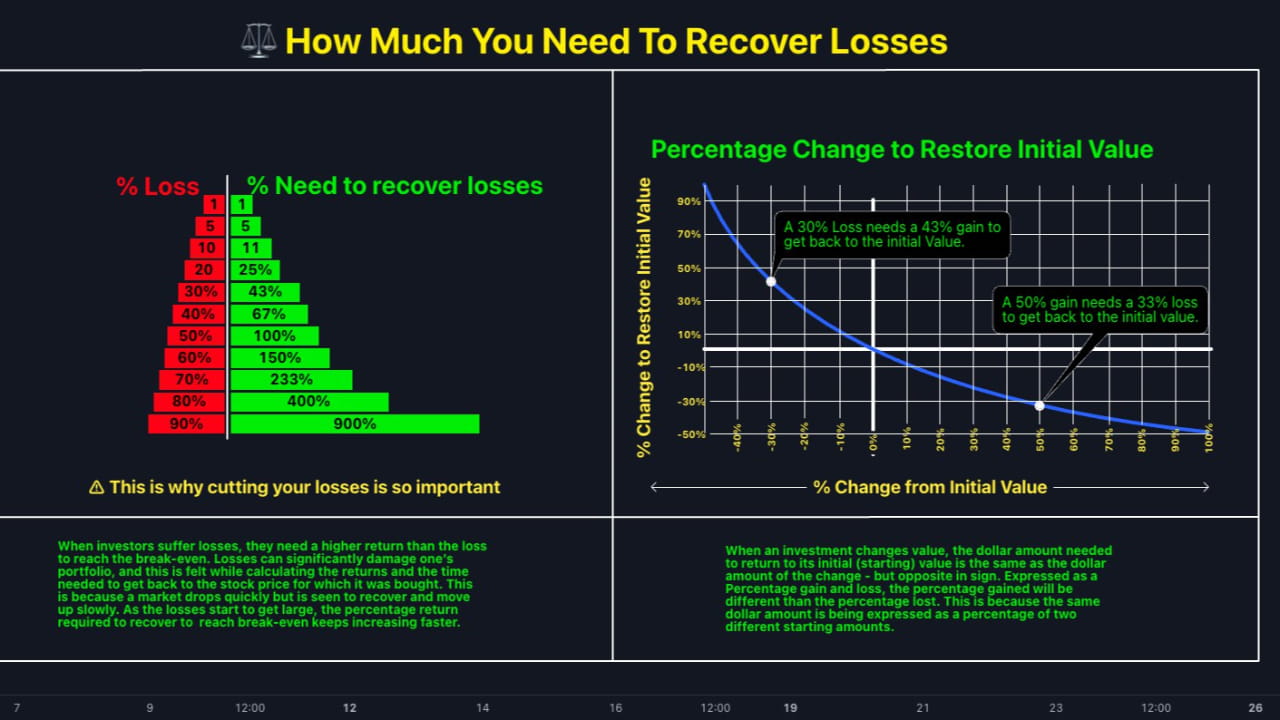

When the value of the investment changes, the amount of money required to return to its original value is equal to the change, but at a different rate. Expressed as a percentage, the percentage gain and loss will be different. This is because the same dollar amount is calculated as a percentage of two different starting prices.
📌The formula is expressed as a change from the initial value to the final value.
Percentage change = ( Final value − Initial value ) / Initial value ∗ 100
Examples:
🔹 With a loss of 10%, one needs a gain of about 11% to recover. (A market correction)
🔹 With a loss of 20%, one needs a gain of 25% to recover. (A bear market)
🔹 With a loss of 30%, one needs a gain of about 43% to recover.
🔹 With a loss of 40%, one needs a gain of about 67% to recover.
🔹 With a loss of 50%, one needs a gain of 100% to recover.
(If you lose half your money you need to double what you have left to get back to even.)
🔹 With a loss of 100%, you are starting over from zero. And remember, anything multiplied by zero is still zero.
As the plot graph showcased on the idea, after a percentage loss, the plot shows that you always need a larger percentage increase to come back to the same value.
To understand this, we can look at the following example:
$1,000 = starting value
$ 900 = $1,000 - (10% of $1,000), a drop of 10%
$ 990 = $ 900 + (10% of $900), followed by a gain of 10%
The ending value of $990 is less than the starting value of $1,000.
🧠 Psychological Aspect:
Investors must be able to accept that they have suffered losses, which is a must in the business world. Entrepreneurs should allow some time to adjust the process and monitor business performance. A major loss that results can affect decision making and shut business down for a few days until confidence is restored. There should be the right focus and no regrets for losses during the trading period.