#canmarketsreboundafterthanksgiving?
When the Federal Reserve cuts interest rates in December, market performance shifts from purely broad-based holiday seasonality to rate-sensitive sector dynamics.
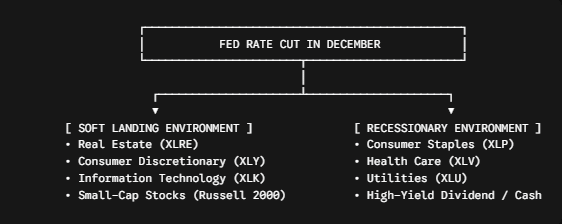
The sectors that historically outperform depend heavily on the underlying economic regime—specifically, whether the Fed is implementing a soft-landing "recalibration" cut (easing into a steady economy) or a recessionary emergency cut.
Top-Outperforming Sectors in Non-Recessionary December Cuts
When rate cuts occur alongside steady economic growth (a soft landing), lower borrowing costs and year-end institutional "window dressing" create strong tailwinds for rate-sensitive and growth-oriented sectors:
1. Real Estate & REITs (XLRE)
Why it Outperforms: Real estate is highly leverage-dependent and yield-sensitive. Lower rates immediately reduce mortgage and property financing costs while boosting dividend yields relative to falling Treasury yields.
December Dynamics: Real Estate often rallies strongly in late Q4 as income-focused investors lock in yields before broad rate cuts take full effect in the new year.
2. Consumer Discretionary (XLY)
Why it Outperforms: The intersection of a Fed rate cut and peak holiday spending creates a unique catalyst for retail, entertainment, and automobile stocks.
December Dynamics: Lower credit rates directly boost consumer spending power during Black Friday, Cyber Monday, and late-holiday shopping, benefiting sector giants (e.g., Amazon, Home Depot, Tesla).
3. Information Technology & High-Beta Growth (XLK)
Why it Outperforms: High-growth tech stocks rely on discount rate calculations for valuations. Lower interest rates decrease the discount factor applied to future earnings, pushing net present values higher.
December Dynamics: Institutional fund managers typically double down on momentum leaders in tech during year-end portfolio rebalancing, driving a pronounced late-December push.
4. Small-Cap Equities (Russell 2000 / IWM)
Why it Outperforms: Small-cap companies carry significantly higher portions of floating-rate debt compared to mega-caps. Rate cuts deliver immediate relief to their interest expenses.
December Dynamics: Small caps historically experience the strongest seasonality rebound during the late-December to early-January period (part of the "January Effect").
Top-Outperforming Sectors in Recessionary December Cuts
If the Fed cuts rates in December because macroeconomic indicators signal an impending economic contraction or severe slowdown, defensive and high-dividend sectors dominate as capital flees risk:
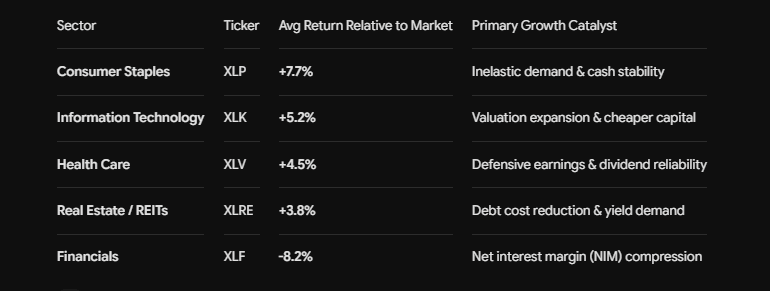
Consumer Staples (XLP): Historically the top-performing sector during rate-cutting cycles triggered by recessions (+7.7% relative market outperformance), supported by consistent inelastic demand.
Health Care (XLV): Delivers durable earnings and strong balance sheets (+4.5% average relative gain during easing cycles).
Utilities (XLU): Functions as a bond proxy; falling yields make utility dividend payouts highly attractive to conservative investors.
Historical Relative Outperformance (12 Months Post-Cut)