
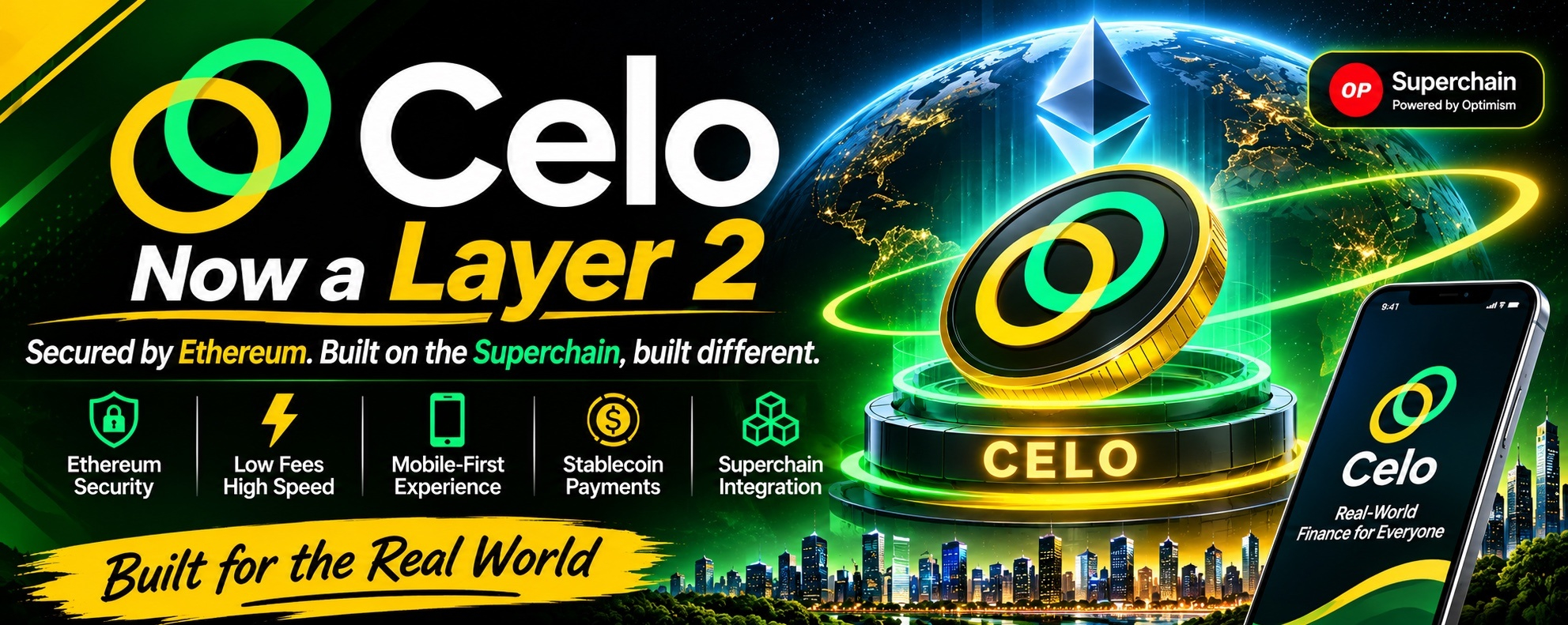


The blockchain industry has spent years trying to solve one fundamental problem: how can decentralized networks become powerful enough to support millions of people without making transactions expensive, complicated, or difficult to access?
Celo has approached this challenge from a different direction.
Originally launched as an independent Layer 1 blockchain, Celo officially transitioned into an Ethereum Layer 2 on March 26, 2025. However, this was not simply a change in infrastructure. It represented a strategic decision to combine Ethereum’s security and developer ecosystem with Celo’s existing focus on mobile accessibility, stablecoins, and real-world financial applications.
And that combination is what makes Celo particularly interesting.
1. Returning to Ethereum Without Losing Its Identity
Celo’s transition was built around the Optimism OP Stack, the same open-source technology framework used across the growing Superchain ecosystem.
One important aspect of this migration was that Celo preserved its existing blockchain state and transaction history. Instead of launching an entirely new network and asking users to start again, the team engineered a transition that maintained continuity for the existing ecosystem.
This matters because blockchain adoption is not just about launching new technology. It is also about protecting the applications, liquidity, developers, and communities already operating on a network.
By integrating with Ethereum, Celo gains access to a much broader development environment, native Ethereum connectivity, and an established settlement ecosystem.
2. Ethereum Security Meets Celo’s Payment-Focused Architecture
Being an Ethereum Layer 2 changes how Celo approaches network security and scalability.
Transactions are executed on Celo, while the network uses Ethereum as its settlement and security foundation. Its architecture combines the OP Stack with a dedicated data availability layer, including EigenDA.
This separation of responsibilities is important.
Ethereum provides the underlying settlement foundation, while Celo focuses on making everyday transactions efficient and affordable.
Celo also continues to develop its own security architecture. Its Jello upgrade introduced zero-knowledge-based fault-proof technology through OP Succinct Lite, strengthening the network’s approach to verifiable execution.
The bigger picture is that scaling should not mean sacrificing the ability to verify what happens onchain.
3. Stablecoins Are at the Center of Celo’s Strategy
Perhaps the most interesting part of Celo is its focus on practical financial use cases.
Many blockchain networks compete for speculative trading activity. Celo has invested heavily in making stablecoins useful for everyday financial interactions.
Its ecosystem supports assets including USDT, USDC, and local-currency stablecoins.
This creates opportunities beyond conventional DeFi.
Imagine someone in an emerging market receiving digital dollars, transferring money internationally, or making payments without depending entirely on traditional banking infrastructure.
That is where Celo’s design philosophy becomes relevant.
Its fee abstraction feature is particularly important because users can pay transaction fees using supported ERC-20 tokens rather than needing to hold CELO specifically for gas.
This removes an unnecessary barrier for people who simply want to use blockchain applications.
4. MiniPay Shows What Real Adoption Can Look Like
Infrastructure only becomes meaningful when people actually use it.
One of Celo’s strongest examples is MiniPay, a mobile-first wallet developed by Opera.
Rather than presenting blockchain as something that requires technical knowledge, MiniPay focuses on making stablecoin payments accessible through a familiar mobile experience.
Celo Core Co. reported more than 14 million MiniPay wallets across over 60 countries in its March 2026 ecosystem update.
That figure highlights an important distinction: blockchain adoption does not always begin with sophisticated trading platforms or complicated financial products.
Sometimes it begins with sending money, receiving payments, and accessing digital dollars through a smartphone.
5. The Superchain Connection Creates a Bigger Opportunity
Celo’s membership in the Superchain ecosystem is another important development.
The Superchain brings together OP Stack-based networks around shared infrastructure, standards, and an increasingly interconnected ecosystem.
For Celo, this means building alongside other Ethereum-aligned networks rather than developing in isolation.
It also creates opportunities for developers to work with familiar tools while exploring applications across multiple chains.
However, interoperability is not automatic. Cross-chain applications still depend on the relevant messaging, bridging, and security infrastructure.
The long-term opportunity is to make different blockchain environments feel less fragmented to users.
6. What Could Define Celo’s Next Growth Phase?
I believe Celo’s strongest opportunity lies at the intersection of three major developments:
Stablecoin payments: Expanding access to digital currencies and everyday financial services.
Agentic finance: Supporting applications and AI agents that need fast, programmable, and affordable onchain transactions.
Onchain financial markets: Creating infrastructure for decentralized exchanges, lending, tokenized assets, and other financial products.
Celo’s technical direction, including its evolving data availability infrastructure and zero-knowledge verification capabilities, shows that its development is not limited to simply maintaining an inexpensive blockchain.
It is building toward a more complete financial infrastructure.
Final Thoughts
Celo’s Layer 2 transition should not be judged only by transaction speed or gas fees.
The more important question is whether it can turn Ethereum-backed infrastructure into products that people genuinely need.
Its combination of Ethereum alignment, Superchain participation, stablecoin payments, mobile-first applications, and developer accessibility gives it a distinctive position in the Layer 2 landscape.
The next challenge is execution: maintaining strong security, decentralizing critical infrastructure, attracting developers, and converting existing adoption into sustainable economic activity.
Celo is no longer just an independent blockchain trying to compete with Ethereum.
It is now helping expand Ethereum’s reach into real-world finance.
Built on Ethereum. Connected to the Superchain. Designed for the real world.
That is what makes Celo worth watching.