
Global Macro & Geopolitical Investment Analysis | November 23, 2026
One inflation report could change the direction of the crypto market. If the Federal Reserve tightens its grip on monetary policy in December, today's recovering AI and Meme Coins could face another wave of selling. But if inflation cools, a new opportunity may emerge for investors willing to take calculated risks.
The crypto market is approaching an important turning point. Bitcoin's recovery, renewed interest in AI tokens and growing activity in the Meme Coin sector are all unfolding against one major macroeconomic question: Where is US monetary policy heading next?
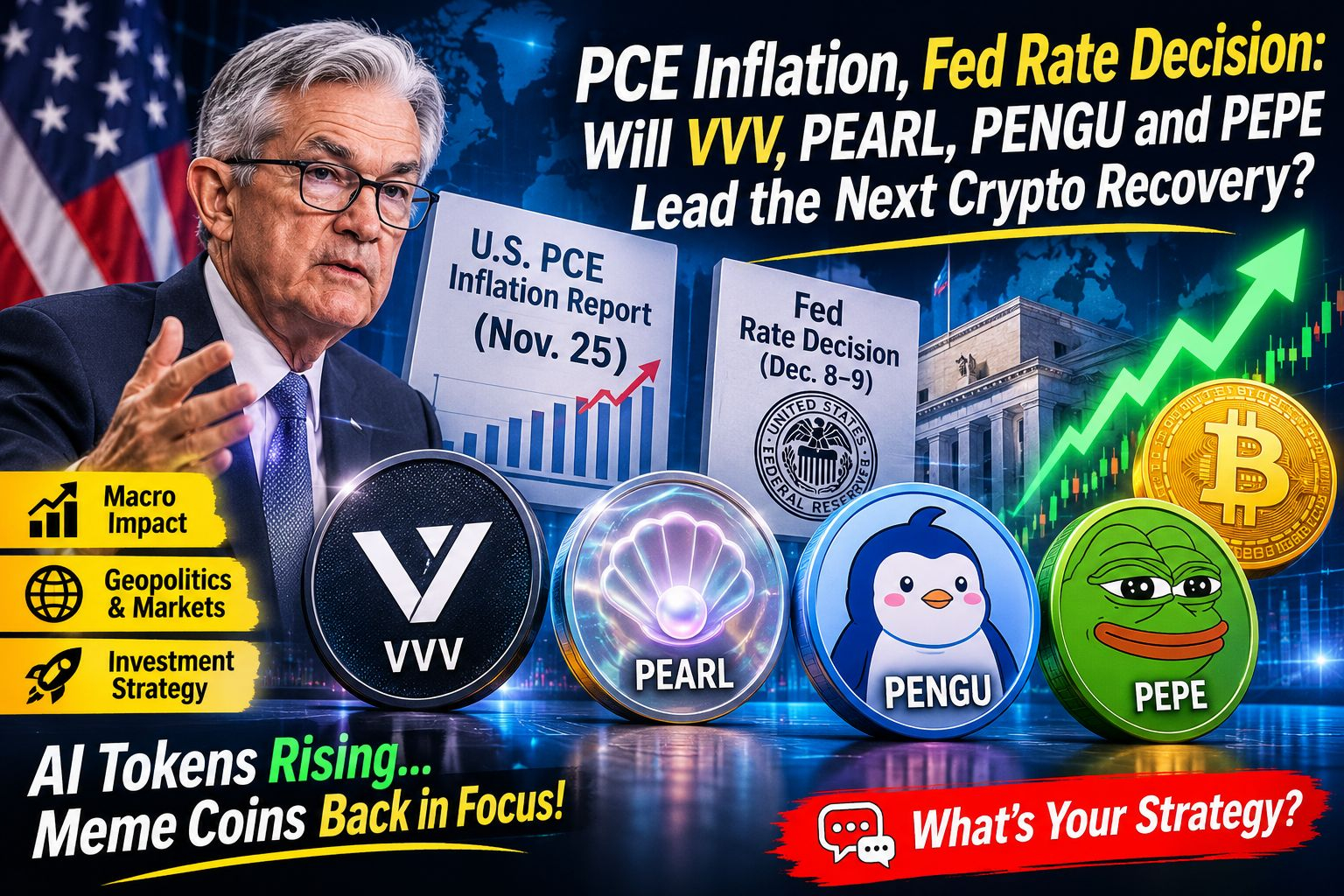
The upcoming US PCE inflation report and the Federal Reserve's December decision could determine whether institutional capital returns to risk assets or moves back toward safer investments.
For investors, four tokens deserve attention: $VVV , PEARL, $PENGU and $PEPE . Their recent recoveries offer an interesting opportunity to examine how macroeconomic conditions can influence different segments of the crypto market.
1. PCE Inflation: Why This Report Matters
The US Bureau of Economic Analysis is scheduled to release October's Personal Income and Outlays report on November 25, at 8:30 AM Eastern Time. The report will include the latest PCE and Core PCE inflation figures.
The latest available September data showed annual headline PCE inflation at 3.6%, while Core PCE stood at 3.1%.
Current October forecasts suggest that Core PCE could rise to approximately 3.2%–3.3% year over year. RBC Economics expects both headline and core PCE to increase by 0.3% month over month, potentially taking their annual rates to 3.8% and 3.3%, respectively.
These are forecasts, not confirmed results. The November 25 release will determine whether inflation is actually accelerating.
Unlike CPI, PCE captures changes in consumer spending patterns and allows for substitutions between goods and services. That makes it particularly important to the Federal Reserve.
Investors should focus on three possible outcomes:
Inflation comes in below expectations: Expectations of further monetary tightening may weaken. Lower Treasury yields and a softer dollar could support Bitcoin and selected altcoins.
Inflation matches expectations: The market may remain cautious, with attention shifting toward consumer spending and the Fed's policy language.
Inflation exceeds expectations: Expectations of another rate increase could strengthen the dollar and trigger fresh selling across high-risk assets.
One important point: good inflation data does not automatically mean Bitcoin will rally. Markets price in expectations before the actual announcement. The difference between expectations and reality often drives the strongest moves.
2. December Fed Decision: The Biggest Risk for Crypto
The Federal Reserve's October 27–28 meeting left its policy rate unchanged at 3.75%–4.00%.
However, the minutes released on November 18 revealed a more hawkish position among several policymakers. Two officials voted for a 25-basis-point increase in October, while almost all participants considered further tightening appropriate under their baseline inflation and employment outlooks.
The next FOMC meeting is scheduled for December 8–9.
As of November 23, market pricing points primarily toward a 25-basis-point increase, which would take the target range to 4.00%–4.25%. However, the recent market sell-off has changed expectations.
According to the latest market reporting, traders have largely removed the possibility of a 50-basis-point December increase. The probability of no rate increase has also risen to approximately 12%.
This means the market is still leaning toward a 25-basis-point hike, but the decision is not guaranteed.
The 2022 tightening cycle offers a useful lesson. As borrowing costs increased, liquidity became more expensive. Technology stocks and cryptocurrencies experienced significant valuation pressure as investors moved toward safer, yield-generating assets.
A similar mechanism could affect crypto again.
Higher interest rates increase the opportunity cost of holding assets that do not generate conventional income. This is particularly relevant for speculative AI and Meme Coins.
3. Geopolitics: The Hidden Force Behind Inflation
Inflation is not driven by domestic demand alone.
Conflicts in the Middle East, oil supply disruptions, international trade tariffs and rising transportation costs can all push prices higher.
Consider the connection.
When geopolitical tensions threaten energy supplies, oil prices may rise. Higher energy costs increase production and transportation expenses. Businesses eventually pass some of those costs to consumers.
That creates additional inflationary pressure.
The Federal Reserve cannot control geopolitical conflicts or global oil production. But it can respond to inflation by maintaining restrictive monetary policy.
This creates a difficult situation for investors: geopolitical developments can increase inflation, while the Fed's response can reduce global liquidity.
4. VVV and PEARL: Can AI Tokens Attract Fresh Capital?
Venice Token (VVV)
VVV stands out because its investment case is linked to the Venice AI ecosystem rather than AI speculation alone.
Its ecosystem includes staking, DIEM-based API compute credits and a token buy-and-burn mechanism linked to revenue.
The project's token economics and actual AI usage deserve close attention.
If demand for AI infrastructure continues growing, tokens connected to real computing services could attract investor interest.
However, investors should monitor token supply, staking activity, large-holder movements and actual platform usage. A strong price recovery without corresponding demand may not last.
PEARL (Pearl Research)
PEARL takes a different approach through its Proof of Useful Work model.
The concept connects GPU-based AI computation with blockchain mining. Instead of using computing power exclusively for network security, the model aims to direct resources toward useful computational tasks.
That is an interesting proposition in a market where demand for AI computing continues to expand.
But the real test is execution. Actual customer demand, network activity and sustainable mining economics will determine whether the model can deliver long-term value.
Investment perspective: VVV offers exposure to an AI ecosystem with utility-related mechanisms, while PEARL represents a more experimental approach to useful computing. Both deserve attention, but neither should be treated as a confirmed long-term winner simply because of a price rebound.
5. PENGU and PEPE: Is Meme Coin Liquidity Returning?
Pudgy Penguins (PENGU)
PENGU has a different investment narrative from most Meme Coins.
Its appeal comes from the Pudgy Penguins brand, NFT community, physical merchandise and broader commercial expansion.
The project has built recognition beyond crypto-native audiences. That gives it a potential advantage if consumer interest and community engagement continue growing.
However, brand popularity does not automatically translate into token demand.
Investors should watch community activity, brand expansion, token liquidity and whether the ecosystem creates sustainable demand for PENGU.
PEPE
PEPE remains one of the most recognizable names in the Meme Coin market.
Its strongest asset is its established internet culture, large community and trading activity.
Unlike AI tokens, PEPE does not depend on a complex technological business model. Its performance is more closely tied to market sentiment, liquidity and speculative demand.
Community discussions show both optimism about a potential recovery and concern about further downside.
That difference matters. A few bullish social media posts are not enough to establish a market trend.
Trading volume, whale movements and sustained buying pressure provide more useful signals.
My assessment: PENGU has a brand-driven investment narrative, while PEPE is primarily a high-risk liquidity and sentiment trade. Both could benefit from a broader market recovery, but they could also experience sharp losses if Bitcoin weakens.
6. How Global Decisions Reach Your Crypto Portfolio
The transmission mechanism is straightforward:
Geopolitical tensions → Higher energy and production costs → Inflation pressure → Fed policy decisions → Dollar and Treasury yields → Institutional capital flows → Crypto market direction.
If inflation cools and monetary policy becomes less restrictive, capital may gradually return to riskier assets.
Bitcoin would likely remain the key market indicator. AI tokens such as VVV and PEARL could attract interest from investors looking for technology-related exposure.
PENGU and PEPE, meanwhile, would depend more heavily on speculative liquidity and community sentiment.
The reverse is also true. Higher inflation and tighter monetary policy could push investors toward cash and safer assets, leaving smaller altcoins exposed to heavier selling pressure.
7. Investment Strategy: What Should Investors Watch?
Over the coming weeks, four indicators deserve priority:
Core PCE: Is underlying inflation slowing or becoming more persistent?
US Dollar and Treasury Yields: Are financial conditions becoming easier or tighter?
Bitcoin Market Structure: Can BTC maintain its recovery and establish stronger support?
Altcoin Liquidity: Are VVV, PEARL, PENGU and PEPE attracting genuine spot demand, or are their recoveries driven mainly by short-term speculation?
My preferred approach is to avoid chasing sudden price increases.
VVV and PEARL deserve attention if their AI-related utility translates into measurable demand. PENGU and PEPE become more interesting if Bitcoin stabilizes and speculative capital begins rotating into smaller assets.
But position sizing matters.
Investors should consider entering in stages, monitoring token unlocks and liquidity, setting clear invalidation levels and avoiding excessive leverage.
Final Investment Outlook
The next phase of the crypto market may be determined less by social media narratives and more by inflation, monetary policy and the direction of institutional capital.
VVV, PEARL, PENGU and PEPE represent four different investment narratives. Their recent recoveries make them worth watching, but a recovery is not proof of a sustainable bull trend.
The November 25 PCE report and December 8–9 FOMC decision could provide the next major signal.
The real opportunity will not necessarily belong to the investor who buys first. It may belong to the one who understands why capital is moving and waits for the right confirmation.
What is your strategy?
If the Fed raises interest rates by 25 basis points in December, would you continue accumulating VVV, PEARL, PENGU and PEPE at lower prices, or would you prefer to wait until Bitcoin and global liquidity show a clearer recovery?
Share your view in the comments.




#WillOctCorePCEShiftFedHikeExpectations? #Geopolitics #CryptoAnalysis #Binance #altcoins