
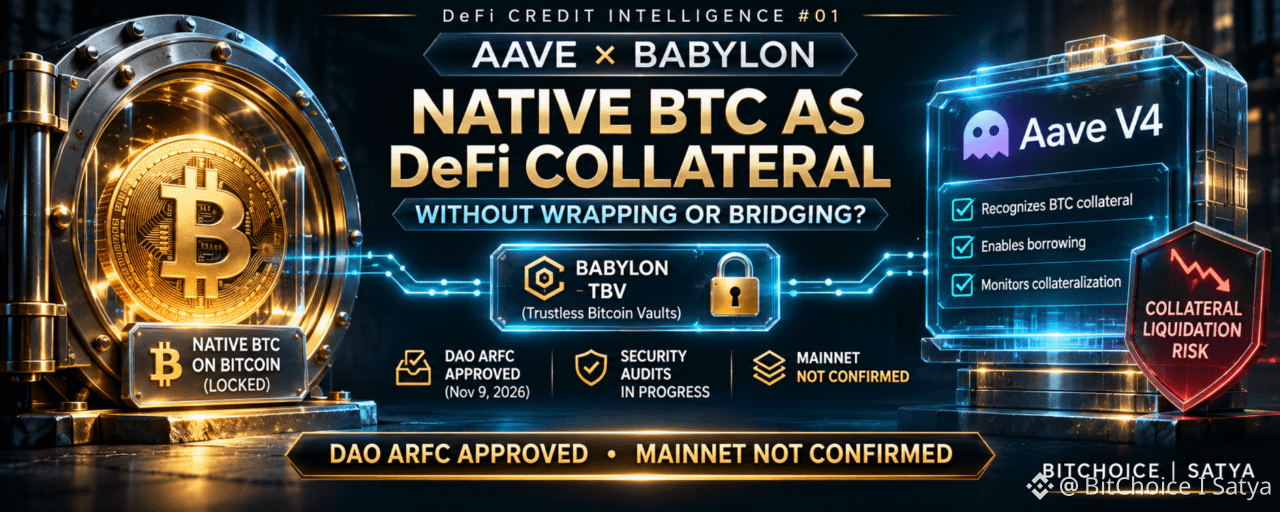

AAVE × BABYLON: CAN BITCOIN BECOME DEFI COLLATERAL WITHOUT WRAPPING OR BRIDGING?
Bitcoin has enormous financial value, but using native BTC inside decentralized lending protocols remains surprisingly complicated.
Traditionally, Bitcoin holders seeking DeFi loans have relied on wrapped tokens, custodians or cross-chain infrastructure.
Now Aave and Babylon are building a different approach.
On November 9, 2026, Aave DAO's initial governance vote approved the proposal to integrate native Bitcoin collateral through Babylon Trustless Bitcoin Vaults (TBV) into Aave V4.
All participating votes supported the proposal.
But this is not a completed mainnet launch.
The integration remains subject to security reviews, final governance steps and deployment.
WHY WRAPPED BITCOIN IS NOT THE SAME AS NATIVE BTC
Bitcoin and Ethereum operate on different networks.
An Ethereum lending protocol cannot directly manage ordinary Bitcoin UTXOs as if they were ERC-20 tokens.
Wrapped Bitcoin products solve this by representing BTC within another ecosystem.
But they can introduce additional dependencies:
• Custody arrangements
• Token issuance and redemption
• Cross-chain messaging or bridging
• Smart-contract security
• Infrastructure operators and counterparties
The risks vary between implementations.
Still, Bitcoin holders are often exposed to more than Bitcoin's underlying market risk.
BABYLON'S TRUSTLESS BITCOIN VAULTS
Babylon proposes a model in which the underlying BTC remains locked on Bitcoin.
Rather than transferring the coins to Ethereum, the system creates a Bitcoin vault with predetermined spending conditions.
Ethereum-side infrastructure recognizes the vault and connects it to lending accounting.
The intended process is:
A user commits native BTC to a Bitcoin vault.
Babylon verifies and tracks the vault's collateral status.
Aave V4 recognizes the corresponding collateral position.
The borrower receives access to supported lending-market liquidity.
Repayment or liquidation determines how the BTC can eventually move.
The objective is to allow BTC-backed borrowing without conventional wrapped assets or custodial bridges.
But this does not make the arrangement free of risk.
WHY AAVE V4 MATTERS
The integration is being developed around Aave V4's Hub-and-Spoke architecture.
Two components are particularly important.
BABYLON CORE LENDING SPOKE
Connects recognized native BTC collateral with Aave's lending system.
BTC is collateral, rather than an ordinary ERC-20 asset that users can borrow.
BTC VAULT SWAP SPOKE
Supports the collateral settlement procedures required when positions must be liquidated.
This second component may be the most important part of the design.
Borrowing is easy to describe.
Reliable liquidation under market stress is far harder to engineer.
THE REAL CHALLENGE: LIQUIDATIONS
Imagine a holder locking BTC to borrow stablecoins.
If the price of Bitcoin falls, the value of collateral declines while the debt remains outstanding.
The position may then become eligible for liquidation.
But the collateral is located on Bitcoin while the loan accounting operates through Ethereum-connected infrastructure.
That creates several important questions.
How quickly can collateral be settled?
What happens when Bitcoin transactions become expensive or delayed?
Can liquidation remain reliable during sudden market volatility?
How are inconsistent states between networks prevented?
What happens when the necessary execution route is unavailable?
The architecture aims to reduce traditional custody and bridging risks.
It does not eliminate operational, market or liquidation risk.
SELF-CUSTODY DOES NOT MEAN UNRESTRICTED CONTROL
A Bitcoin vault can preserve self-custodial security properties without leaving the collateral freely spendable.
Once BTC is pledged against a loan, contractual spending conditions apply.
The borrower cannot simply withdraw the collateral while ignoring outstanding debt.
Predetermined settlement conditions can also become relevant during liquidation.
This is the fundamental difference between holding Bitcoin in an ordinary wallet and using it to secure a loan.
WHAT THE GOVERNANCE APPROVAL MEANS
The November 9 ARFC vote was an important step for Aave and Babylon.
It showed governance support for expanding Aave V4 into native Bitcoin collateral markets.
However, an approved preliminary governance proposal is not equivalent to deployed production infrastructure.
Babylon's testnet documentation demonstrates how the system can be evaluated using test assets.
Aave's development reporting indicates that the integration has undergone or is undergoing specialized security assessments.
The necessary final approvals and mainnet deployment remain separate milestones.
THE POTENTIAL MARKET OPPORTUNITY
A successful implementation could give Bitcoin holders more choices.
Rather than selling BTC to obtain liquidity, a borrower could potentially pledge native BTC and borrow supported assets.
Possible applications include:
• Stablecoin credit against BTC
• Institutional collateral management
• Long-term treasury liquidity strategies
• Bitcoin-backed lending products
• Onchain credit markets connected to native Bitcoin
But collateral-backed borrowing is not free liquidity.
Borrowers face interest costs, price volatility and possible liquidation.
A Bitcoin-backed loan can become financially dangerous even when the underlying technical infrastructure works correctly.
THE FIVE TESTS THAT MATTER
Security
Can the vault architecture and integration withstand realistic attacks and unexpected failure conditions?
Liquidation reliability
Can unhealthy loans be resolved efficiently during market stress?
Capital efficiency
Are borrowing limits and collateral requirements commercially useful?
Execution costs
Do Bitcoin transaction costs, interest rates and settlement expenses make the product competitive?
Real adoption
Do borrowers and lenders actually use the system after launch, rather than merely expressing interest during testing?
OUR ASSESSMENT
The significance of Aave × Babylon is not simply that Bitcoin may enter DeFi.
Wrapped Bitcoin has already provided various forms of DeFi exposure for years.
The real innovation being tested is whether native BTC can secure programmable loans while remaining on the Bitcoin network.
That could reduce dependence on familiar custody and bridging models.
But it also requires new mechanisms for cross-network accounting, collateral control and liquidation.
The November governance approval is encouraging.
The decisive evidence will come from independent security assessments, operational mainnet performance and sustainable credit demand.
The question is not whether Bitcoin can support loans.
It already does.
The question is whether this architecture can deliver safer and more efficient credit without introducing hidden risks.
Would you use native BTC as DeFi collateral if no wrapped token or conventional bridge were required?
BITCHOICE | SATYA
DeFi Credit Intelligence #01
Research: Aave Governance, Babylon Labs and Babylon Trustless Bitcoin Vaults technical documentation, November 2026.
#Bitcoin #Aave #DeFi #Babylon #BTCFi $BTC
