What happens when AI agents start spending money on our behalf? 🪁
AI can already help us research, plan, and make decisions. But taking action in the real economy is a different challenge.
Imagine an AI agent that needs to pay for data, access a paid API, or hire another digital service. Who authorizes the payment? How much can it spend? And how can we verify what happened?
This is where Kite is building something interesting.
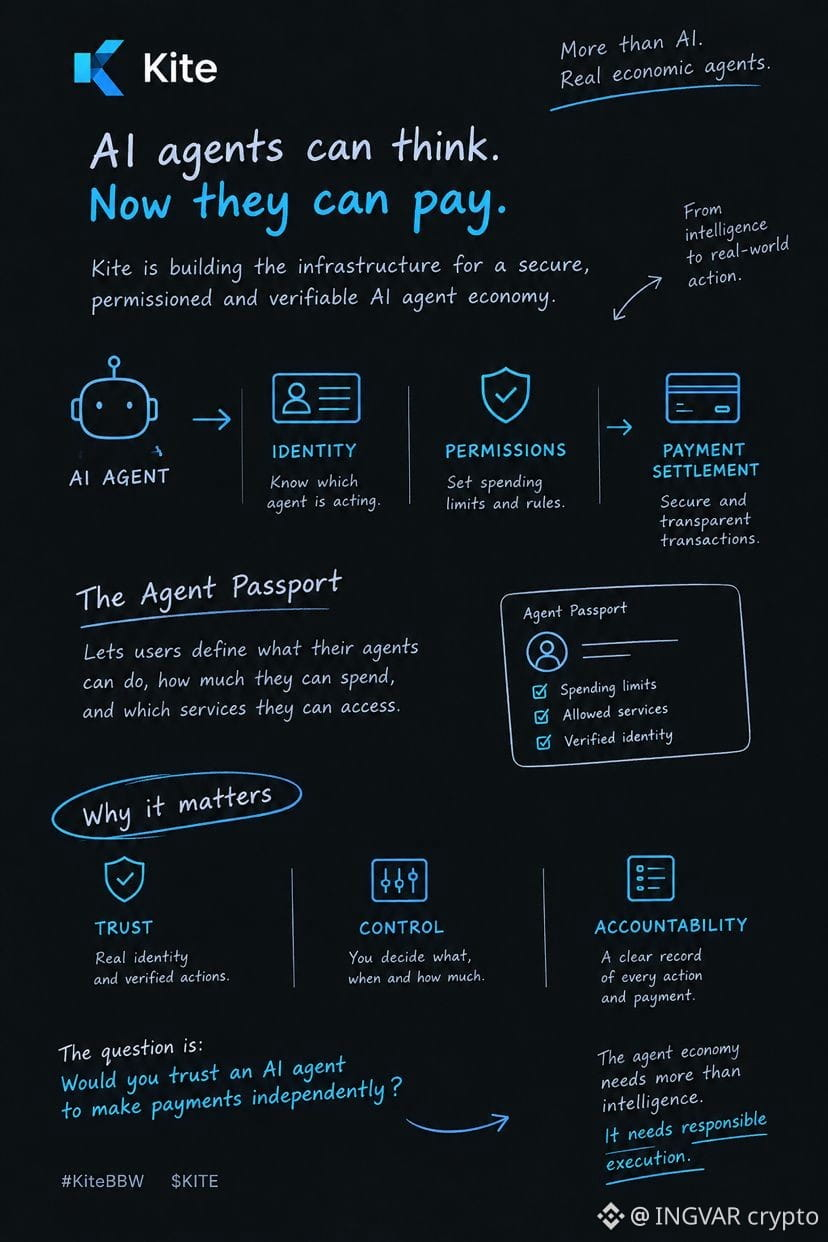
Kite is developing infrastructure that combines agent identity, programmable spending permissions, and payment settlement. Its Agent Passport lets users define spending limits and authorize agents to pay for services within those boundaries.
For me, the most important idea isn’t simply making AI payments faster. It’s making autonomous actions more controllable.
Three things matter:
🔹 Identity — knowing which agent is acting.
🔹 Permissions — defining what it can do and how much it can spend.
🔹 Verification — maintaining a record of actions and payments.
Of course, no infrastructure removes every risk. Permissions must be configured carefully, and users still need to understand what authority they delegate.
But if AI agents are going to become real economic participants, trust and accountability must be part of the foundation — not added as an afterthought.
My question: Would you trust an AI agent to make payments independently if you could set strict limits and review its activity?
The agent economy needs more than intelligence. It needs responsible execution.
#KiteBBW $KITE