


Cadence launched Maestro on October 26, giving chipmakers AI models they can fine-tune using proprietary designs and run behind their own firewalls. The launch raises a bigger question in its rivalry with Synopsys: who controls the models, the data they handle, and the value they create?
Two bets on where the models live
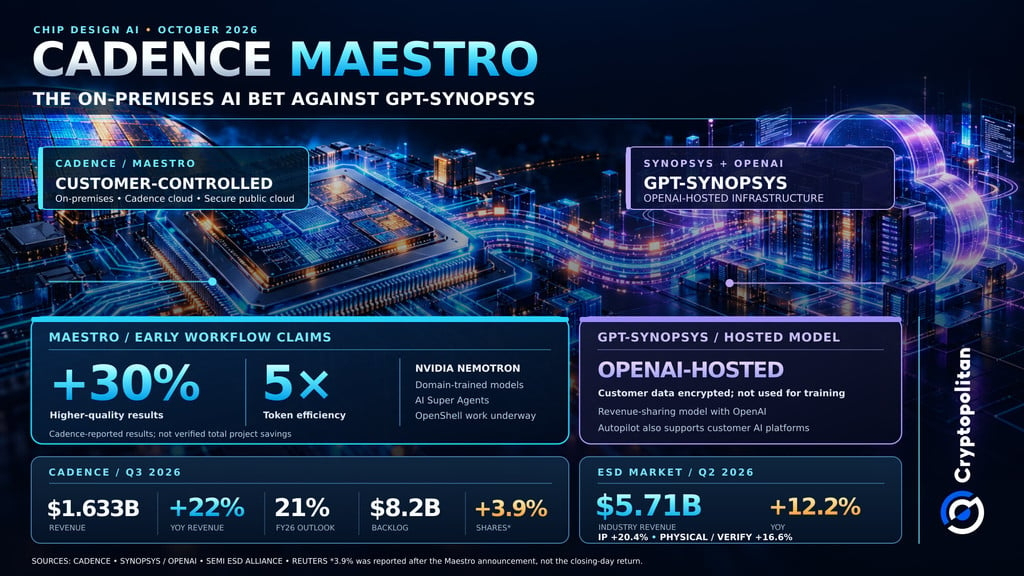
Maestro brings together specialized models, NVIDIA’s open-weight Nemotron technology, reinforcement learning, and Cadence AI Super Agents connected to chip-design tools. Customers can run the complete system on their own servers, through Cadence or in secured public clouds. Cadence says it is also working with NVIDIA to integrate OpenShell security.
“There are more (AI) model providers out there than there are (chip design software) vendors.”
Cadence senior vice president Paul Cunningham told Reuters that open- and closed-weight approaches were being “pursued equally.”
Synopsys has taken a different route. Under its September 30 OpenAI partnership, GPT-Synopsys will run on OpenAI-hosted infrastructure and work directly with Synopsys design tools. The companies will share revenue. Synopsys promises encryption, adjustable retention controls, and no training on customer data. The distinction is not absolute, however: its broader Autopilot strategy also supports integrating agents into customers’ own AI platforms.
 Cadence Maestro AI Chip Models: Performance and Market Potential
The efficiency claim, unverified on total cost
Cadence says Maestro delivered up to 30% better-quality results and five times greater token efficiency than a general-purpose model in early workflows. Its engineering tools check agent outputs against design constraints and feed the results back into training. Still, these are Cadence’s figures, not independently verified savings across an entire design project.
As Cryptopolitan previously reported, cost per completed task matters more than token price when a model needs repeated attempts or engineers must fix its output. Keeping Maestro in-house may help protect sensitive layouts, but running that infrastructure also costs money. The first models go to select early-access customers in the fourth quarter of 2026.
A market big enough to fight over
There is plenty at stake. The electronic system design market generated $5.71 billion in the second quarter of 2026, up 12.2%, according to SEMI. Semiconductor IP revenue grew 20.4%; IC physical design and verification rose 16.6%. TrendForce forecasts nearly 31% growth in AI server shipments this year as Google and Amazon expand custom-chip programs.
Cadence also announced a sovereign AI data center in Munich on October 21, addressing demand to keep sensitive workloads within regional borders.
Cadence reported third-quarter revenue of $1.633 billion, up 22%, with an $8.2 billion backlog and a 21% full-year revenue-growth outlook. Its AI Super Agents have more than 100 active customer engagements. Reuters reported that shares rose 3.9% after the Maestro announcement.
That is where the rivalry will be settled: not in token counts or cloud promises, but in whether engineers can deliver better chip designs faster, without adding to the total bill.
Don’t just read crypto news. Understand it. Subscribe to our newsletter. It's free.