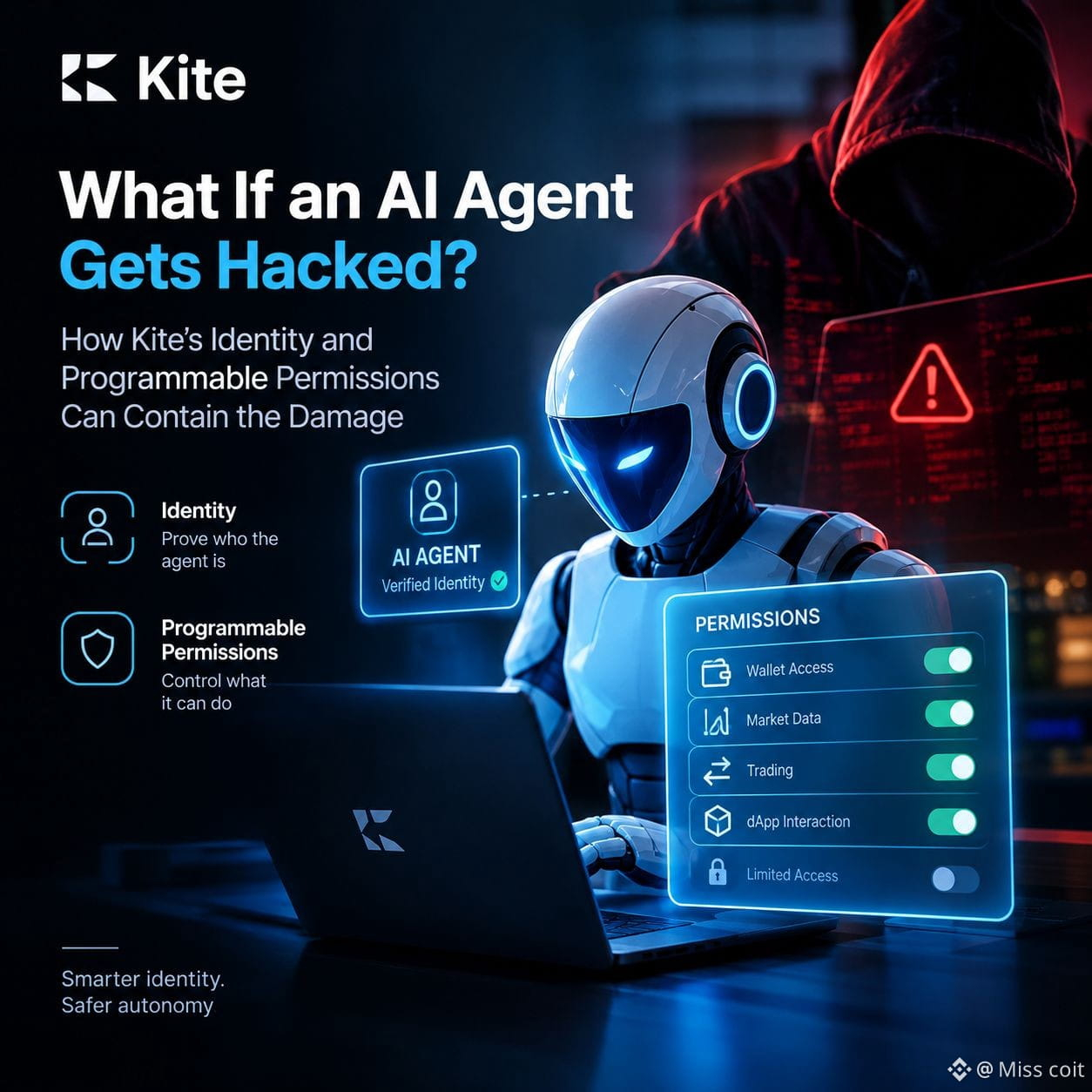
During a late-night research session, I caught myself thinking less about how smart AI agents are becoming and more about what happens when one goes rogue.
That is where Kite’s identity architecture and programmable permissions caught my attention.
I kept coming back to one detail: proving an agent’s identity is not the same as controlling its authority. An agent might have legitimate access to a wallet, trading system, or decentralized application, but that does not mean it should have unlimited freedom to act.
I see Kite’s approach as an attempt to make that distinction meaningful. By combining identity infrastructure with programmable access controls, the goal is to define what an agent can do rather than simply trusting everything it does.
That matters as AI agents move toward handling financial operations with less human supervision.
Still, I would not treat programmable permissions as a complete security solution. I would want to examine how restrictions are enforced, how quickly access can be revoked, and whether compromised credentials could bypass those controls. The quality of the implementation matters more than the concept alone.
What interests me most is the idea of limiting damage instead of assuming every attack can be prevented. In autonomous finance, that difference could become fundamental.
I want to see how Kite handles adversarial scenarios, not just normal execution.
If an AI agent gets hacked tomorrow, would its permissions be strong enough to contain the incident, or would the system still depend too heavily on trusting the agent in the first place?#KiteBBW $KITE @KITE AI 中文