#NIL $NIL @Nillion
Last week, a friend asked me where her medical records actually live. I started to answer, then realized I had no idea. Somewhere on a server, owned by someone, copied who knows how many times. 🤔
That small moment sent me down a rabbit hole, and Nillion was one stop along the way.
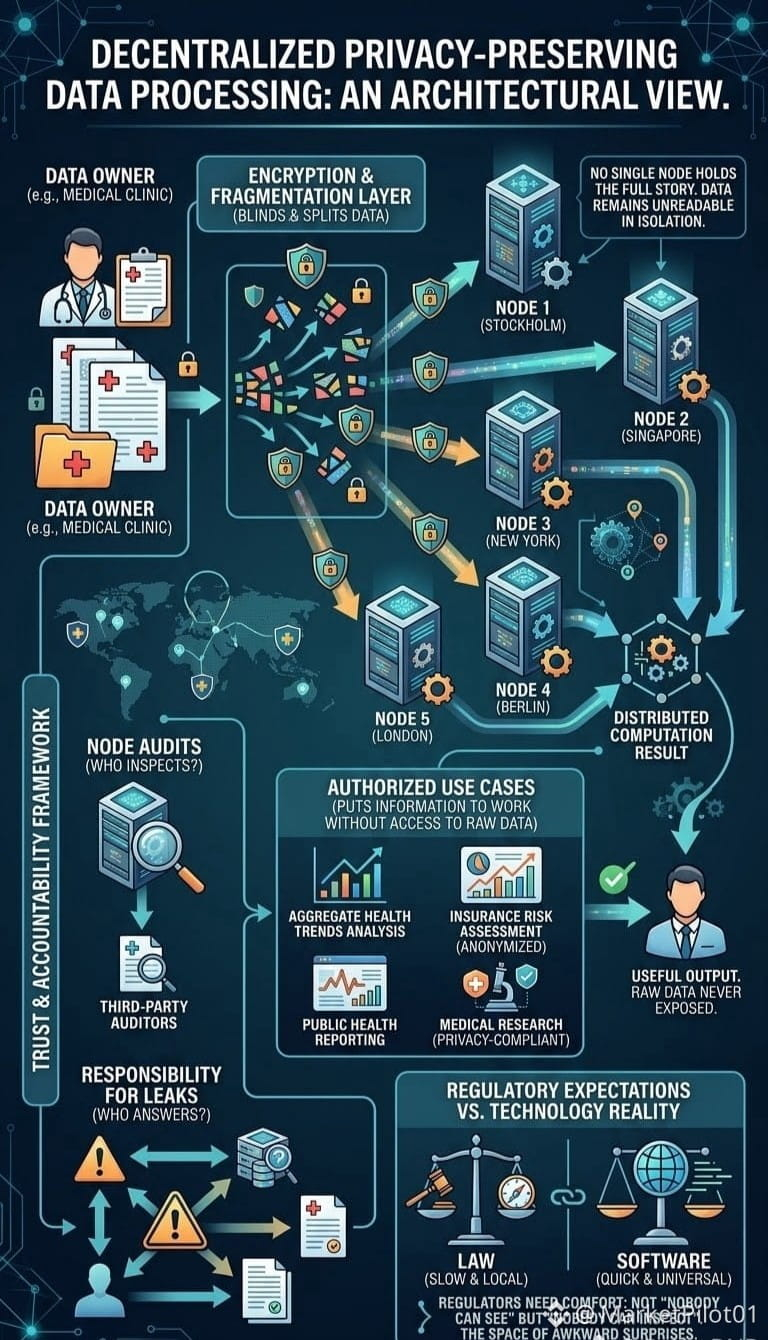
What caught my attention is its core idea: your information can be used without being exposed in readable form. Data can be distributed across multiple nodes, so no single node needs to hold the complete picture. 🔐
The problem Nillion is trying to address is real. Hospitals, insurers, banks, and public institutions all face serious challenges when it comes to protecting sensitive information. A technology designed to help preserve privacy while enabling useful computation could have practical applications beyond crypto.
But I wouldn't be honest if I stopped there.
Good technology doesn't automatically mean good implementation.
Who audits the nodes? What happens if something leaks? And how will regulators respond?
There's a big difference between saying, "Nobody can see this data" and saying, "Nobody can inspect this system." That distinction matters.
Law moves slowly and varies from country to country. Software moves quickly and crosses borders. The gap between the two is where unexpected problems can emerge.
There's another irony: even if the mathematics is sound, most of us will still depend on someone else's explanation to understand it. Trust doesn't disappear. It simply moves somewhere else.
My takeaway? Nothing dramatic.
📖 Read the documentation before forming an opinion.
🔍 Look for evidence of real-world testing.
🛡️ Understand the security model.
⚖️ Ask who takes responsibility when things go wrong.
I'm not an expert, and I'm okay with that.
Learning slowly beats believing quickly.
$NIL | @Nillion