



Midterm Election curse ‼️😱
🐼 PANDA TRADERS | SPECIAL MARKET REPORT
October 21, 2026
Something very interesting is happening in the crypto market right now, and I want every single member to understand this before making their next trading decision.
Bitcoin is struggling, altcoins are under pressure, geopolitical tensions are rising, and uncertainty is spreading across global financial markets.
But here's something most traders haven't considered.
What if this correction is happening at one of the most important moments of the entire year?
And what if the same historical pattern that appeared in 2018 and 2022 is becoming relevant once again?
I'm talking about something known in financial markets as the US MIDTERM ELECTION CYCLE.
Today, we're going to connect the history, understand what is happening right now, examine what institutional investors are doing, and most importantly, discuss how we should position ourselves for the coming weeks.
Read this carefully. Because understanding WHY the market moves is just as important as knowing WHERE it might move next.
📉 CHAPTER 1: THE HISTORY MOST BITCOIN TRADERS FORGET
Let's go back eight years.
🔴 NOVEMBER 2018 — THE FIRST BIG LESSON
On November 6, 2018, the United States held its midterm elections.
Bitcoin was already struggling after the massive 2017 bull market.
Then, during the second half of November, the market experienced another devastating sell-off.
Between November 13 and November 24, Bitcoin declined from approximately $6,339 to $3,854.
That's nearly a 39% decline in just 11 days.
Imagine the sentiment during that period.
Retail investors were panicking, confidence was disappearing, and many traders were convinced that Bitcoin would never recover.
However, there's something important to understand.
The crash wasn't simply caused by the midterm elections. The controversial Bitcoin Cash hard fork and existing bearish market conditions played major roles.
So why am I mentioning the election?
Because it provides an interesting historical example of major market instability occurring around a politically uncertain period.
And four years later, something similar happened.
🔴 NOVEMBER 2022 — HISTORY GETS EVEN MORE INTERESTING
Fast-forward to November 8, 2022.
Another US midterm election.
And once again, Bitcoin was experiencing extreme volatility.
During the same week, the FTX crisis exploded.
Binance initially considered acquiring FTX, confidence in the crypto industry collapsed, and a massive wave of selling followed.
Bitcoin eventually fell below $16,000.
Billions were wiped from the crypto market.
But again, the important distinction is that the FTX collapse was the immediate driver of the crash, not the election itself.
Now think about this.
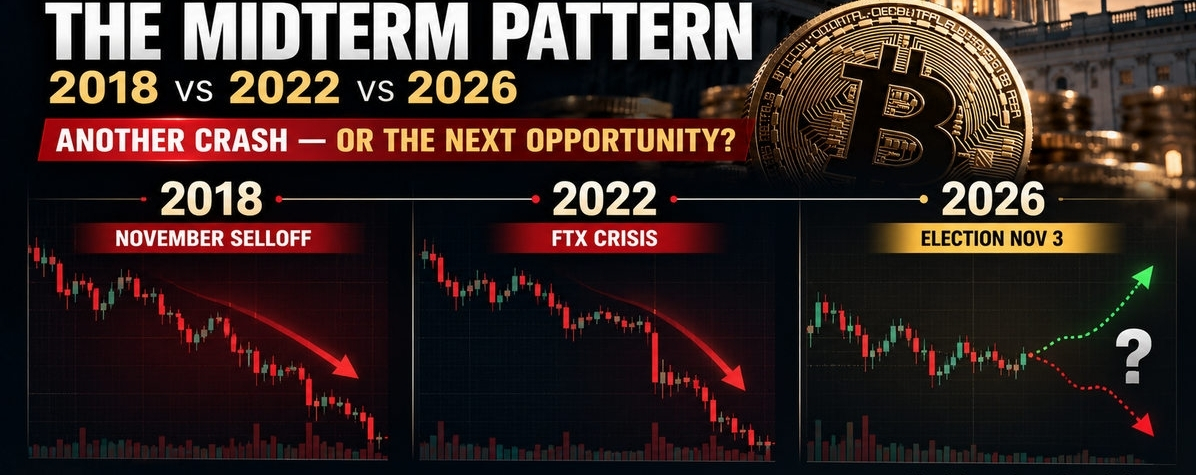
2018: Midterm election period, followed by major Bitcoin weakness.
2022: Midterm election period, alongside a historic crypto collapse.
2026: Another midterm election approaching.
Is Bitcoin guaranteed to crash again?
Absolutely not.
But should we completely ignore this historical timing?
I don't think so.
Because the more useful lesson isn't that elections automatically cause crashes.
It's that major economic uncertainty, weak market structure, and unexpected catalysts can become especially dangerous when traders are already nervous.
And that's exactly why I'm watching the coming weeks so carefully.
🇺🇸 CHAPTER 2: WHY THE US MIDTERM ELECTIONS MATTER
The next US midterm elections are scheduled for November 3, 2026.
For those who don't understand American politics, let me explain something.
Midterm elections happen halfway through a US president's four-year term.
Americans vote to decide control of Congress, including all House seats and a portion of the Senate.
And why should Bitcoin traders care?
Because changes in Congress can influence government spending, taxation, regulation, and the direction of future legislation.
For crypto, this may also affect expectations surrounding digital-asset regulation.
The problem is uncertainty.
Before the elections, institutions cannot be completely certain which political party will control Congress or how future economic policies will develop.
And there's one thing large financial markets generally dislike.
UNCERTAINTY.
When uncertainty increases, investors may reduce exposure to risky assets, strengthen hedges, or temporarily move capital into safer investments.
Bitcoin, despite its long-term appeal, can still behave like a risk asset during periods of financial stress.
That's why macroeconomic events matter so much.
But here's where things get really interesting.
📈 WHAT HAPPENS AFTER THE ELECTIONS?
Historically, US stocks have often performed strongly after midterm elections.
Research from J.P. Morgan Asset Management shows that since 1950, the S&P 500 has recorded positive returns in the 12 months following every US midterm election, averaging approximately 15%.
That's a remarkable historical observation.
Why might this happen?
One possible explanation is that uncertainty begins to disappear.
Once the election results become clearer, investors can reassess government policies, economic conditions, and future expectations.
That can support confidence and increase risk appetite.
However, this is a historical stock-market pattern, not a guarantee that Bitcoin will behave the same way.
And importantly, any recovery may begin before the actual election, after it, or much later.
So the lesson is not to blindly buy on November 3.
The lesson is to understand the market cycle and prepare for potential opportunities.
---
⚠️ CHAPTER 3: THREE MAJOR CATALYSTS THAT COULD CHANGE EVERYTHING
Now let's connect this history with what's happening in October 2026.
We have three major factors worth monitoring.
1️⃣ THE FEDERAL RESERVE — OCTOBER 27–28
The Federal Reserve's next interest-rate decision is scheduled for October 28.
And this meeting matters tremendously.
Why?
Because interest rates influence borrowing costs, liquidity expectations, and investor appetite for risk.
Higher interest rates can put pressure on Bitcoin and stocks.
Lower interest rates, or expectations of easier monetary policy, can sometimes support them.
For this meeting, economists largely expect the Fed to leave rates unchanged.
But here's the catch.
The interest-rate decision alone isn't everything.
The market will also pay close attention to the Fed chair's press conference and the message about future policy.
Imagine two scenarios.
🟢 Scenario A: The Fed holds rates steady and signals that inflation risks are improving.
That could support risk appetite and potentially help Bitcoin recover.
🔴 Scenario B: The Fed holds rates steady but warns that inflation remains too high and additional rate hikes may be necessary.
That could disappoint traders expecting a more supportive policy outlook.
So don't automatically assume that unchanged interest rates equal an immediate Bitcoin pump.
Sometimes the actual market reaction depends more on what the Fed says about the future.
And sometimes the expected good news is already priced in.
2️⃣ GEOPOLITICAL TENSIONS AND OIL PRICES
Another major factor is the continuing tension in the Middle East, particularly involving the United States and Iran.
This isn't just a political story.
It's an economic one.
Why?
Because geopolitical tensions can disrupt energy supplies and push oil prices higher.
And when oil becomes expensive, transportation, production, and other economic costs can rise.
That creates additional inflation pressure.
Now connect the dots.
Higher oil prices → Inflation concerns → Potentially tighter Federal Reserve policy → Pressure on risk assets.
This is one reason geopolitical developments can influence Bitcoin even when the headlines have nothing directly to do with cryptocurrency.
However, if tensions ease and oil prices begin cooling, the opposite effect may occur.
Inflation concerns could decline, helping improve market sentiment.
That's why I'm closely watching geopolitical developments alongside the BTC chart.
Sometimes the catalyst behind a major Bitcoin movement originates far outside the crypto market.
3️⃣ BITCOIN ETF FLOWS — ARE INSTITUTIONS RETURNING?
Now this is perhaps one of the most interesting developments.
Let's look at the latest reported US spot ETF data.
October 19, 2026:
Bitcoin ETFs recorded approximately $526.7 million in net inflows.
October 20, 2026:
Bitcoin ETFs recorded another $23.2 million in net inflows.
That's approximately $550 million in combined net inflows across two trading sessions.
Now compare that with Ethereum.
During those same two sessions, Ethereum ETFs experienced approximately $129 million in combined net outflows.
Interesting, right?
Bitcoin is attracting capital into its ETF products while Ethereum is still experiencing withdrawals.
This divergence may indicate that institutional demand is currently stronger for BTC than for ETH.
However, two days of inflows do not prove that institutions have identified the final bottom.
We need sustained buying, healthier price structure, and confirmation from the broader market.
Still, it's an important development worth monitoring.
Because when money starts returning to Bitcoin consistently, it can provide a foundation for a stronger recovery.
And when Bitcoin eventually establishes a clear bullish trend, altcoins may begin benefiting from improving sentiment too.
Remember one of our most important Panda trading rules.
BTC FIRST. ALTCOINS SECOND
🧠 CHAPTER 4: THE IMPORTANT LESSON — BUY THE RUMOR, SELL THE NEWS
Now I want to explain something that many beginners misunderstand.
Why does the market sometimes crash after positive news?
Imagine investors expecting a major political agreement or a favorable economic announcement.
Weeks before the announcement, traders begin buying.
The market rises because everyone is anticipating good news.
Then the announcement finally arrives.
And instead of pumping, the market suddenly starts dumping.
Why?
Because the positive outcome may already have been reflected in the price.
Early buyers begin securing their profits.
Late buyers enter emotionally.
And the market reverses.
This is the famous principle:
BUY THE RUMOR, SELL THE NEWS.
But remember, this isn't a law.
Sometimes good news leads to a sustained rally, particularly when the outcome is better than expected.
That's why professional trading requires more than simply knowing the news.
You need to understand market positioning, liquidity, expectations, and price structure.
For the coming Fed meeting and midterm elections, this concept becomes especially important.
If the market rallies aggressively before an event, we should watch for possible profit-taking.
If Bitcoin sells off before an event and the actual outcome reduces uncertainty, we should watch for a potential recovery.
The chart must confirm which scenario is developing.
📊 CHAPTER 5: WHAT IS BITCOIN TELLING US RIGHT NOW?
Now let's come to the most important question.
HAS BITCOIN ALREADY FORMED ITS BOTTOM?
Here's my perspective.
I believe Bitcoin is entering an important decision period, but I am not ready to declare the final bottom confirmed.
There are reasons to watch for a recovery.
Institutional ETF demand has recently improved.
An important political event is approaching.
The Federal Reserve meeting could significantly change expectations.
And Bitcoin has already experienced considerable volatility.
But there's another side to the story.
The market can always produce one more aggressive liquidity sweep before a sustainable reversal.
That's why we must study price structure rather than simply guessing the bottom.
Now let's discuss our key areas.
🐼 $85,000 — IMPORTANT RECLAIM ZONE
This area remains important in our working plan.
With Bitcoin recently trading below it, I want to see a convincing recovery above $85,000, followed by buyers successfully defending the level.
A proper reclaim with volume and bullish structure would strengthen the recovery argument.
🐼 $84,000–$83,000 — DECISION AREA
This is the zone we need to monitor for potential accumulation or a liquidity sweep.
But don't mistake a price level for automatic support.
Bitcoin has already traded into and below parts of this region.
What matters now is whether buyers can reclaim the area and establish higher lows.
If price sweeps below the recent lows and quickly recovers, that could suggest sellers are losing control.
But if Bitcoin continues accepting lower prices, we must reassess rather than blindly averaging down.
🐼 WHAT IF BITCOIN BREAKS LOWER?
Then we don't panic.
And we don't automatically buy every red candle.
We move to the next established 1H and 4H demand zones, identify liquidity below recent lows, and wait for fresh confirmation.
No guessing.
No revenge trading.
No chasing.
🔍 CHAPTER 6: WHAT OUR PANDA STRUCTURE ANALYSIS MUST CONFIRM
Members who have attended our classes already know that I never want you trading purely because a price looks cheap.
A proper reversal should have supporting evidence.
First, I want to examine the 4H and 1H market structures.
Is Bitcoin still forming lower highs and lower lows?
Has a major swing high been reclaimed?
Are we seeing a legitimate change of character?
Then we move to the 15-minute chart.
I want to see whether buyers can defend demand and produce a bullish break of structure.
The 5-minute chart is for refining execution, not for overriding the higher timeframes.
We also need to monitor liquidity.
Are equal lows being swept?
Is price rejecting a breakdown?
Are buyers showing enough volume to support the recovery?
Next comes funding and open interest.
If leverage becomes excessively crowded in one direction, the market can move aggressively against those traders.
A reset in overheated positioning can help create healthier conditions for a future move.
Exchange premiums can also provide clues about regional demand.
For example, a negative Coinbase premium may suggest relatively weaker buying on Coinbase than on the comparison exchange.
But it is not a guaranteed bottom signal.
We should never buy solely because one indicator looks extreme.
The strongest setups come when several independent factors agree.
Structure.
Liquidity.
Volume.
Market positioning.
BTC direction.
That's how we build confidence in a trade without pretending we can predict every candle.
💰 CHAPTER 7: HOW I'M APPROACHING THE NEXT TWO WEEKS
Now let's discuss what actually matters to us as traders.
How should we operate during this uncertainty?
I believe the coming weeks require patience, discipline, and careful risk management.
For spot investors:
Gradual accumulation may be worth considering when Bitcoin reaches well-established demand and begins showing signs of stabilization.
Avoid deploying all your capital at once.
Keep some liquidity available in case the market experiences another significant correction.
For futures traders:
This is not an environment where I want members blindly using excessive leverage.
Instead, I prefer selective setups supported by higher-timeframe structure.
Look for a sweep and reclaim near demand before considering longs.
Look for rejected rallies near supply if the bearish structure remains intact.
And if price is stuck in the middle of a range without confirmation?
NO TRADE.
Remember our usual risk framework.
Keep risk around 0.5–1% of trading capital per position.
Place stop-losses beyond meaningful structural invalidation, with appropriate room for volatility, while keeping the position size small enough to respect that risk limit.
When the trade reaches TP1, we can consider securing around 30% of the position and managing the remainder according to structure.
Our objective is not to catch every movement.
Our objective is to trade high-quality opportunities while protecting our capital.
📅 CHAPTER 8: WHEN COULD THE NEXT BIG RECOVERY BEGIN?
Now let's connect all the pieces.
October 27–28: Federal Reserve meeting.
November 3: US midterm elections.
Between these events, geopolitical developments and ETF activity could also influence sentiment.
This creates an important window for potential volatility.
My base scenario is that Bitcoin may establish a more convincing recovery during late October or November, provided buyers reclaim key levels and institutional demand strengthens.
But there is no fixed date for a bottom.
A recovery could begin before the elections.
It could develop afterward.
Or it could be delayed if inflation, monetary policy, or geopolitical conditions deteriorate.
So I want our members to prepare for two outcomes.
🟢 THE BULLISH SCENARIO
Bitcoin sweeps liquidity, quickly reclaims important levels, and develops higher lows.
ETF demand remains supportive.
Macro uncertainty begins easing.
If these factors align, we can start looking for a stronger recovery, with BTC leading and selected altcoins potentially following.
🔴 THE BEARISH SCENARIO
Bitcoin repeatedly fails to reclaim resistance.
Selling volume increases.
Important demand zones break without a successful recovery.
Inflation or geopolitical conditions worsen.
If this happens, we stay defensive and wait for price to reach fresh areas of interest.
There's no reason to force a bullish trade when the market isn't ready.
The secret is being prepared for both situations.
🐼 FINAL MESSAGE TO ALL PANDA TRADERS MEMBERS
I want everyone to remember something.
The market doesn't reward the person who predicts the bottom most confidently.
It rewards traders who can recognize opportunities, manage uncertainty, and protect their capital long enough to benefit from them.
2018 taught us how brutal crypto corrections can become.
2022 reminded us that unexpected events can destroy even the strongest-looking market assumptions.
And 2026 is presenting us with another interesting combination of political uncertainty, monetary policy decisions, geopolitical risks, and changing institutional demand.
Will history repeat itself?
Maybe.
Will we see one more Bitcoin liquidity sweep before a recovery?
It's possible.
Could Bitcoin recover without giving everyone a perfect entry?
Absolutely.
But here's what I don't want.
I don't want our members blindly chasing green candles.
I don't want anyone risking their entire account trying to catch one bottom.
And I certainly don't want our members making emotional decisions because of social media headlines.
We'll continue watching the charts, analyzing liquidity, monitoring market positioning, and updating our setups as the evidence changes.
Because our advantage isn't knowing exactly what happens tomorrow.
It's knowing how to respond when the market reveals its next direction.
Remember:
The best opportunity isn't always the lowest price.
Sometimes it's the moment uncertainty begins turning into confirmation.
Stay patient. Protect your capital. Prepare your levels.
The coming weeks could offer important opportunities, but we'll let the market prove where those opportunities exist.
🐼 PANDA TRADERS
We don't chase the market. We study it, prepare for it, and trade it with discipline.
🚨 NOW TELL ME YOUR EXPECTATION:
Will Bitcoin reclaim $85K and start recovering, or do we get another major liquidity sweep first?
Share your opinion below. I want to hear how everyone is preparing for November.
Panda Traders 🐼
