

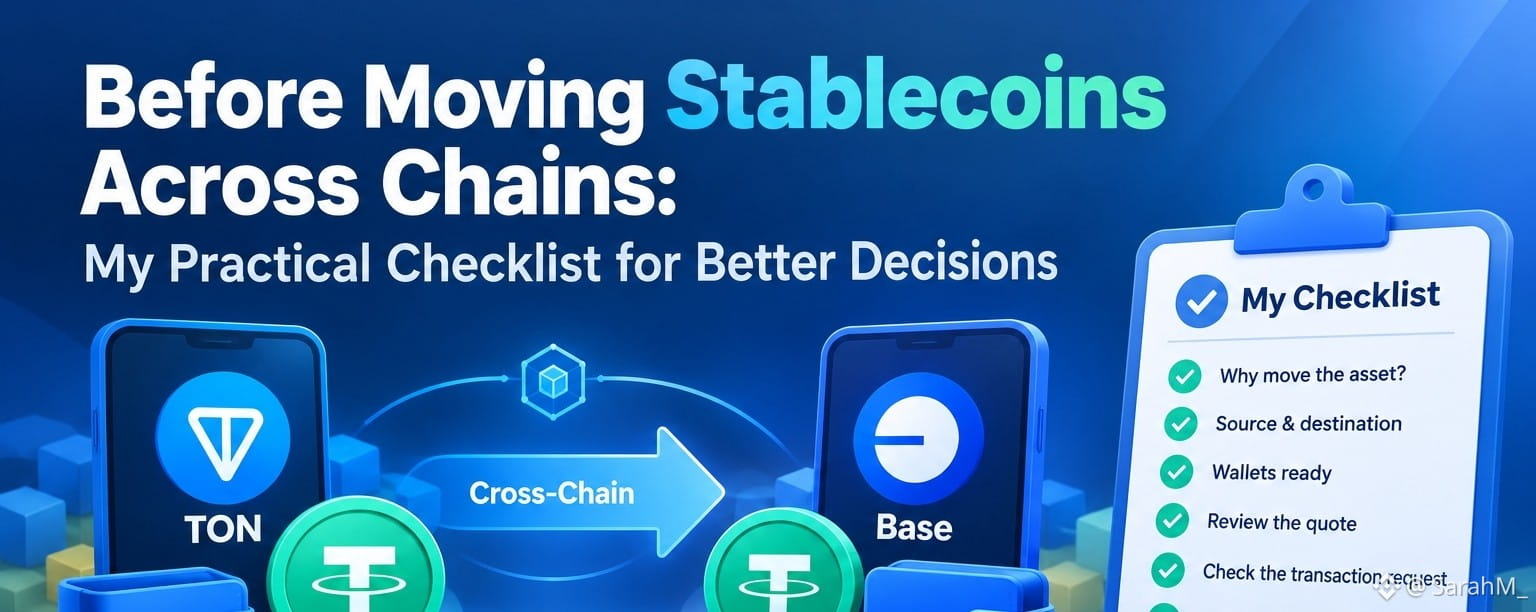

Introduction:
A Better Process Begins Before the Transaction
Moving stablecoins between blockchain networks can be useful when you need access to a particular application, asset, or ecosystem.
However, a cross-chain transfer involves more than entering an amount and pressing a button.
You need to identify the correct asset, select the right networks, understand the transaction quote, and verify the destination.
While researching cross-chain infrastructure and DeFi user experience, I found it helpful to approach the process as a series of decisions rather than a single transaction.
This article turns those decisions into a practical checklist.
The examples focus on moving USDT from TON to Base, but the general principles can help when evaluating other supported routes.
For the current TON-to-Base workflow, consult STON.fi's official "guide to sending USDT from TON to Base" (https://ston.fi/how-to-send-usdt-from-ton-to-base).
1. First Question: Why Am I Moving the Asset?
Before opening a cross-chain interface, identify your objective.
Perhaps you want to use a decentralized application on Base.
Perhaps the destination network supports a particular asset or trading pair you need.
Perhaps you are moving funds into another wallet environment for a specific purpose.
Whatever the reason, establish that the destination provides a meaningful benefit.
Moving assets between networks can introduce fees, execution conditions, and additional risks.
If you do not need to use the destination network, a transfer may not be necessary.
This first question can help prevent unnecessary transactions.
2. Second Question: Do I Understand the Source and Destination?
The next step is to identify the asset you currently hold and the asset you intend to receive.
For example, USDT on TON and USDT on Base share a familiar symbol, but they exist in different blockchain environments.
The source asset and destination asset should be selected according to the route's current supported options.
I would check:
- The source token.
- The source network.
- The destination token.
- The destination network.
- The intended receiving wallet.
If any of these details are unclear, I would stop and verify them before proceeding.
A familiar token symbol is not enough to establish that the route is correct.
3. Third Question: Are My Wallets Ready?
A cross-chain transaction can require more than holding the asset you intend to move.
The source wallet may need additional funds for network fees.
The destination wallet must be compatible with the intended network and allow you to access the received asset.
I would confirm that I can access both wallets and that I have selected the correct accounts.
I would also verify the receiving address whenever it is displayed.
Finally, I would make sure that I am using the official service.
No legitimate cross-chain workflow should require me to disclose my recovery phrase to an unfamiliar support representative.
4. Fourth Question: Do I Understand the Quote?
The quote is a central part of the decision.
It tells you what the service currently expects the transaction to deliver under the displayed conditions.
Depending on the route, the interface may provide the expected output, applicable fees, price information, and other execution details.
I would review each item rather than focusing only on the amount I am sending.
Expected output
How much should arrive at the destination?
Fees
What charges apply to the transaction?
Price impact
Could the transaction size affect the execution price?
Slippage and execution conditions
What conditions determine whether the transaction can proceed as expected?
Quote validity
Does the quote expire or require refreshing before authorization?
These questions matter because a transaction's outcome depends on more than the displayed market price of the asset.
If the quote is unclear or the expected output is not acceptable, there is no need to rush.
5. Fifth Question: Is the Transaction Request Consistent With My Intent?
Once the route has been selected and the quote reviewed, the wallet may request authorization.
Before signing, I would check that the request matches the action I intended to perform.
Unexpected permissions, unfamiliar contract interactions, or inconsistent transaction details should not be ignored.
If I cannot determine what the request does, I would stop and consult the official documentation.
The objective is not simply to complete the transaction.
It is to authorize the correct transaction.
6. Sixth Question: Do I Know How to Verify the Outcome?
The process does not end when the source transaction is submitted.
Cross-chain operations may involve processing across multiple networks.
The service's final status is therefore important.
I would know where to check the transaction and what information the interface provides about its progress.
After completion, I would open the destination wallet, confirm the correct network, and verify the received asset.
If the transaction remains pending or reports a problem, I would follow the official troubleshooting instructions before attempting another transfer.
I would not assume that a delay means the funds are lost or that a failed transaction has automatically refunded every cost.
7. My Practical Checklist for a TON-to-Base Transfer
Here is the process in a compact format.
Before starting
- Establish why the destination network is needed.
- Confirm the intended source and destination assets.
- Verify that the route is currently supported.
- Make sure both wallets are accessible.
- Check the source wallet's network-fee requirements.
Before signing
- Review the expected destination amount.
- Check applicable fees.
- Verify the receiving wallet.
- Read the wallet request.
- Understand any displayed execution conditions.
After signing
- Monitor the transaction status.
- Follow official instructions if it remains pending or fails.
- Verify the destination network and asset.
- Confirm the final balance before taking further action.
This process is not limited to one platform. It is a practical framework for evaluating cross-chain transactions generally.
8. What If Something Does Not Look Right?
A good checklist should also tell you when to stop.
If the expected output changes significantly, review the updated quote.
If the intended destination asset is unavailable, verify whether the route is supported.
If the wallet requests an unfamiliar permission, do not sign until you understand it.
If the transaction is pending, check its status before submitting another one.
If someone sends you an unsolicited message offering to recover the funds, use official support channels instead.
Pausing is a valid decision.
You do not need to complete every transaction you begin exploring.
9. Applying the Checklist Beyond TON and Base
The same approach can help when moving supported assets between other blockchain networks.
However, different routes can have different fees, supported assets, wallet requirements, and execution mechanisms.
That means you should not assume that instructions for one route automatically apply to another.
For a practical TON-to-Base example, start with the official "STON.fi USDT transfer guide" (https://ston.fi/how-to-send-usdt-from-ton-to-base).
To understand the broader cross-chain process, consult the "STON.fi cross-chain swap guide" (https://ston.fi/cross-chain-swap-from-ton-to-base).
For the underlying principles of decentralized trading, "What Is a DEX?" (https://whatisdex.com/) is a useful educational resource.
Final Thoughts
Cross-chain transactions become easier to evaluate when you approach them as a sequence of decisions.
First, identify the reason for moving the asset.
Then verify the networks, check the wallets, review the quote, and understand the authorization request.
Finally, monitor the transaction and confirm the destination.
This process does not eliminate technical or market risk, but it helps you avoid treating a complex operation as a routine button press.
As a Web3 content creator, I believe practical guides should help people develop habits they can use repeatedly, even when the interface changes.
Before moving stablecoins across chains, make sure you understand the route, the cost, and the result you are authorizing.