

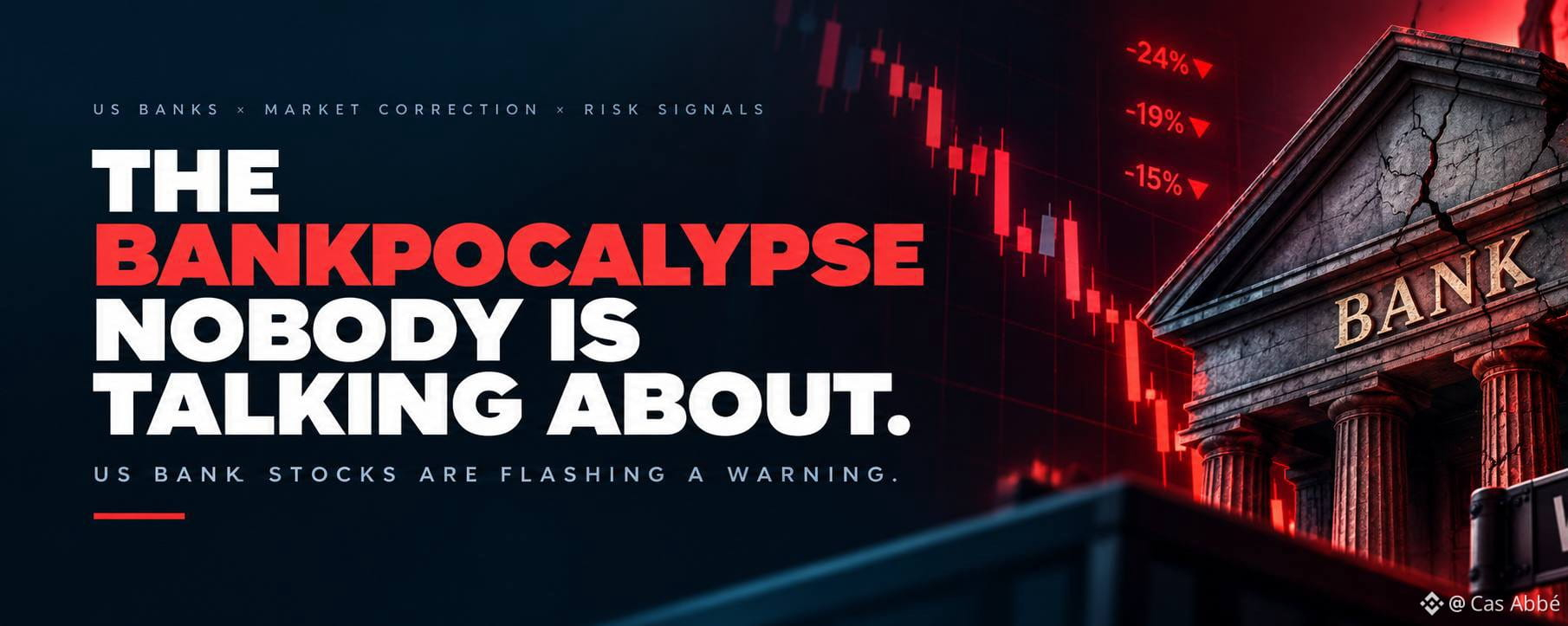


Everyone is watching Bitcoin, AI stocks, and the next big market rally. But I think there is another part of the financial market that deserves serious attention right now: American banks are struggling to convince investors that everything is fine.
And the numbers are getting difficult to ignore.
Goldman Sachs and Capital One are reportedly down around 24% to 25% from their highs, while Bank of America and Morgan Stanley have suffered declines approaching 19%.
These are substantial moves for some of the biggest names in American finance.
What makes this more interesting is that the weakness is not limited to one bank. Different institutions have different business models, yet pressure is spreading across the sector. That suggests investors are looking beyond individual earnings reports and questioning the environment these companies are operating in.
And here is the part I find particularly interesting: the broader stock market has been holding up far better than the banks.
That divergence matters. When investors lose confidence in one sector while the broader market remains relatively strong, I want to understand what the market might be pricing in before jumping to conclusions.
WHY ARE BANKS UNDER PRESSURE?
In my view, three major forces deserve attention.
First, interest rates and bond yields.
The Federal Reserve raised interest rates on September 16, its first increase in three years, and persistent inflation has kept pressure on the policy outlook. Higher rates can help banks earn more on certain loans, but they can also increase deposit and funding costs, put pressure on bond portfolios, and make borrowing more expensive for customers. The outcome depends on how quickly each bank’s income and costs adjust.
Second, Wall Street’s dealmaking business is losing some momentum.
Investment banking depends heavily on companies issuing shares, borrowing money, and completing mergers and acquisitions. When borrowing costs rise and uncertainty increases, companies may delay those decisions. Reuters reported that weaker dealmaking weighed on investment banking during the third quarter, while rising bond yields and uncertainty around AI added to investor concerns.
Third, the market is questioning whether the AI boom can keep delivering.
AI has created enormous opportunities for technology companies, but banks are exposed to the other side of that story, too. They finance businesses, provide capital-markets services, and depend on customers maintaining healthy financial positions. If AI-related investment becomes more expensive to finance or expected returns disappoint, parts of the financial system could feel the impact.
There is another longer-term concern: AI agents could eventually change how customers manage money and interact with financial institutions. That is not an immediate threat to every bank, but investors are beginning to consider how technology could reshape traditional banking economics.
BUT IS THIS REALLY ANOTHER 2008?
This is where I would be careful.
A falling bank stock price does not automatically mean a bank is insolvent, and a correction in banking shares is not the same thing as a financial crisis.
In fact, recent third-quarter results offer a more complicated picture. Reuters reported on October 16 that several regional banks, including PNC Financial and US Bancorp, continued to see strong loan demand. PNC reported 14.2% loan growth, suggesting that parts of the banking system are still experiencing meaningful business activity.
That is an important counterpoint.
The current sell-off may reflect concerns about profitability, funding costs, bond yields, and future economic conditions rather than evidence of widespread bank failures.
For me, the key question is not whether bank stocks are falling. It is whether the weakness in their share prices eventually shows up in the underlying businesses.
I would be watching loan delinquencies, credit-loss provisions, deposit stability, funding costs, and lending standards.
If those indicators deteriorate together, the situation becomes more concerning. If earnings and credit quality remain resilient, the market may be pricing in more pessimism than the fundamentals justify.
WHY I’M WATCHING THIS AS A CRYPTO INVESTOR
This is where the story gets particularly relevant to me.
Crypto does not operate in isolation. It sits inside a financial environment shaped by liquidity, interest rates, investor confidence, and access to capital.
If pressure on banks spreads into tighter lending and weaker economic activity, risk assets could face another challenge. Bitcoin and altcoins might struggle if investors reduce exposure to volatile assets and liquidity becomes harder to access.
But I would not automatically turn this into a bearish Bitcoin prediction.
If financial stress eventually leads to expectations of easier monetary policy, some investors could start looking toward scarce assets such as Bitcoin. However, that outcome is not guaranteed. In an initial risk-off move, crypto can fall alongside stocks as investors sell assets to raise cash.
The sequence matters. First comes the market reaction. Then comes the policy response, if one is needed.
That is why I would rather watch the evidence than assume a banking sell-off must be bullish or bearish for crypto.
MY TAKE: THE WARNING IS REAL, BUT THE CONCLUSION ISN’T SETTLED
What catches my attention is not the dramatic word Bankpocalypse. It is the possibility that investors are reassessing the cost of money, the sustainability of AI-related investment, and the earnings outlook for traditional financial institutions at the same time.
A roughly 13% decline in the KBW Bank Index, combined with a six-week losing streak, is significant enough to monitor. But the evidence does not yet justify treating it as proof that another 2008-style crisis is unfolding.
My next move would be to watch how banks perform after earnings, whether credit quality begins to weaken, and whether rising yields continue to pressure the sector.
Because markets rarely send just one signal. Sometimes the most useful clue is the divergence between what investors are celebrating and what they are quietly selling.
The question I want answered is simple: are investors overreacting to pressure on bank earnings, or are bank stocks warning us about a broader problem that the rest of the market has not fully priced in yet?
That is the part I will be watching.