


#GlobalMarkets 🌍 #PositiveMindsGlobalResults | Binance Square Official | October 17, 2026
📊 Executive Summary: Inflation, Oil and AI Concerns Shake Investor Confidence
Global financial markets are entering the weekend under pressure as accelerating US inflation, escalating geopolitical tensions, surging crude oil prices and concerns about artificial intelligence (AI) investment profitability converge.
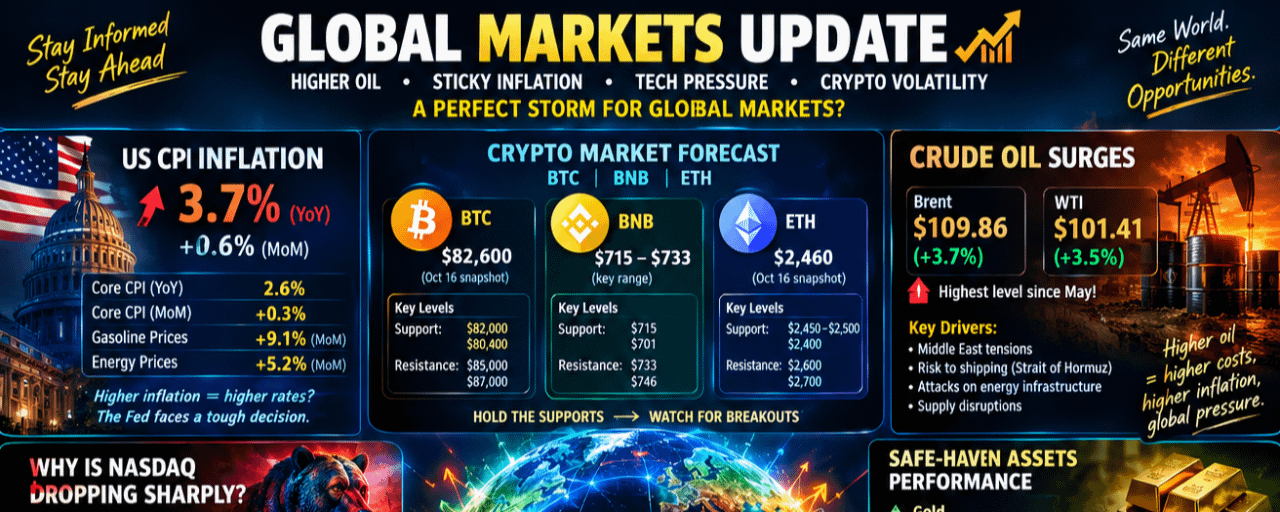
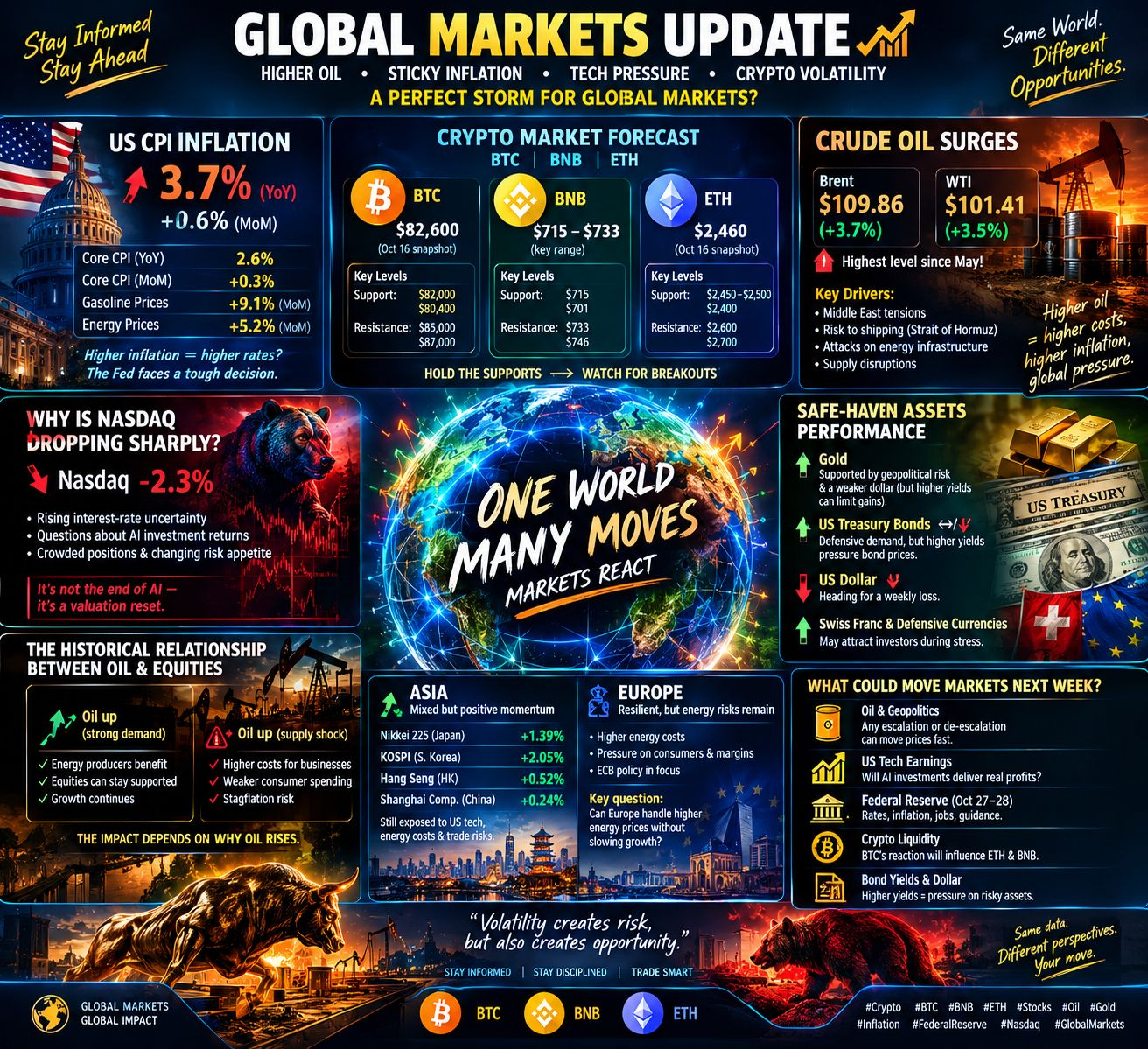
On Friday, October 16, Brent crude surged 3.7% to settle at $109.86 per barrel, briefly exceeding $110 for the first time since May. US West Texas Intermediate (WTI) crude climbed 3.5% to $101.41. Meanwhile, the Nasdaq Composite fell approximately 2.3%, the S&P 500 declined 1.3%, and the Dow Jones Industrial Average lost 0.57%, according to Reuters' global market report.
The latest US Consumer Price Index (CPI) report added to investor anxiety. Annual headline inflation accelerated to 3.7% in September from 3.4% in August, while monthly inflation increased 0.6%.
These developments are raising concerns about interest rates, corporate profitability, economic growth and the outlook for Bitcoin, Ethereum and BNB.
The central question for investors is whether this represents a temporary market correction or the beginning of a more prolonged repricing of financial assets.
🔥 1. US Inflation Accelerates: Is the Federal Reserve Facing Another Challenge?
The latest inflation report, released by the US Bureau of Labor Statistics on October 14, delivered an unwelcome signal to financial markets.
Key September figures:
Headline CPI: 3.7% year over year, compared with 3.4% in August.
Monthly CPI: +0.6%, following a 0.4% increase in August.
Core CPI: 2.6% year over year.
Monthly core CPI: +0.3%.
Gasoline prices: +9.1% month over month.
Overall energy prices: +5.2% month over month.
Gasoline alone accounted for more than half of September's monthly increase in headline consumer prices.
Why does this matter for financial markets?
Higher inflation complicates the Federal Reserve's decisions. If energy costs remain elevated and inflation spreads into other categories, policymakers may have less room to lower interest rates.
Markets must therefore assess two competing risks: maintaining restrictive monetary policy could slow economic growth, while easing policy too soon could allow inflation to become more persistent.
Higher borrowing costs can also reduce the present value of future corporate earnings, putting pressure on growth stocks, technology companies and other assets whose valuations depend heavily on future profitability.
For cryptocurrency investors, the implications are equally important. If investors expect interest rates to remain higher for longer, demand for speculative assets may weaken. Conversely, falling yields and improving liquidity could support a recovery.
However, inflation does not automatically mean that every asset must decline. Market reactions depend on expectations, positioning, earnings, liquidity and how central-bank guidance evolves.
📉 2. Why Is the Nasdaq Under Pressure?
Technology stocks have become a major focus of the current market sell-off.
The Nasdaq Composite fell approximately 2.3% on Friday, while the broader S&P 500 and Dow Jones also closed lower. Technology and communication-services shares led the decline.
Three major forces are contributing to the pressure.
First: Rising interest-rate uncertainty.
Accelerating inflation has revived concerns that the Federal Reserve could maintain restrictive policy or consider further tightening. Higher discount rates generally put pressure on highly valued growth companies.
Second: Questions about AI investment returns.
The AI industry continues to attract enormous investment in data centres, advanced chips, electricity infrastructure and cloud computing. Nevertheless, investors increasingly want evidence that these expenditures can translate into sustainable revenue, cash flow and profits.
Companies that rely heavily on borrowing to finance infrastructure may face additional pressure when financing costs rise.
Third: Crowded positions and changing risk appetite.
When investors begin reducing exposure to expensive technology shares, selling can spread across semiconductor companies, AI infrastructure providers and other growth-sensitive sectors. Leveraged positions may amplify these moves.
Reuters reported that CoreWeave shares fell sharply amid growing investor concerns about AI financing, while semiconductor stocks experienced an extended losing streak.
The key distinction is that investors are not necessarily abandoning AI technology itself. Instead, they are reassessing valuations, funding requirements, profitability timelines and the price they are willing to pay for future growth.
🛢️ 3. Crude Oil Surges Above $110: Geopolitical Risk Returns to the Forefront
Oil has emerged as one of the most important drivers of the current market environment.
On October 16:
Brent crude settled at $109.86 per barrel, up approximately 3.7%.
WTI crude settled at $101.41 per barrel, up approximately 3.5%.
Brent briefly crossed $110, reaching its highest level since May.
The rally reflects concerns about disruptions to global energy supplies amid escalating tensions in the Middle East, risks to shipping through the Strait of Hormuz and attacks affecting Russian energy infrastructure.
Reports of threats to Saudi energy facilities and damage to Russian refining capacity have added to uncertainty about how much oil and refined fuel can reliably reach international markets.
Although strategic-reserve releases and efforts to redirect supply may help cushion disruptions, their effectiveness depends on the scale and duration of any interruption.
Why rising oil prices can become a global economic problem
Higher oil prices affect far more than energy producers.
They can increase:
Transportation, shipping and aviation expenses.
Manufacturing and electricity costs.
Fertiliser and food-distribution expenses.
Household fuel bills and commuting costs.
Operating expenses for businesses across multiple industries.
Companies may respond by raising prices, reducing margins, postponing investment or cutting costs. Consumers facing higher fuel expenses may have less money available for other purchases.
This creates a difficult combination: inflation can remain elevated even as economic growth weakens.
For markets, the crucial question is whether the current oil rally reflects a temporary geopolitical risk premium or a prolonged supply shock.
If shipping flows normalise and tensions ease, crude prices could retreat. If disruptions intensify or persist, oil could remain elevated, increasing inflationary pressure and uncertainty across global markets.
🪙 4. Bitcoin Forecast: Can BTC Defend the $80,000 Region?
Bitcoin remains sensitive to global liquidity, investor risk appetite, institutional demand and expectations for US monetary policy.
An October 16 price snapshot placed BTC around $82,600, although cryptocurrency prices fluctuate continuously across exchanges.
Important technical reference levels
Initial support: around $82,000.
Further support: around $80,400.
Resistance: $85,000.
Higher recovery zone: $87,000.
Bullish scenario: If Bitcoin holds above the $82,000 region and buyers return, it could attempt to reclaim $85,000. A sustained breakout above that level would improve the short-term technical picture.
Neutral scenario: BTC may consolidate around $80,400–$85,000 as traders balance dip-buying against macroeconomic uncertainty.
Bearish scenario: A confirmed break below $80,400 could increase downside risk, particularly if equity markets weaken again, the dollar strengthens or leveraged positions are liquidated.
These levels are reference zones rather than verified live support and resistance. They should be checked against current exchange prices and trading volume.
Bitcoin's longer-term outlook also depends on spot-market demand, institutional flows, regulatory developments and broader liquidity conditions.
A temporary price recovery should not automatically be interpreted as a confirmed trend reversal.
🔶 5. BNB Forecast: Support Levels and Recovery Potential
BNB remains an important asset within the BNB Chain ecosystem, where its uses include transaction fees, staking-related functions and participation in network applications.
Its short-term price direction, however, remains exposed to broader cryptocurrency sentiment and market liquidity.
Technical levels to monitor
Initial support: around $715.
Lower support: around $701.
Initial resistance: around $733.
Higher resistance: around $746.
These are technical reference levels from the recent market discussion, not independently verified live prices.
Bullish scenario: Holding the $715 area could support a rebound toward $733 and potentially $746 if buying pressure strengthens.
Neutral scenario: BNB could consolidate between approximately $715 and $733 while traders wait for clearer signals from Bitcoin and global markets.
Bearish scenario: A sustained break below $701 would weaken the short-term outlook and could expose BNB to additional selling.
Beyond price action, investors should monitor BNB Chain network activity, ecosystem development, token-related supply changes and broader demand for blockchain applications.
Strong network activity can support the ecosystem's long-term relevance, but it does not guarantee that the token price will rise during a broad market correction.
♦️ 6. Ethereum Forecast: Can ETH Reclaim $2,600?
Ethereum is facing the same macroeconomic uncertainty as Bitcoin, alongside its own ecosystem-specific drivers.
These include network activity, staking demand, decentralised-finance usage, scaling developments and institutional interest.
An October 16 market snapshot placed ETH near $2,460.
Key technical reference levels
Initial support: $2,450–$2,500.
Further downside reference: $2,400.
Initial resistance: $2,600.
Higher recovery zone: $2,700.
Bullish scenario: If ETH maintains support and buying volume improves, a move toward $2,600 could signal a recovery attempt. A sustained breakout could bring $2,700 into focus.
Neutral scenario: ETH may remain range-bound around $2,450–$2,600 while investors await clearer macroeconomic signals.
Bearish scenario: A decisive move below $2,450 would weaken the setup and could increase the likelihood of a test of $2,400.
Ethereum can sometimes experience larger percentage moves than Bitcoin because of differences in liquidity, positioning and risk appetite. However, relative performance varies over time and should not be assumed in advance.
For ETH, the most important confirmation signals are sustained spot demand, improving market breadth and a convincing recovery through resistance.
🏆 7. Safe-Haven Assets: Gold, Government Bonds and the US Dollar
The current environment is producing mixed signals across traditional defensive assets.
Gold: Geopolitical uncertainty and concerns about financial-market stability can support gold demand. A weaker dollar can provide additional support. However, higher real interest rates can make non-yielding gold less attractive.
US Treasury bonds: Government debt can attract defensive demand during equity sell-offs. Yet hotter inflation may push yields higher, reducing the market value of existing fixed-rate bonds. Bond prices and yields move in opposite directions.
US dollar: The dollar often benefits from risk aversion, but its performance also depends on relative interest rates and expectations for Federal Reserve policy. Reuters reported that the dollar was heading toward a weekly loss on Friday despite broader market uncertainty.
Swiss franc and other defensive currencies: These may attract investors during periods of geopolitical or financial stress, although currency movements depend on central-bank policies and local economic conditions.
The important lesson is that safe-haven assets do not always rise together. When markets fear both geopolitical escalation and persistent inflation, investors can face conflicting signals across gold, currencies and government bonds.
🌏 8. Asian Markets: A Regional Recovery, but Risks Remain
Asian equity markets delivered a mixed regional picture during the latest completed sessions.
Friday's reported closing figures included gains in several major markets:
Nikkei 225, Japan: approximately +1.39%.
KOSPI, South Korea: approximately +2.05%.
Hang Seng, Hong Kong: approximately +0.52%.
Shanghai Composite, China: approximately +0.24%.
These gains indicated some recovery after pressure on technology and semiconductor shares.
However, a single positive session does not prove that the broader correction has ended. Asian markets remain exposed to US technology valuations, energy-import costs, currency fluctuations and global trade conditions.
South Korea and Taiwan are particularly sensitive to semiconductor demand and technology-sector sentiment. Japan's market is influenced by the yen, corporate earnings and global trade, while China's outlook also depends on domestic demand, property-sector conditions and policy support.
Indonesia experienced exceptional market pressure amid concerns surrounding a potential MSCI market-classification change, illustrating that country-specific developments can outweigh broader regional trends.
For the next Asian session, investors will be watching oil prices, US futures, semiconductor performance and developments in the Middle East.
🇪🇺 9. European Markets: Energy Risks and Growth Concerns
European equities displayed greater resilience than some US technology benchmarks during portions of Friday's trading, although performance varied across indices.
Europe faces a complicated combination of risks.
Higher crude prices can raise transportation and industrial costs, while expensive energy can place pressure on household purchasing power and corporate margins.
At the same time, energy producers may benefit from stronger commodity prices, and some defensive sectors can outperform during periods of uncertainty.
The European Central Bank's policy outlook is also important. If energy-driven inflation persists, policymakers may have less flexibility to ease monetary conditions. If economic growth weakens significantly, however, the case for policy support could strengthen.
For investors, the key question is whether higher energy costs remain manageable or become a broader shock to European economic activity.
Because October 17 is Saturday, the latest European equity figures refer to completed trading sessions rather than live Saturday market prices.
📉 10. The Historical Relationship Between Oil Prices and Equities
History suggests that the impact of rising oil prices depends heavily on why prices are increasing.
When oil rises because global demand is strengthening, energy producers may benefit while broader equities can remain supported by economic growth.
When oil rises because supply is threatened, the implications can be more negative. Businesses face higher costs even if demand is not improving, while households lose purchasing power.
This second scenario can create stagflationary pressure: higher inflation combined with weaker economic growth.
The current environment deserves close attention because energy-price pressure is occurring alongside sticky US inflation, uncertainty over interest rates and concerns about the returns on AI infrastructure spending.
Energy producers may outperform, but airlines, logistics companies, manufacturers and consumer-facing businesses can face increasing pressure.
For investors, the most important variables are the duration of the oil shock, the extent to which businesses pass costs to consumers, and the response from central banks.
📅 11. What Could Move Markets Next Week?
Several developments could determine whether markets stabilise or extend their losses.
Oil and geopolitical developments: Any escalation affecting energy infrastructure or shipping routes could increase the risk premium in crude prices. Credible de-escalation could have the opposite effect.
US technology earnings: Investors will be watching major technology-company results and guidance for evidence that AI investment is translating into sustainable profits and cash flow.
Federal Reserve expectations: The October 27–28 policy meeting is a key event to monitor. Inflation, employment, financial conditions and policymakers' guidance will shape expectations for interest rates.
Bitcoin and crypto liquidity: BTC's reaction to the reopening of traditional markets may influence the direction of ETH and BNB. Spot-market demand, exchange liquidity and leverage will be important indicators.
Government bond yields and the dollar: A renewed rise in yields could put pressure on high-valuation equities and speculative assets. Falling yields could provide relief, although the reason for the decline matters.
🔎 Final Market Outlook: A Critical Test for Investors
Global markets are facing a difficult combination of higher energy costs, persistent inflation, geopolitical uncertainty and questions about the sustainability of expensive AI investments.
The recent equity sell-off highlights how quickly investor sentiment can change when several risks converge. Meanwhile, the surge in crude oil prices adds another layer of uncertainty for central banks and businesses.
For cryptocurrency markets, Bitcoin's ability to defend the $80,000 region, Ethereum's reaction around $2,450–$2,500 and BNB's behaviour near $701–$715 are useful reference points for the coming sessions.
Nevertheless, price levels alone cannot determine the direction of the market. Confirmation from trading volume, spot demand, liquidity, bond yields and geopolitical developments will be essential.
The coming week could bring either stabilisation or another round of volatility. Investors should avoid assuming that one rebound signals a lasting recovery—or that one sharp decline guarantees further losses.
What is your view?
Will Bitcoin hold above $80,000 and lead a crypto recovery, or will rising oil prices, persistent US inflation and renewed pressure on technology stocks push BTC, ETH and BNB lower?
Share your analysis and the market levels you are watching.
Disclaimer: This article is for informational and educational purposes only and does not constitute financial or investment advice. Cryptocurrency and financial markets are volatile. Price levels are indicative technical reference zones, not guaranteed forecasts or verified live quotes. Always conduct your own research (DYOR), verify current market data and assess your risk tolerance before making investment decisions.
🌍 #PositiveMindsGlobalResults #ThinkPositiveGlobal #BinanceSquare #CryptoMarket #Bitcoin #BTC #BNB #Ethereum #ETH #USInflation #CPI #FederalReserve #Nasdaq #CrudeOil #Gold #GlobalMarkets #StockMarket #MarketOutlook #AIStocks #RiskManagement