

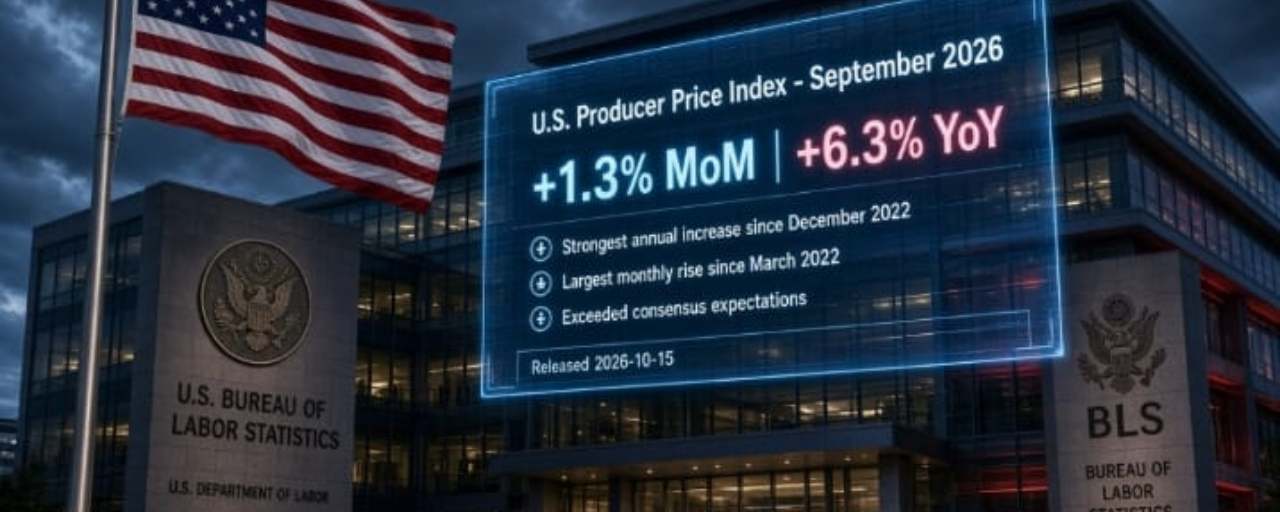

U.S. September PPI rises to 6.3% YoY
U.S. producer-price inflation accelerated sharply in September. The Producer Price Index for final demand rose +1.3% month over month and +6.3% year over year, according to data released on 2026-10-15. The annual increase was the strongest since December 2022, while the monthly rise was the largest since March 2022. The result exceeded consensus expectations and arrived immediately after a hotter-than-expected September CPI release. Public news sources and U.S. Bureau of Labor Statistics data confirm the headline figures.
Key statistical breakdown
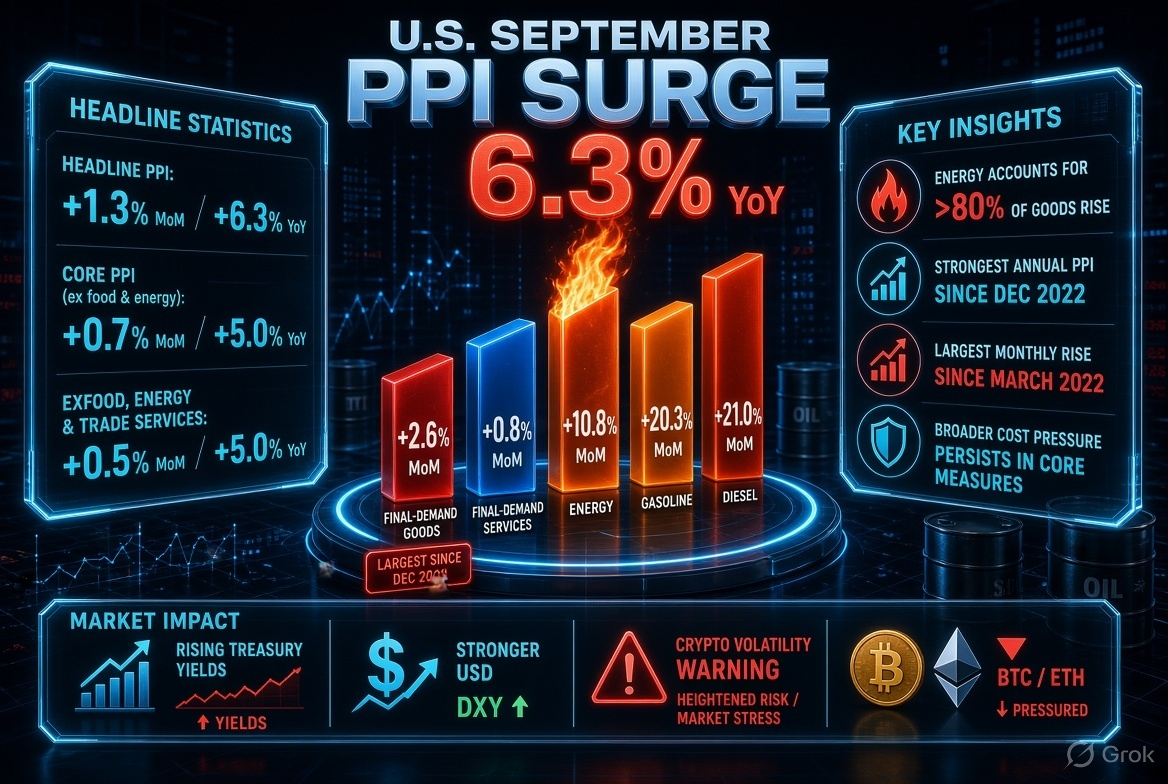
Headline PPI: +1.3% MoM; +6.3% YoY
Core PPI, excluding food and energy: +0.7% MoM; +5.0% YoY
Underlying measure excluding food, energy, and trade services: +0.5% MoM; +5.0% YoY
Final-demand goods: +2.6% MoM, the largest monthly increase in the available series since December 2009.
Final-demand services: +0.8% MoM.
Energy: +10.8% MoM, accounting for more than 80% of the increase in final-demand goods; producer-level gasoline rose +20.3% and diesel rose +21.0% during the month. (benzinga.com)
Why the composition matters
The energy shock explains a substantial part of September’s headline surge, which matters because energy-led inflation can reverse if fuel prices cool. However, the core figures make this release harder to dismiss as only an oil-price event: core PPI rose +0.7% on the month and the narrower ex-food, energy, and trade-services measure still increased +0.5%. That points to broader cost pressure across supply chains, transportation, warehousing, and trade-related services.
Market impact: macro transmission to crypto
The near-term market mechanism is straightforward:
Hotter producer inflation → higher concern about consumer-inflation persistence → fewer or later policy-easing expectations → tighter financial conditions → reduced appetite for higher-volatility assets.
For BTC, ETH, and major altcoins, the initial sensitivity is typically through U.S. Treasury yields, the dollar, and leveraged positioning rather than through PPI itself. If investors reprice the outlook toward tighter policy for longer, liquidity-sensitive assets can face pressure. Conversely, if the market concludes that the rise was largely energy-specific and temporary, the reaction may fade.
The latest pre-generated crypto-market snapshot for 2026-10-15 showed BTC at +0.9%, ETH at +0.4%, and SOL at +2.0% over 24 hours before today’s session. That suggests crypto had been stabilizing ahead of the full reassessment of inflation risk, but it should not be read as proof that the PPI surprise has been fully absorbed.
Sentiment reflection
Macro sentiment: Cautious. A second consecutive hotter inflation release increases uncertainty around the pace of future policy easing.
Crypto sentiment: Mixed. Major assets had shown some stabilization, while selected altcoins outperformed, but a higher-rate narrative can make that breadth more fragile—especially where gains are driven by leverage or thinner liquidity.
Positioning risk: Elevated around upcoming U.S. macro releases and central-bank communication. Inflation data can trigger rapid repricing in derivatives funding, open interest, and liquidation flows, even without a change in crypto-specific fundamentals.
What to watch next
Energy prices: A sustained decline would support the view that September’s spike was concentrated and potentially temporary.
Core inflation and PCE Persistent strength in broader measures would matter more for policy expectations than one energy-heavy PPI print.
U.S. yields and the dollar: These are practical real-time gauges of whether markets are tightening financial conditions after the data.
Crypto derivatives conditions: Funding rates, open interest, and liquidation activity can show whether the macro shock is creating stress in leveraged positions.
ETF flows and spot demand: Continued inflows or outflows can indicate whether longer-horizon demand is offsetting macro-driven risk reduction.
Post-ready takeaway: September’s 6.3% YoY U.S. PPI is a material inflation surprise, not merely a headline number. Energy was the largest contributor, but elevated core and services readings raise the possibility of broader cost pressure. For crypto, the key question is not whether this single report determines direction, but whether subsequent inflation data and Federal Reserve communication keep financial conditions tighter for longer.
The above is market analysis and does not constitute investment advice.


#AustraliaProposesCryptoTransactionReportingLaw #SolanaAlpenglowUpgradeToActivateOnOct21 #RussiaToBanDirectCryptoP2PTradesFromJuly2027 #MSCIFinalizesRulesThatCouldExcludeStrategy