

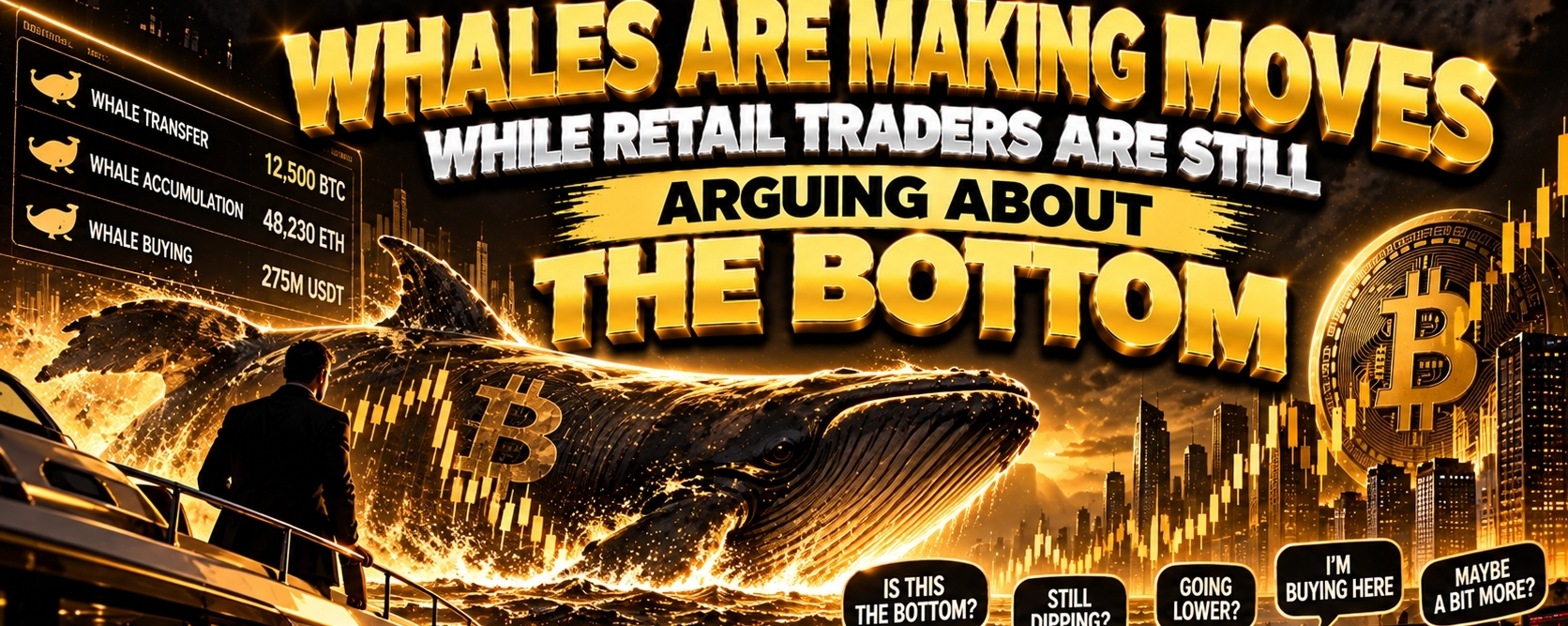


Everyone in crypto is trying to predict the next big move.
Some traders believe Bitcoin has already found its bottom. Others are convinced another massive crash is coming. Meanwhile, social media is full of arguments about support levels, price targets, and whether the bull market is officially over.
But here's the plot twist.
While retail traders are busy debating what happens next, large crypto holders are moving billions of dollars across the blockchain.
Bro, imagine spending three hours arguing about a Bitcoin candle while a whale quietly transfers thousands of BTC.
The real question isn't whether whales are moving money.
It's what those movements actually mean for the market.
Who Are These Crypto Whales Anyway?
In simple words, crypto whales are individuals or organizations holding large amounts of cryptocurrency.
They can include early Bitcoin investors, investment funds, exchanges, institutions, and other major holders.
Because their positions are so large, their transactions can attract attention across the market.
When a whale moves thousands of Bitcoin, blockchain tracking platforms can detect the transaction and share the information publicly.
Within minutes, crypto communities start reacting.
Some people call it bullish.
Others start predicting a crash.
But here's what many investors forget.
A large transaction doesn't automatically mean someone is buying or selling.
Sometimes whales are simply moving funds between wallets they already control.
And that's where the confusion begins.
Retail Traders Want the Perfect Bottom
Let's be real.
Everyone wants to buy Bitcoin at the lowest possible price.
Nobody wants to enter the market and immediately watch their investment fall another 20%.
So traders spend hours studying charts, drawing support zones, and predicting where the next major reversal might happen.
One person says Bitcoin will recover from its current level.
Another says the real bottom is much lower.
Then someone enters the conversation with a completely different prediction.
Bro, the comment section becomes a full-time battlefield.
But financial markets rarely make the perfect entry obvious.
A price that looks like a bottom today could become tomorrow's resistance.
And a market that appears weak can sometimes recover faster than expected.
That's why predicting exact turning points is extremely difficult, even for experienced traders.
Are Whales Actually Accumulating?
This is where things get interesting.
When large Bitcoin wallets increase their balances, analysts sometimes describe the activity as whale accumulation.
That can suggest certain large holders are increasing their exposure.
But the interpretation isn't always straightforward.
Some wallets belong to exchanges or custodians holding funds for thousands of customers.
Others might represent institutions moving assets between accounts.
A growing wallet balance doesn't necessarily mean one wealthy investor has suddenly become bullish.
And even genuine accumulation doesn't guarantee an immediate price increase.
Large investors can be wrong too.
That's why whale activity should be viewed as one piece of information rather than a guaranteed trading signal.
Whale Transfers Can Create Instant Market Panic
Imagine seeing this headline:
"A whale transfers $500 million worth of Bitcoin to an exchange."
Within seconds, traders start worrying about selling pressure.
Why?
Because transferring cryptocurrency to an exchange can sometimes indicate that a holder is preparing to trade or sell.
But here's the catch.
It could also involve custody management, collateral transfers, internal exchange operations, or other activities.
The blockchain shows that funds moved.
It doesn't always reveal why.
That's why treating every exchange inflow as an incoming crash can be misleading.
The same applies to large exchange outflows.
They might suggest movement into long-term storage, but they don't prove that someone plans to hold forever.
Context matters.
Whales Don't Have a Crystal Ball
Crypto communities sometimes act like whales know exactly what happens next.
If a large wallet buys, people immediately become bullish.
If a whale sells, everyone starts preparing for disaster.
But wealthy investors aren't immune to mistakes.
They can misjudge market conditions, face liquidity problems, or make decisions based on their own financial needs.
A transaction that looks strange to retail traders might have nothing to do with predicting Bitcoin's next move.
And large holders don't all follow the same strategy.
One institution might be increasing exposure while another is reducing risk.
Both transactions can happen on the same day.
So the idea that all whales are secretly following one perfect market plan is unrealistic.
The Market Is Bigger Than One Whale
Here's something worth remembering.
Bitcoin's price isn't controlled by a single wallet.
Its market reflects activity across exchanges, investment products, institutions, individual investors, and global trading platforms.
Large orders can influence prices, especially when liquidity is thin.
But broader factors also matter.
Interest rates, inflation expectations, economic uncertainty, regulatory developments, and investor sentiment can all affect cryptocurrency demand.
That's why even significant whale accumulation may not prevent a market decline.
And large whale selling doesn't automatically mean a rally is impossible.
The market is more complicated than one transaction alert.
Why Retail Traders Keep Getting Distracted
Let's talk about the psychological side.
Retail traders often focus heavily on short-term price movements because those changes are easy to see.
A sudden red candle creates fear.
A massive green candle creates excitement.
And a viral whale alert can make everyone feel like something important is about to happen.
But reacting to every notification can become exhausting.
Not every transaction deserves immediate attention.
Not every price movement signals a new trend.
And not every social media prediction is based on reliable evidence.
Sometimes the most useful information comes from understanding broader market conditions instead of constantly reacting to individual headlines.
Bro, the market doesn't need another argument about whether Bitcoin will move up or down in the next ten minutes.
It needs more people asking better questions.
On-Chain Data Is Useful, but It Has Limits
One of the most interesting things about cryptocurrency is that many blockchain transactions are publicly visible.
Analysts can study wallet balances, exchange flows, transaction volumes, and movements among different groups of holders.
This information can help explain how assets are circulating through the network.
But on-chain data isn't perfect.
Wallet ownership can be difficult to identify.
One organization might control multiple addresses.
And activity on centralized exchanges may not be fully visible through blockchain transactions alone.
That means analysts sometimes have to make assumptions when interpreting the data.
Those assumptions can be wrong.
So while on-chain analysis can provide valuable insights, it shouldn't be treated as a guaranteed way to predict prices.
The Biggest Whale Move Might Not Be the Loudest One
Here's the interesting part.
The transactions that attract the most attention aren't necessarily the ones that matter most.
A huge Bitcoin transfer might go viral simply because the dollar amount looks impressive.
Meanwhile, gradual changes in market liquidity, trading activity, or long-term holder behavior might receive far less attention.
But those broader developments can sometimes provide more useful context.
That's why looking beyond individual transactions matters.
Instead of asking whether one whale bought or sold, it can be more helpful to examine whether large-holder behavior is changing over time.
Are exchange balances increasing or decreasing?
Is demand strengthening?
Are trading volumes supporting price movements?
Are market conditions becoming more stable or more uncertain?
No single answer predicts the future.
But together, these questions can create a clearer picture of what's happening.
What If Retail Traders Are Watching the Wrong Signals?
Imagine spending an entire week trying to predict Bitcoin's exact bottom.
You follow every influencer, study every short-term chart, and react to every whale transaction.
But during that time, you barely look at the broader market.
You ignore changes in liquidity.
You overlook economic developments.
And you forget to question whether the information you're following is actually reliable.
That's a problem.
The crypto market contains far more information than anyone can process.
So the challenge isn't simply collecting more data.
It's learning which information is meaningful and which is just noise.
Because a thousand notifications won't automatically make someone a better investor.
Final Thoughts: Whales Are Moving, but Nobody Knows the Perfect Bottom
Crypto whales will continue transferring large amounts of Bitcoin and other cryptocurrencies.
Retail traders will continue debating support levels, market cycles, and future price targets.
And social media will probably continue turning every major wallet movement into a dramatic headline.
But here's the reality.
Large transactions don't guarantee a pump.
Exchange inflows don't guarantee a crash.
And whale accumulation doesn't mean the market has officially reached its bottom.
Even the biggest players operate in an uncertain environment.
The real advantage isn't pretending to know what whales are thinking.
It's understanding what blockchain data can reveal, recognizing its limitations, and avoiding emotional conclusions based on incomplete information.
Because in crypto, the loudest prediction isn't always the most accurate one.
And the biggest wallet isn't always the smartest investor.
So tell me, crypto fam.
Are whales genuinely positioning themselves for Bitcoin's next major move, or are retail traders giving too much importance to every large transaction?
And here's the bigger question.
Would you rather follow whale movements or trust your own market research?