

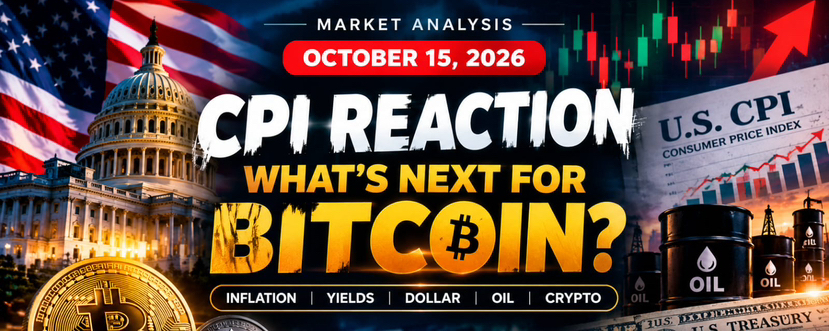

Hot CPI, Higher Yields: What Comes Next for Bitcoin?
The September U.S. inflation report has changed the macro conversation. Is Bitcoin facing another wave of selling pressure—or could volatility create a new opportunity?
The latest U.S. Consumer Price Index (CPI) report has delivered a clear message: inflation is not cooling as quickly as markets would like.
According to the U.S. Bureau of Labor Statistics, headline CPI rose 0.6% month over month and 3.7% year over year in September 2026, up from 3.4% annual inflation in August. Core CPI, which excludes food and energy, increased 0.3% monthly and 2.6% annually.
The headline annual rate exceeded the 3.6% consensus forecast reported by Reuters, while core inflation also came in above the 2.5% annual expectation. These figures have renewed concerns about the Federal Reserve’s future interest-rate decisions.
Sources: U.S. Bureau of Labor Statistics; Reuters, October 14, 2026.
1. The Inflation Signal: Why the Details Matter
Energy was a major contributor to the increase. The BLS reported that its gasoline price index rose 9.1% during September, while the overall energy index increased 5.2% over the month.
But the story is not limited to fuel. Core CPI rose 2.6% over the year, compared with 2.4% in August. That matters because persistent price pressures outside food and energy could complicate the path toward lower inflation.
For crypto investors, the key question is not simply whether inflation is high. It is whether inflation will remain strong enough to keep monetary policy restrictive for longer.
2. Treasury Yields and the U.S. Dollar: The Macro Connection
After the inflation release, Reuters reported that U.S. Treasury yields and the dollar strengthened as investors reassessed the interest-rate outlook.
Why should crypto traders care?
When Treasury yields rise, interest-bearing assets may become more attractive relative to riskier investments. A stronger dollar can also create headwinds for assets priced in dollars.
This does not automatically mean Bitcoin must fall. Crypto markets have their own drivers, including liquidity, institutional flows, positioning, leverage, and investor sentiment.
However, higher yields combined with persistent inflation can create a more challenging environment for speculative assets.
3. Bitcoin: Bearish Pressure or a Potential Recovery?
Bitcoin’s immediate response deserves attention. Cointelegraph reported that BTC fell below $82,000 after the hotter-than-expected inflation release on October 14.
That move highlights how sensitive crypto can be to unexpected macroeconomic data. But one price move does not establish the next trend.
The bearish scenario: If Treasury yields and the dollar continue rising, while Bitcoin struggles to recover important technical levels, selling pressure could persist. Traders should watch whether attempted rebounds attract sustained buying or quickly lose momentum.
The recovery scenario: If yields stabilize, the dollar loses momentum, and Bitcoin reclaims important levels with convincing trading volume, a recovery could develop despite the inflation surprise.
Neither scenario is guaranteed. Confirmation from price action and market conditions matters more than an emotional reaction to one headline.
4. What Should Traders Watch Next?
Rather than guessing the next candle, consider monitoring these four signals:
- Treasury yields: Do they continue rising, or begin to stabilize?
- The U.S. dollar: Does dollar strength persist after the initial reaction?
- Bitcoin price action: Can BTC recover important levels and hold them?
- Market liquidity and positioning: Are leveraged positions increasing the risk of sudden moves?
Also remember that CPI is only one inflation measure. The Federal Reserve considers a broader range of economic indicators when making policy decisions.
5. My Market Takeaway
The latest CPI report strengthens the case for caution, not blind bearishness.
Higher-than-expected inflation can challenge risk assets through interest-rate expectations, Treasury yields, and dollar strength. Yet markets can reverse when positioning changes or new information alters expectations.
For me, the key is to separate the macroeconomic signal from the trading decision. A bearish headline is not, by itself, a short signal—and a sudden Bitcoin rebound is not proof that the risk has disappeared.
Risk management, disciplined position sizing, and confirmation from the market remain essential.
Community Discussion
What is your outlook for Bitcoin after the hotter-than-expected U.S. CPI report?
A. Bearish — higher yields could pressure BTC further.
B. Neutral — the market needs more confirmation.
C. Bullish — the inflation shock may already be priced in.
Share your reasoning in the comments. Let’s discuss the data, not just the direction.
This article is for informational and educational purposes only. It is not financial advice or a guarantee of future market performance.

#CPIWatch #Bitcoin #CryptoMarket #USCPIWatch #Inflation #BinanceSquare