



Key Highlights
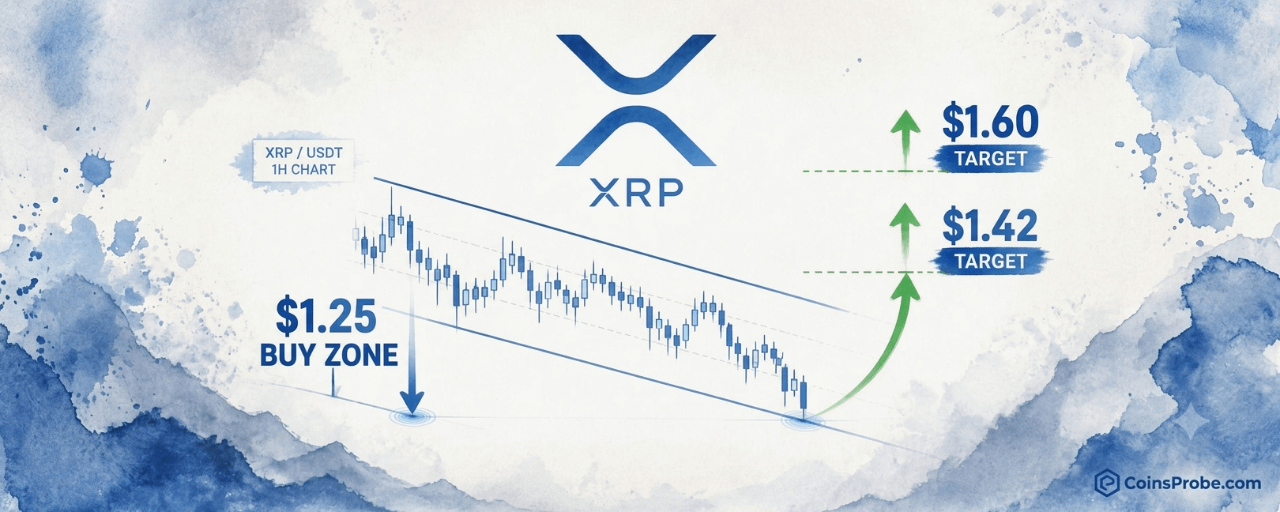
XRP is trading at $1.31 — down 4.83% in 24 hours — with a market cap of $82.4 billion
Analyst @alicharts identifies a paArallel channel on the hourly chart; lower boundary at $1.25 is the stated buy zone
A confirmed hold at $1.25 targets $1.42 (+13.6%) and $1.60 (+28%) per channel structure
XRP is trading at $1.31 — down 4.83% in the past 24 hours — with a market cap of approximately $82.4 billion. The decline has not broken the structure. According to technical analyst Ali Martinez (@alicharts), XRP is printing a parallel channel on the hourly chart, and the current move down may be the setup — not the breakdown.
Martinez flagged the pattern on October 15, 2026, noting that XRP could extend its decline toward the lower boundary of the channel at approximately $1.25 before any meaningful rebound materializes. That level — not the current price — is the one he is watching for a potential entry.
The Channel Structure — What It Shows
A parallel channel on the hourly chart is a well-defined price structure in which the asset oscillates between two parallel trendlines: an upper resistance line and a lower support line. Neither line is arbitrary — both are drawn from confirmed pivot highs and lows, giving them structural weight even on a short timeframe.
As Martinez identifies it, XRP is currently trading in the middle-to-lower portion of this channel. The lower boundary sits near $1.25 — approximately 4.6% below the current price of $1.31. That gap is modest, but meaningful: it represents the distance between current price and the zone where the channel’s support has historically absorbed selling pressure and generated reversals.
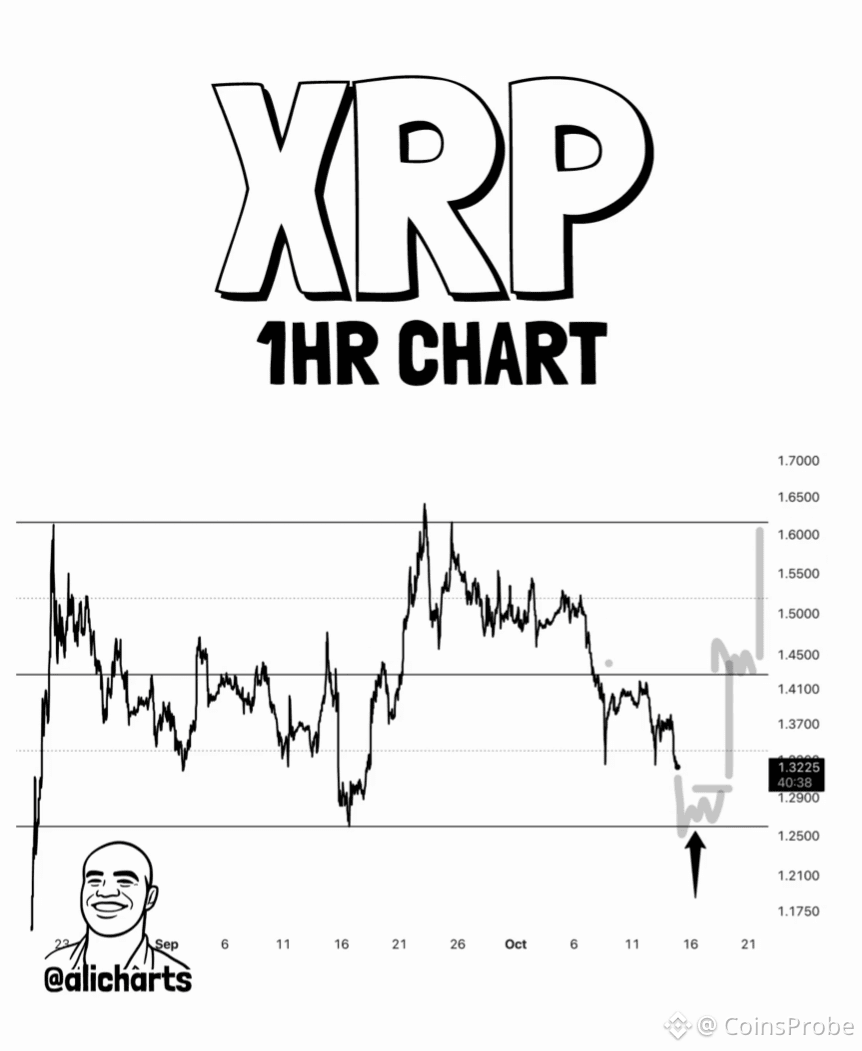
XRP 1H Chart | Source: @alicharts (X)
The mid-range target following a bounce from $1.25 is $1.42, with the upper channel boundary at $1.60 representing the full measured move if momentum follows through. From $1.25, that translates to a rebound of approximately 13.6% to $1.42, and 28% to $1.60.
Why $1.25 — And Not the Current Level
This is the critical nuance in Martinez’s read. XRP at $1.31 is not yet at the buy zone — it is approaching it. The analyst is not calling an immediate reversal from current levels. He is identifying a conditional setup: if XRP reaches $1.25, then the channel structure suggests a meaningful rebound becomes probable.
This distinction matters. Buying at $1.31 and expecting the channel to hold means accepting the risk of an additional 4.6% drawdown before the structure resolves. Buying at $1.25, by contrast, means entering directly at the technical support level where the channel’s lower trendline is expected to arrest the decline.
The macro context adds weight to the caution. Broader risk-off pressure has already been documented — the KOSPI’s 15% five-day crash and Nasdaq futures decline reflect the kind of environment where assets follow through to support rather than reversing early. That context alone argues for waiting on confirmation at $1.25 rather than front-running the signal.
The Rebound Targets — $1.42 and $1.60
Martinez’s analysis identifies two upside levels following a successful hold at $1.25. The first is $1.42 — the mid-channel zone and the nearest meaningful resistance inside the structure. The second is $1.60 — the upper channel boundary, representing the full range of the pattern.
These are not arbitrary levels. In parallel channel analysis, the mid-range acts as a natural equilibrium point where price frequently stalls or consolidates before either resuming the move or reversing. A bounce from $1.25 that stalls at $1.42 is still a clean 13.6% return. A bounce that reaches $1.60 is a 28% move from the lower boundary — structurally consistent with a channel of this width.
Level Role Distance from$1.25 $1.25 Lower channel boundary — buy zone — $1.42 Mid-channel target +13.6% $1.60 Upper channel boundary — full target +28.0%
For context on how altcoin channel structures have resolved in recent months, the STRK, MAGIC, and W analysis documented similar measured-move setups playing out across the altcoin space.
Bullish and Bearish Scenarios
Bullish Scenario — Hold at $1.25
XRP reaches the lower channel boundary at $1.25, finds buyers, and holds above that level on an hourly close. A confirmed bounce from that zone opens the initial target of $1.42 — a 13.6% move — followed by the upper boundary at $1.60 if momentum sustains. The channel structure remains intact throughout, and the setup resolves as Martinez outlined.
Bearish Scenario — Loss of $1.25
If XRP closes below $1.25 on the hourly chart with sustained selling pressure, the parallel channel breaks down. A breakdown of this structure invalidates the rebound thesis and removes the defined support level. In that scenario, the next meaningful technical reference would need to be re-established from scratch — and the $1.42–$1.60 targets become irrelevant until a new structure forms.
It is worth noting that whale distribution pressure has been a consistent theme across major altcoins in this environment, which raises the odds of a full test of $1.25 before any reversal.
The Setup in Plain Terms
XRP is in a defined hourly parallel channel. It has not yet reached the buy zone. The analyst watching this structure — Ali Martinez (@alicharts) — is explicit: $1.25 is the level he is monitoring for a potential entry, not the current price. A drop from $1.31 to $1.25 is a 4.6% move that would complete the channel’s lower test. A subsequent rebound to $1.42 is 13.6% from that entry. A full channel target at $1.60 is 28%.
The channel is the framework. $1.25 is the trigger. Everything above it — $1.42 and $1.60 — depends entirely on whether that lower boundary holds when tested.
Watch $1.25 as the level that either confirms the rebound setup or invalidates the entire channel structure.
Disclaimer: The views and analysis presented in this article are for informational purposes only and reflect the author’s perspective, not financial advice. Technical patterns and indicators discussed are subject to market volatility and may or may not yield anticipated results. Investors are advised to exercise caution, conduct independent research, and make decisions aligned with their individual risk tolerance.