
Sometimes I feel like the financial market never really gets a chance to breathe.
There is always something happening. One day, everyone is talking about Bitcoin. The next day, it is AI tokens, some new crypto project, or another narrative that supposedly has the potential to change everything. Then the market turns red, people start talking about a crash, and suddenly all those confident predictions disappear.
A few weeks later, the same cycle starts again.
Honestly, after watching crypto go through so many ups and downs, I have become a little tired of the noise. Not because I have lost interest in the market, but because I have seen how quickly excitement can turn into disappointment. Projects that once looked unstoppable have faded away. Tokens that attracted huge communities have struggled to find real demand. And people who sounded absolutely certain about the future have quietly moved on to their next big idea.
That is just how this market works sometimes.
But one thing I have learned is that crypto does not exist in its own little world. No matter how much people want to believe that Bitcoin and digital assets operate independently of everything else, the wider economy still matters. Interest rates matter. Inflation matters. Liquidity matters. And sometimes, something as ordinary as the price of oil can become more important to the market than the latest crypto narrative.
That is why I am paying attention to September's US Consumer Price Index report.
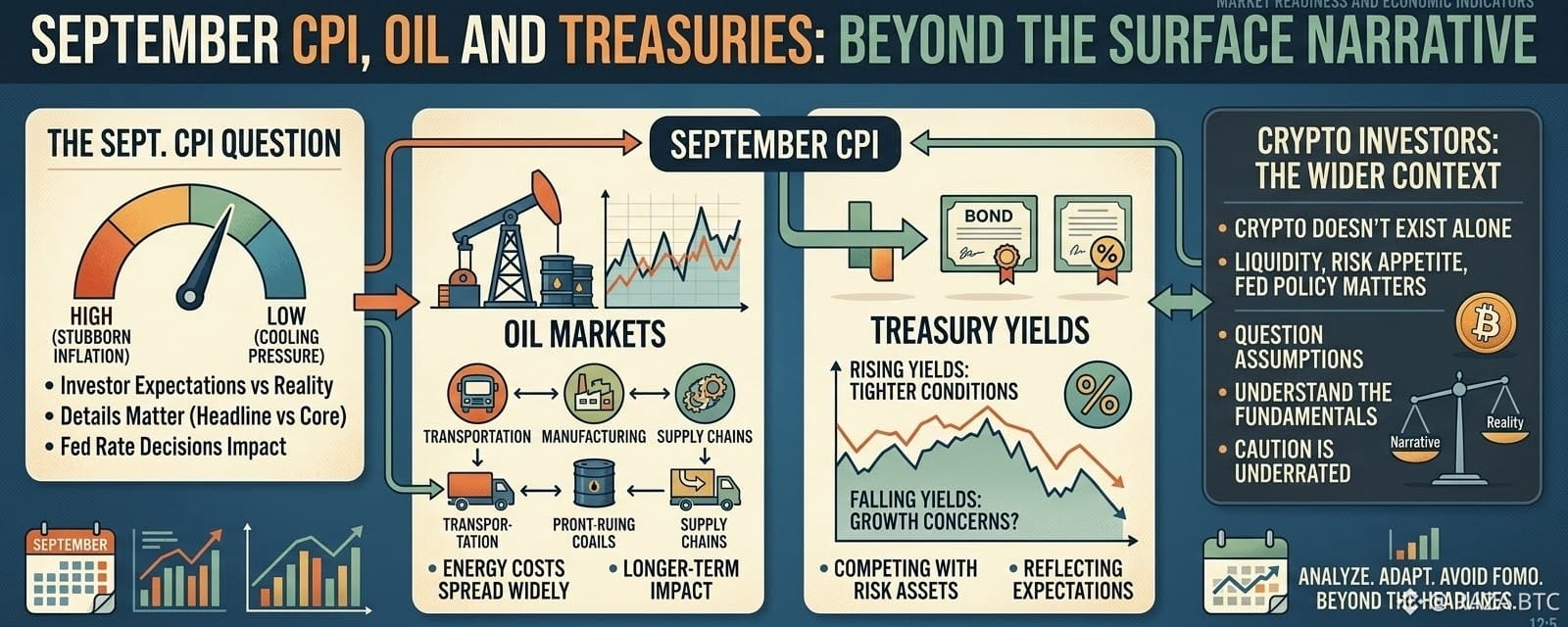
Not because I expect one economic release to tell us exactly where everything is heading, but because the relationship between inflation, oil prices, and Treasury yields is becoming increasingly difficult to ignore.
The question is simple enough: could September CPI shake the oil and Treasury markets?
The answer is that it could, but I think the more interesting story is what investors are expecting from the report and how much of that expectation is already reflected in market prices.
Because, let’s be real, financial markets rarely make things easy.
You can spend days studying the economic outlook, read every available forecast, and convince yourself that you understand what should happen next. Then the numbers come out, the market moves in the opposite direction, and everyone suddenly has a different explanation.
I have seen that happen too many times to treat any economic report as a guaranteed opportunity.
Still, this one deserves attention.
Inflation has a way of affecting almost everything, even when people are not actively thinking about it. When the cost of fuel rises, transportation becomes more expensive. Businesses have to spend more to move products. Some companies absorb those costs for a while, while others eventually pass them on to customers.
And ordinary people feel the pressure in ways that rarely show up in a market headline.
You do not need to be a professional economist to understand the problem. When everyday expenses keep increasing, people have less room to spend elsewhere. Businesses become more careful with their budgets. Borrowing becomes harder to justify when financing costs are already high.
It is not complicated in principle, even if the details can be difficult to measure.
That is one reason oil prices deserve more attention than they sometimes receive.
Oil is not just another commodity that traders buy and sell. It is connected to transportation, manufacturing, agriculture, shipping, and countless other activities that keep the economy moving. When energy costs rise sharply, the effects can spread far beyond the fuel market.
Of course, higher oil prices do not automatically mean that inflation will continue rising. Other prices can move in different directions, and the impact of energy costs depends on how long they remain elevated. Businesses may absorb some increases, consumers may adjust their spending, and supply conditions may improve.
But if energy prices stay high for an extended period, it becomes harder to dismiss them as a temporary problem.
That is where the September CPI report becomes interesting.
Investors will want to know whether inflation is cooling as expected or whether rising costs are making the situation more complicated. They will also be looking at the details rather than just the headline number.
A lower inflation reading could offer some relief. A higher reading could bring back concerns that price pressures are proving more stubborn than expected.
But neither result would tell the whole story.
I think that is something markets sometimes forget. We spend so much time waiting for one number that we start treating it like the final answer to a question that has been developing for months.
The economy does not work that way.
One report can change expectations, but it cannot explain every movement in energy prices, every shift in consumer spending, or every decision made by businesses across the country.
And it certainly cannot tell us exactly what the Federal Reserve will do next.
That brings me to Treasury yields, which I think deserve more attention from crypto investors than they usually get.
I understand why people prefer watching Bitcoin. It is easier to get excited about an asset moving sharply in a single day than it is to spend time studying government bond yields.
But those yields are part of the financial environment that influences how investors think about risk.
When Treasury yields rise, other investments have to compete with the returns available from government debt. Higher yields can also contribute to more expensive borrowing, depending on the type of loan or financing involved. That can create pressure for businesses, consumers, and speculative assets that depend heavily on favorable financial conditions.
When yields fall, the situation can look different.
Investors may start expecting easier monetary policy, or they may be responding to concerns about economic growth. Sometimes falling yields can support risk appetite. Other times, they reflect worries that the economy is losing momentum.
The reason behind the movement matters.
This is where I think the conversation becomes more complicated than the usual market commentary suggests.
People often see Treasury yields moving lower and immediately assume it is good news for crypto. If yields move higher, they assume risk assets are in trouble.
Sometimes those assumptions make sense. Sometimes they do not.
Markets are not controlled by one variable, and Bitcoin does not follow a perfectly predictable relationship with government bonds. Liquidity, investor positioning, leverage, institutional demand, and developments within crypto itself can all influence what happens next.
Still, ignoring Treasury yields completely would mean ignoring an important part of the bigger picture.
For me, the real question is whether the September CPI report changes expectations in a meaningful way.
If inflation comes in higher than anticipated, investors may become less confident that interest rates will fall as quickly as they hoped. That could put renewed pressure on Treasury yields and create an uncomfortable environment for some risk assets.
If inflation comes in softer than expected, investors might become more comfortable with the idea that monetary policy could eventually become less restrictive.
But even then, I would not rush to celebrate.
A softer inflation reading does not automatically mean the economy is suddenly healthy. It does not guarantee that oil prices will remain under control, and it does not mean every crypto asset is about to become more attractive.
Sometimes good news is simply good news. Sometimes it is already priced in. And sometimes the market finds a reason to sell anyway.
That last possibility is something crypto investors know particularly well.
We have watched Bitcoin rise on news that seemed insignificant and fall after developments that were supposed to be positive. We have watched entire communities convince themselves that a particular catalyst would finally push prices higher, only to see the excitement disappear within days.
After a while, you stop assuming that every headline needs an immediate reaction.
You start asking a different question: does this actually change anything, or is the market simply looking for its next reason to move?
I think that is the right mindset to bring into the September CPI discussion.
The numbers matter, but expectations matter too. If investors have already prepared for a hotter inflation reading, the reaction might be relatively limited. If the data surprises in a direction nobody was expecting, the movement could be more significant.
Even then, the initial reaction might not last.
Traders can react quickly to the headline before paying attention to the details. Investors can change their interpretation as they consider what the report means for interest rates, energy prices, and economic growth.
Sometimes the first move is not the move that ultimately matters.
That is why I find it difficult to trust anyone who speaks with complete certainty about what will happen immediately after an economic release.
Maybe they will be right. But being right about one report does not mean they understand every force affecting the market.
And being wrong once does not necessarily mean their entire analysis was useless.
The problem is that social media rewards confidence much more than honesty. A person who says they know exactly what will happen often attracts more attention than someone who explains three possible outcomes and admits that the evidence is incomplete.
Unfortunately, markets do not reward confidence on its own.
They reward being right, and even then, timing and risk management matter.
This is especially relevant for crypto because so much of the market still depends on expectations about the future.
Investors buy tokens because they believe adoption will increase, a product will improve, a network will attract users, or a new narrative will bring more capital into the sector.
Some of those expectations eventually become reality.
Others do not.
I have nothing against optimism. Without some willingness to look beyond the present, it would be difficult to recognize new opportunities. But there is a difference between believing something could work and assuming it must work simply because enough people are talking about it.
We have seen too many projects struggle to justify their valuations once the excitement faded.
A token can have an interesting idea behind it and still fail to attract consistent demand. A project can have an active online community without demonstrating that people genuinely need its product. A promising technology can exist for years without becoming commercially useful.
And a good project can still be a poor investment at the wrong price.
These are not particularly exciting observations, but they are worth remembering.
A better macroeconomic environment might help crypto. Easier financial conditions could encourage investors to take more risks, and stronger liquidity could benefit parts of the market.
But cheaper money cannot solve every problem.
It cannot guarantee that a token has a reason to exist. It cannot create real users where there is no meaningful demand. And it cannot turn a weak business model into a sustainable one just because investors suddenly feel more optimistic.
That is the part that worries me when people treat interest-rate expectations as the main explanation for everything happening in crypto.
The macro environment matters, but it is not an excuse to stop thinking about the assets themselves.
If Bitcoin benefits from a more favorable financial environment, that does not mean every small token will benefit equally. If investor confidence improves, capital may still concentrate in established assets rather than flowing into every speculative project.
And if conditions become more difficult, some projects will probably struggle more than others.
The differences between assets matter.
I think investors sometimes lose sight of that during a strong market because rising prices make almost every decision look intelligent. Projects attract attention, communities grow, and people begin assuming that the next phase will be even better than the last.
Then conditions change, and suddenly everyone remembers that risk was there all along.
That history is one reason I am interested in the September CPI report without wanting to make it bigger than it is.
I want to understand what it might tell us about inflation and financial conditions. I want to see how oil prices respond and whether Treasury yields confirm or challenge the market's existing expectations.
I also want to know whether any initial reaction continues after investors have had time to think about the details.
But I do not expect the report to provide a perfect answer.
Oil prices have their own influences. Treasury yields reflect several competing expectations. The Federal Reserve has to consider more than a single inflation reading. And crypto markets can move for reasons that have little to do with any of those things.
There is too much happening at once to reduce everything to a simple prediction.
Maybe that sounds cautious, but I think caution is underrated in a market where everyone is constantly encouraged to take a position.
There is always pressure to decide whether the next development is bullish or bearish. People want a clear opinion, preferably one they can act on immediately.
But sometimes the most honest answer is that the information is not sufficient to justify a strong conclusion.
That does not mean doing nothing forever. It means understanding what you know, recognizing what you do not know, and avoiding decisions based entirely on the fear of missing out.
I have learned that lesson the hard way, as have plenty of other people who have spent enough time in crypto.
You see a token moving higher, read a few convincing explanations, and begin wondering whether you are missing an opportunity. You start paying more attention to the upside than the risks. Before long, you are no longer asking whether the investment makes sense. You are asking whether you can get in before the next move.
It is a subtle change in thinking, but it can be expensive.
The same thing happens around major economic events. Investors start building expectations, looking for signals, and trying to position themselves ahead of everyone else.
Sometimes that works.
Sometimes the report arrives, the market moves unpredictably, and people who thought they had a clear advantage discover that they were relying on assumptions they never properly questioned.
There is nothing wrong with preparing for different outcomes. The problem is believing that preparation eliminates uncertainty.
It does not.
The September CPI report could influence oil prices, Treasury yields, and expectations about interest rates. It could change the way investors think about the broader economy, at least in the short term.
But it is still one report.
What happens afterward will depend on the details, the market's existing expectations, developments in energy markets, and the economic information that follows.
I would rather watch those developments than try to force a prediction out of every new headline.
And honestly, I think that approach makes sense beyond this particular report.
Crypto investors would benefit from spending less time searching for the one event that supposedly determines everything and more time understanding the conditions in which their investments operate.
That means paying attention to inflation and interest rates without assuming they explain every price movement. It means following new projects without automatically believing their promises. It means recognizing that a growing market can create opportunities while also encouraging people to take risks they do not fully understand.
Most importantly, it means remembering that uncertainty is not something that disappears just because the market becomes exciting again.
There will always be another narrative. There will always be another economic announcement. There will always be somebody claiming that the next move is obvious.
Maybe September CPI will produce a major reaction across oil and Treasuries. Maybe the numbers will be close enough to expectations that investors quickly move on. Maybe the immediate reaction will look important and become irrelevant a few days later.
I genuinely do not know which outcome will dominate.
What I do know is that oil, inflation, and Treasury yields are connected to the real economy in ways that deserve more than a quick glance. Their movements can influence the financial conditions surrounding crypto, but they cannot tell us whether every individual project is valuable or whether every token deserves investor attention.
Those questions still require independent judgment.
After watching enough cycles, I have become less interested in finding reasons to feel excited about the market and more interested in understanding what is actually happening.
That does not mean I expect everything to go wrong. It simply means I no longer believe that every promising development needs to become a big prediction.
Sometimes oil prices rise. Sometimes inflation surprises. Sometimes Treasury yields move in a direction that nobody expected. Markets react, investors reconsider their positions, and life goes on.
There is always another piece of information coming.
The challenge is learning how to respond without letting every new development control your thinking.
So, yes, I will be watching September CPI. I will be paying attention to oil, Treasury yields, and what the report might mean for expectations about interest rates.
But I will also remember that the market can surprise us, that the first reaction is not always the final one, and that a single economic release rarely tells the entire story.
No dramatic prediction. No pretending to know what happens next.
Just another reminder that investing is difficult, the economy is complicated, and confidence can become dangerous when it gets too far ahead of the evidence.
After everything crypto investors have experienced over the years, perhaps that is a lesson worth holding on to.
Not every headline is an opportunity. Not every dip is the beginning of a recovery. Not every rally confirms the story we wanted to believe.
Sometimes, the smartest thing you can do is pay attention, question your assumptions, and give reality enough time to show you what is actually changing.
Because the market will always have another story to sell.
Whether that story deserves your money is a different question entirely.