

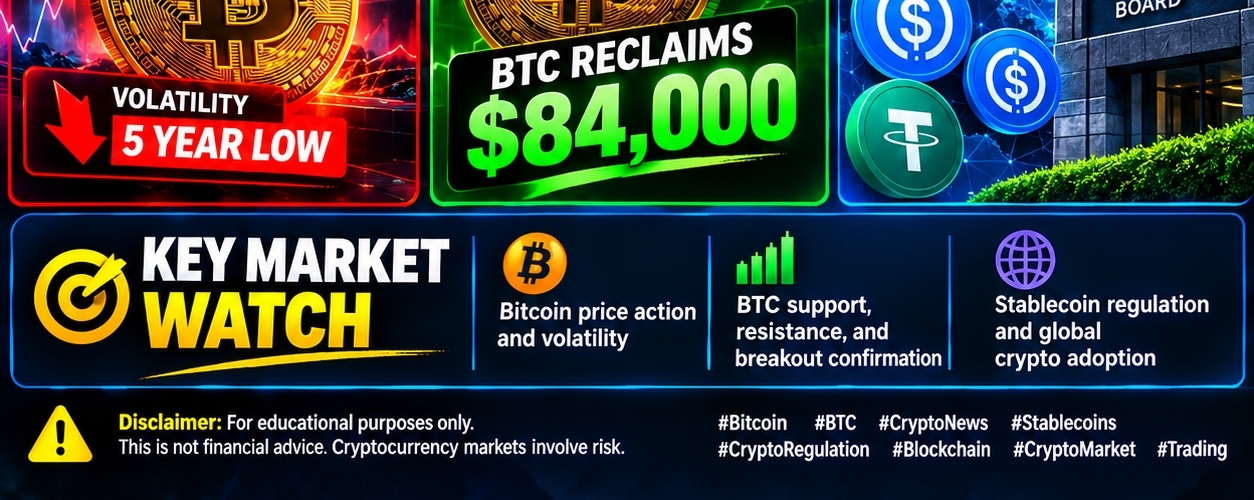

🚨 CRYPTO MARKET NEWS — LATEST TOPICS 📊🔥 ₿ 1. #BitcoinOptionsVolatilityHitsFiveYearLow Bitcoin options volatility has reportedly fallen to a five-year low. 📉 Is the market entering a period of calm, or could a major price move be approaching? Traders are watching closely for the next breakout. 🚀 2. #BitcoinReclaims$84K Bitcoin has reclaimed the $84,000 level, putting market momentum back in focus. 📈 Traders are watching key support and resistance levels to see whether BTC can sustain its recovery. 🌍 3. #FSBWarnsCrossBorderStablecoinRulesRemainUnderdeveloped The Financial Stability Board warns that rules governing cross-border stablecoin activities remain underdeveloped. ⚠️ Clearer international regulations could become increasingly important as stablecoins expand globally. 📊 KEY MARKET WATCH ₿ Bitcoin price action and volatility 📈 BTC support, resistance, and breakout confirmation 🌍 Stablecoin regulation and global crypto adoption ⚠️ Disclaimer: For educational purposes only. This is not financial advice. Cryptocurrency markets involve risk. #Bitcoin #BTC #CryptoNews #Stablecoins #CryptoRegulation #Blockchain #CryptoMarket #Trading
#BitcoinOptionsVolatilityHitsFiveYearLow Bitcoin options implied volatility has plummeted to a five-year low of 33.5%, signaling an unusual period of compressed pricing in the derivatives market. Despite recent downward pressure pushing Bitcoin down approximately 4% this month to the $83,400 range, the options market is currently pricing in much smaller future movements than the asset is actually delivering. [1, 2]
Simultaneously, the Financial Stability Board (FSB) has issued a stark warning to G20 finance ministers, noting that cross-border stablecoin regulations and crisis management frameworks remain underdeveloped. Led by Chair Andrew Bailey, the FSB's latest review reveals that only 11 out of 28 surveyed jurisdictions have finalized their stablecoin regulatory frameworks, raising concerns about systemic spillover risks into traditional finance during high-stress market runs. [1, 2]
Volatility Compression: #BitcoinReclaims$84K Calm Before the Storm?
Options front-month implied volatility (IV) sitting more than 4 points below actual realized volatility indicates that options are historically cheap. [1, 2]
The Smart Money Play: Institutional traders are capitalizing on this mispricing. Rather than expressing outright bearish panic, they are executing heavy downside protection. Data highlights over $204 million in block trades targeted at October put options with strike prices between $78,000 and $80,000. [1, 2, 3]
Macro Triggers to Watch: With the U.S. Dollar Index (DXY) testing an 18-month high and key U.S. CPI data looming, this tight volatility compression suggests a significant breakout or breakdown is brewing as macro headwinds intensify. [1, 2]
Regulatory Gaps: #The FSB Framework Exposure
The rapid globalization of stablecoins is outpacing unified international law, exposing dangerous blind spots. [1, 2]
The Multi-Issuer Threat: The FSB highlighted that stablecoins issued across multiple companies can trap reserves in one country while redemption demands spike in another. This severely fragments cross-border crisis responses. [1]
Systemic Spillover Risk: Because national rules remain entirely untested in a severe market crisis, a sudden run on a major stablecoin could trigger forced liquidations of traditional reserve assets (like U.S. Treasuries) and rapid commercial bank deposit withdrawals. [1, 2]
Call for Cooperation: Rather than proposing entirely new binding rules, the FSB is strongly urging the G20 to enforce deeper international information-sharing and consistent implementation of existing 2023 global regulatory frameworks. [1, 2]
If you want to track how these shifts impact trading conditions, let me know:
If you want a breakdown of technical support and resistance zones around $82,500 and $87,000. [1, 2]
How the U.S. GENIUS Act or Europe's MiCA rules intersect with these cross-border gaps. [1]
A deeper look into implied vs. realized volatility strategies for the current market environment. [1]