



#statecouncilcallsfornationalblockchainnetwork
China Orders National Blockchain Network in New 19-Measure Plan — Clear Separation from Crypto Remains
Key Facts (as of Oct 10–11, 2026)
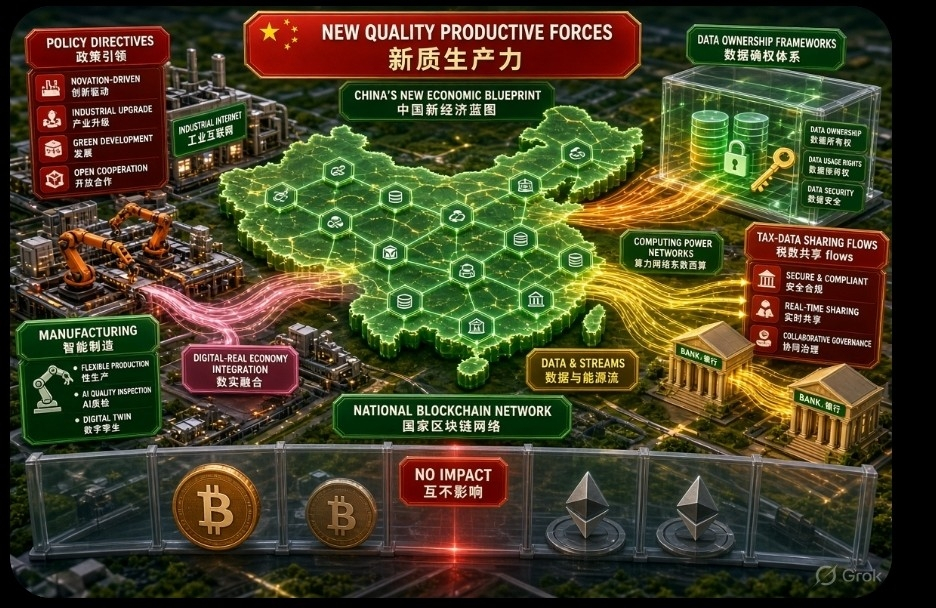
On October 9, 2026, the Communist Party of China Central Committee and the State Council jointly issued the “Opinions on Developing New Quality Productive Forces.” The document contains 19 measures across five areas and was published by Xinhua.
It explicitly calls for:
• Construction of a national blockchain network
• Construction of a nationwide integrated computing power network
• Optimization of national data infrastructure layout, construction, and operation
• Deep digital transformation of manufacturing
• Implementation of the “East Data, West Computing” project, intelligent manufacturing, and industrial internet innovation
Clearer frameworks for data property rights, market trading, rights allocation, and interest protection
• Pilot projects treating data as a core factor of production
• Building internationally competitive digital industry clusters
Context & Existing Infrastructure
The national blockchain network builds on the existing Blockchain-based Service Network (BSN), launched in April 2020. BSN is a permissioned, state-governed consortium network involving the State Information Center, China Mobile, China UnionPay, and technical partners. It supports identity verification, logistics tracking, trade/finance compliance, and related enterprise/government applications. It does not support public cryptocurrencies or tokens.
Crypto Impact Analysis
China continues its long-standing dual approach:
Promotes blockchain technology as state-controlled data infrastructure and industrial tool.
Maintains the 2021 ban classifying most cryptocurrency trading, mining, and related activities as illegal financial activities. Recent reaffirmations (including on stablecoins and tokenized assets) remain in force.
Direct impact on public cryptocurrencies (BTC, ETH, etc.): Negligible to none.
No authorization of permissionless chains, tokens, exchanges, or mining.
No merger with the digital yuan that opens public crypto markets.
No new domestic demand, institutional capital, or liquidity channel for decentralized assets.
Historical pattern: Similar Chinese blockchain infrastructure announcements have produced muted or zero sustained reaction in global crypto prices because they are deliberately insulated from open markets.
Secondary/Indirect Considerations
Accelerates enterprise and government adoption of permissioned DLT inside China and potentially via BSN-linked overseas deployments.
Strengthens regulated data-as-a-factor-of-production markets and cross-border data flow pilots under state rules.
Computing network focus is more about optimizing existing (sometimes underutilized) capacity than a pure new-build boom.
Document also warns against blind investment, industrial bubbles, and excessive competition.
Bottom Line for Traders & Markets
This is industrial policy and data-governance infrastructure, not a crypto catalyst. It reinforces rather than relaxes China’s separation between controlled blockchain technology and banned cryptocurrency assets. Public crypto price drivers remain global (macro liquidity, regulatory clarity elsewhere, adoption cycles). No evidence of material positive spillover into BTC, ETH, or altcoin demand from this directive.
Sources for verification: Xinhua publication of the Opinions, Odaily, CryptoBriefing, AInvest analyses, and related official reporting dated Oct 9–11, 2026.


#EthereumSurpasses2500USDT #XRPLedgerPatchesXRPCreationBug #STRKRisesAbout20%In24Hours #LedgerPausesCryptoBilisSales