


Bitcoin’s Volatility Paradox: Lower Average Swings, Higher Frequency of Extreme Outliers
Executive Overview
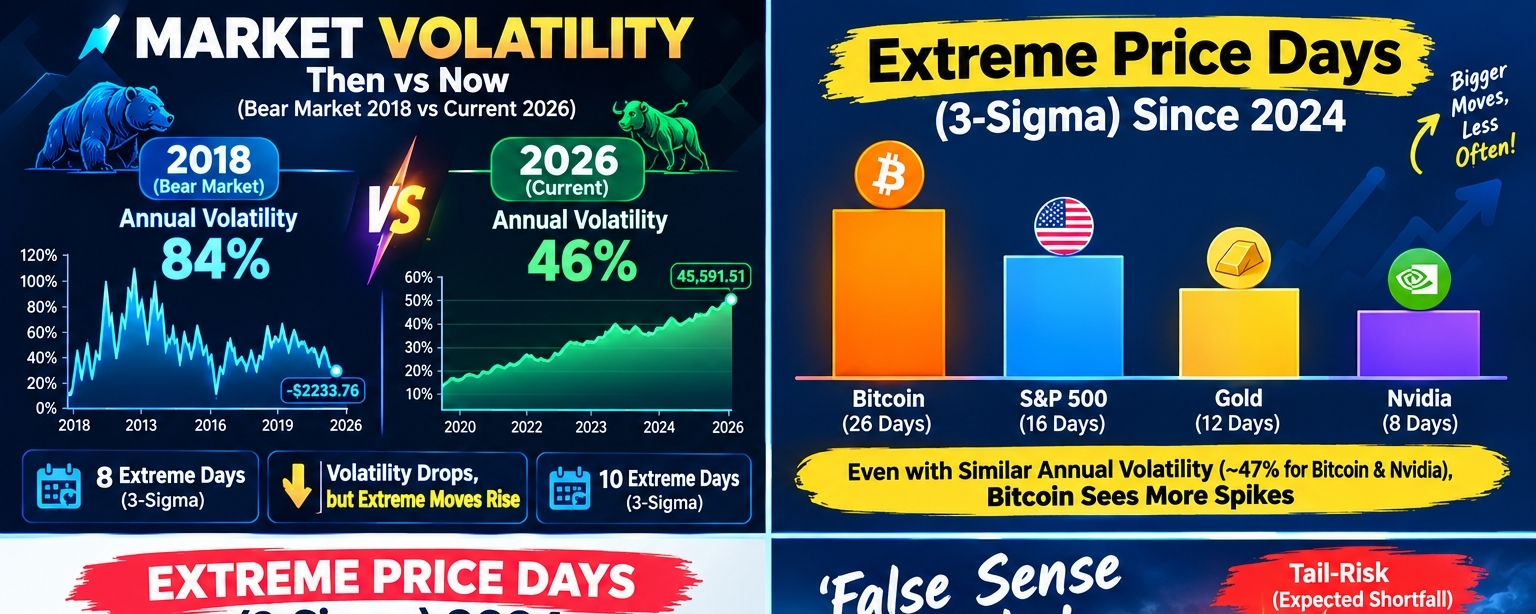
While Bitcoin’s average daily price fluctuations have significantly calmed down over the last eight years, the cryptocurrency is experiencing a surprising uptick in rare, extreme statistical outliers. According to recent CoinDesk analysis, Bitcoin recorded 10 three-sigma price movement days in 2026—surpassing the 8 days logged during the entire 2018 bear market.
This creates a deceptive risk environment: overall annualized volatility has plummeted from 84% in 2018 to roughly 46% in 2026, yet sudden, unexpected price spikes and dips relative to recent trading trends are happening more frequently.
Key Metrics & Asset Comparisons
Overall Volatility Shift: Annualized volatility dropped from 84% (2018) to 46% (2026).
Intensity of Outliers: The average size of a three-sigma move shrank from 10% in 2018 to 7% today.
Asset Comparison (Since 2024): Even though Bitcoin and Nvidia share similar overall volatility (~47%), Bitcoin exhibits far more extreme tail-risk days.
Asset
Extreme (3-Sigma) Days Since 2024
Bitcoin
26
S&P 500
16
Gold
12
Nvidia
8
Why Traditional Risk Models Are Falling Short
Standard Wall Street tools like Value-at-Risk (VaR) can lead investors into a false sense of security during low-volatility regimes.
Expected Shortfall (ES): Deribit CEO Luuk Strijers notes that risk managers are shifting toward models like Expected Shortfall to better evaluate potential loss depth during worst-case scenarios rather than relying on standard volatility thresholds.
Market Accelerators: Macroeconomic shocks, packed derivatives positioning, and strategies like volatility selling or call overwriting can trigger rapid position adjustments, magnifying price moves when surprise events occur.
Maturity Meets Resilience
Despite these abrupt shifts, deeper institutional participation and liquid derivatives markets are helping absorb market stress. For example, crypto trading platform Paradigm handled a record $6.7 billion in options volume on September 21 during Bitcoin’s latest three-sigma event.
According to Nicolas Quatravaux, Head of EMEA at Paradigm, stronger risk management protocols and institutional adoption have bolstered market resilience—even if tail-risk shocks remain a core feature of crypto markets.