
Is Bitcoin Actually Getting Less Volatile? It’s Complicated.
If you’ve been looking at Bitcoin’s overall price chart lately, you might think the asset is growing up and settling down. And on paper, you’d be right. But under the hood, a strange pattern is unfolding.
Let's break down what’s really happening with Bitcoin's price swings.
1. How can Bitcoin be "less volatile" but have more extreme days?
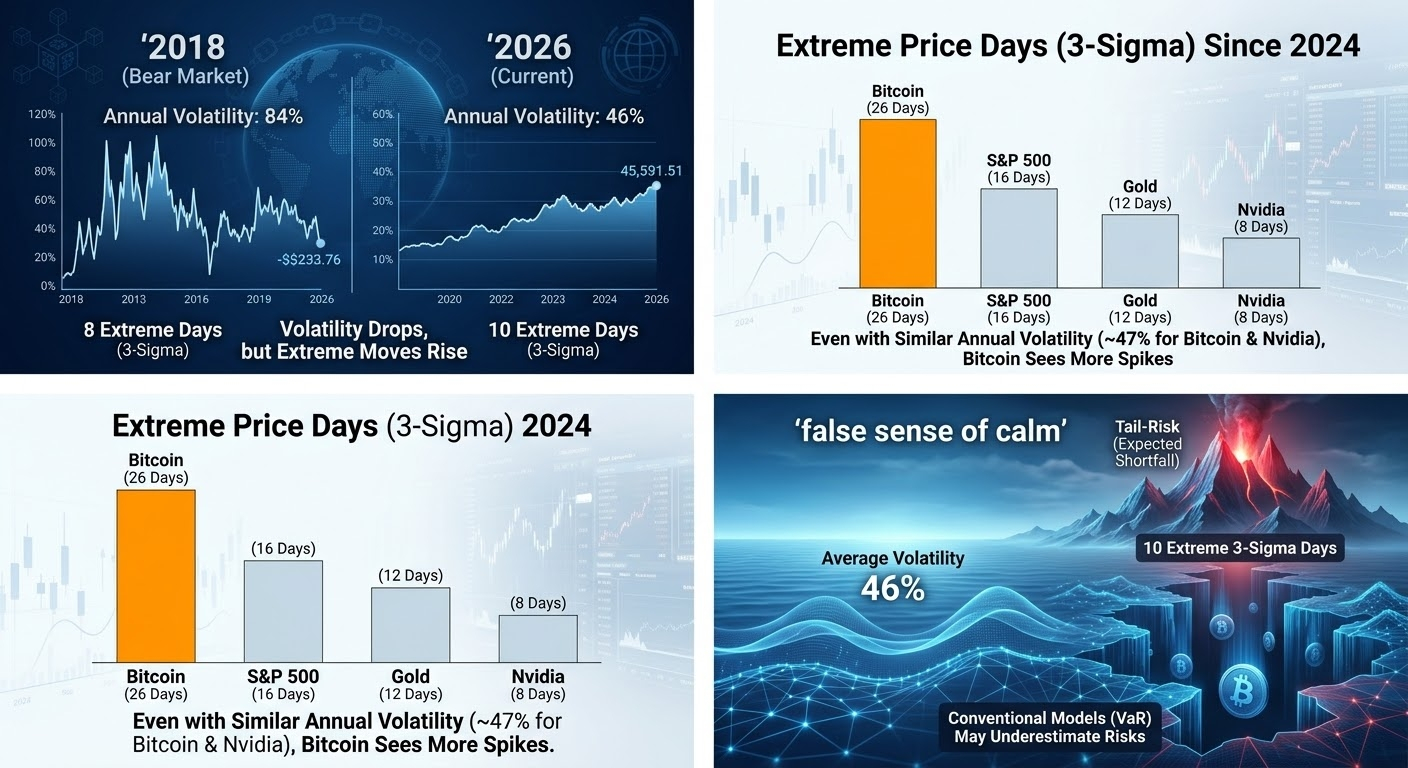
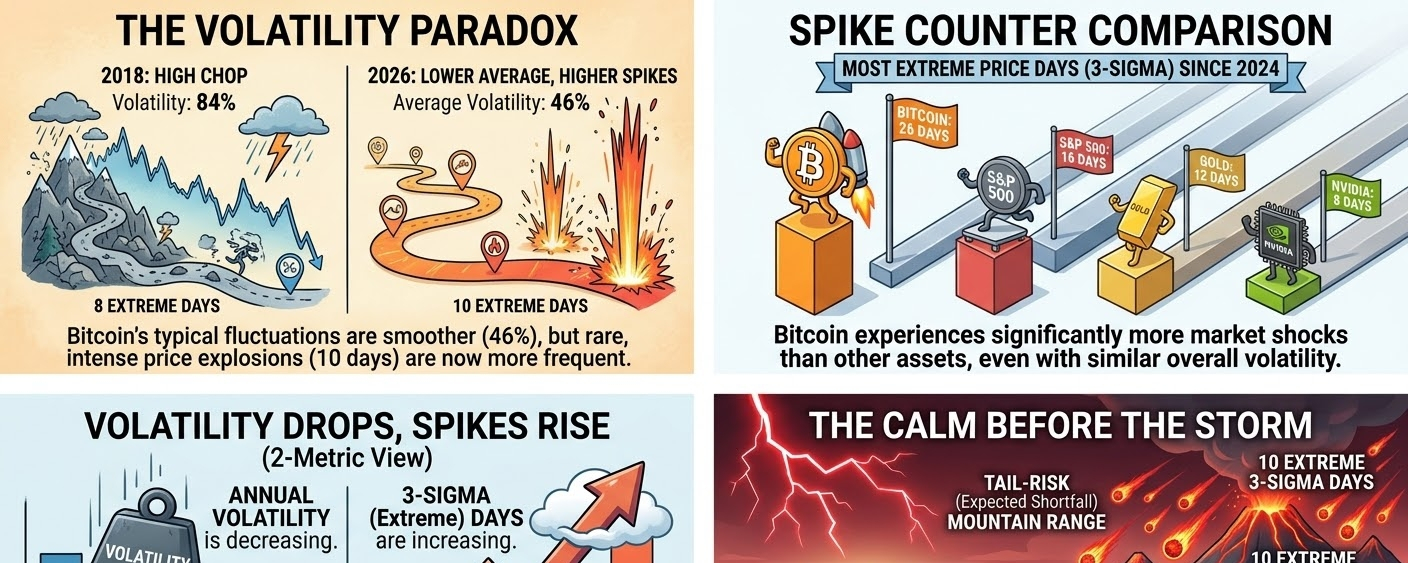
Think of volatility as an average temperature. Bitcoin’s "average temperature" has cooled off drastically—its annualized volatility fell from 84% in 2018 down to 46% in 2026.
However, measured against its recent 30-day volatility baselines, Bitcoin experienced 10 "three-sigma" extreme days in 2026 alone. By comparison, the entire brutal bear market of 2018 only saw 8 such days. The average size of these extreme moves did soften—from 10% in 2018 to 7% today—but they are occurring more often relative to current market conditions.
2. How does Bitcoin compare to traditional assets like Gold and Nvidia?
Since 2024, Bitcoin and tech giant Nvidia have registered nearly identical baseline volatility (~47%). But when it comes to sudden, statistically unusual price shocks, Bitcoin is in a league of its own:
Bitcoin: 26 extreme days
S&P 500: 16 extreme days
Gold: 12 extreme days
Nvidia: 8 extreme days
3. Why is this dangerous for traditional risk models?
Standard finance models like Value-at-Risk (VaR) can lull traders into believing an asset is safe simply because overall volatility looks low.
As Deribit CEO Luuk Strijers points out, institutions are adopting Expected Shortfall to measure how bad losses get when things go wrong, rather than just how often thresholds are breached. When macro news drops or traders unwinding volatility-selling strategies get caught off guard, sudden cascade moves occur rapidly.
4. What’s keeping the market from crashing during these spikes?
Institutional liquidity is serving as a major shock absorber. On September 21, when Bitcoin hit its latest three-sigma move, institutional desk Paradigm processed a record-breaking $6.7 billion in options trades.
As Nicolas Quatravaux (Head of EMEA at Paradigm) notes, mature infrastructure and institutional involvement mean the market can withstand heavy blows without breaking—even if sudden price surges and dips aren’t disappearing anytime soon.