

🏦 A pension fund has cash and wants to earn interest.
A hedge fund owns Microsoft shares and needs cash, but wants to keep its investment.
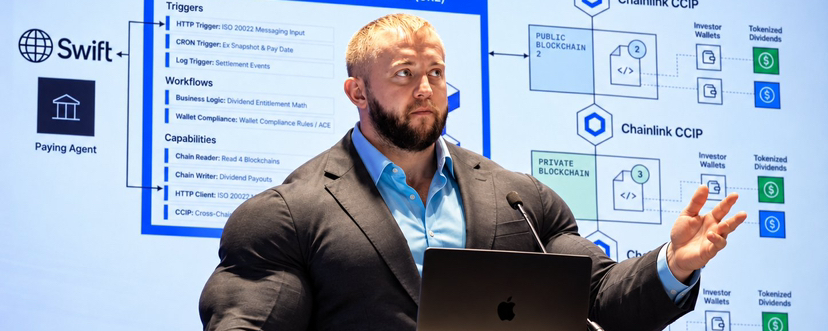
@chainlink and @The_DTCC demonstrated how those two institutions can make a financing agreement, exchange cash against collateral across blockchains, and automate the steps around it.
The product connecting it all is Chainlink Fulcrum.
Why would institutions use this? 👇
💰 Earn interest on available cash
Pension funds and other lenders can put cash to work in financing agreements backed by eligible assets.
🔓 Borrow without selling investments
The borrower uses its shares as collateral to raise cash while keeping exposure to their value.
🌐 Access more financing opportunities
Cash and collateral can sit on different supported blockchains. Institutions can reach counterparties beyond the network where they hold their assets.
⚙️ Choose their own terms
Lenders set the interest rate, duration, accepted collateral and required coverage. They can also restrict whether pledged collateral may be reused.
📊 Automate collateral checks
Pricing data helps the system check whether the pledged assets still provide enough coverage. Agreed rules can trigger margin calls or liquidation when thresholds are breached.
🤝 Make delivery conditional
The borrower receives cash only after the required collateral is confirmed. This reduces the risk of one party delivering while the other does not.
🕒 Coordinate financing around the clock
The infrastructure supports workflows beyond traditional settlement windows, including weekends and holidays. Asset pricing and the agreement’s terms still determine what actions are available.
🏦 Put capital to better use
Moving collateral more efficiently can reduce idle assets and the extra cash institutions hold to cover settlement delays.
📉 Reduce funding and operating costs
Less reliance on expensive short-term funding, fewer manual checks and less reconciliation between separate systems.
🔐 Keep sensitive information controlled
DTCC’s AppChain provides the need-to-know privacy described in the presentation, alongside two-second blocks and zero gas.
The potential is substantial: the presentation showed a DTCC model in which applying the AppChain to part of a large bank’s funding activity could save billions in operating costs. Those are projected benefits, but they explain the incentive to build this.
So how does it work? 👇
1️⃣ The pension fund sets its lending conditions and deposits tokenized cash.
2️⃣ The hedge fund accepts the offer and provides tokenized Microsoft shares.
3️⃣ Chainlink coordinates moving the collateral representation to DTCC’s AppChain, where it is valued and checked against the agreement.
4️⃣ Once the collateral requirements are met, the cash is released to the hedge fund.
5️⃣ When the loan is repaid, the obligation is settled and the collateral is released.
🔗 Why does this put Chainlink at the centre of the workflow?
Because the cash, shares and collateral agreement are spread across different systems. Something has to connect them and make each step depend on the right information.
CRE coordinates the process.
CCIP connects the blockchains and moves collateral across them.
Chainlink pricing data supports collateral valuation.
DTCC manages the collateral environment. The institutions provide the assets, cash and financing terms. Chainlink connects those pieces into one coordinated workflow.
That is what Fulcrum adds to tokenization: a practical way to use tokenized assets for financing, wherever the cash and collateral happen to sit.