
$ONDO: Managing Entry Quality versus Chasing
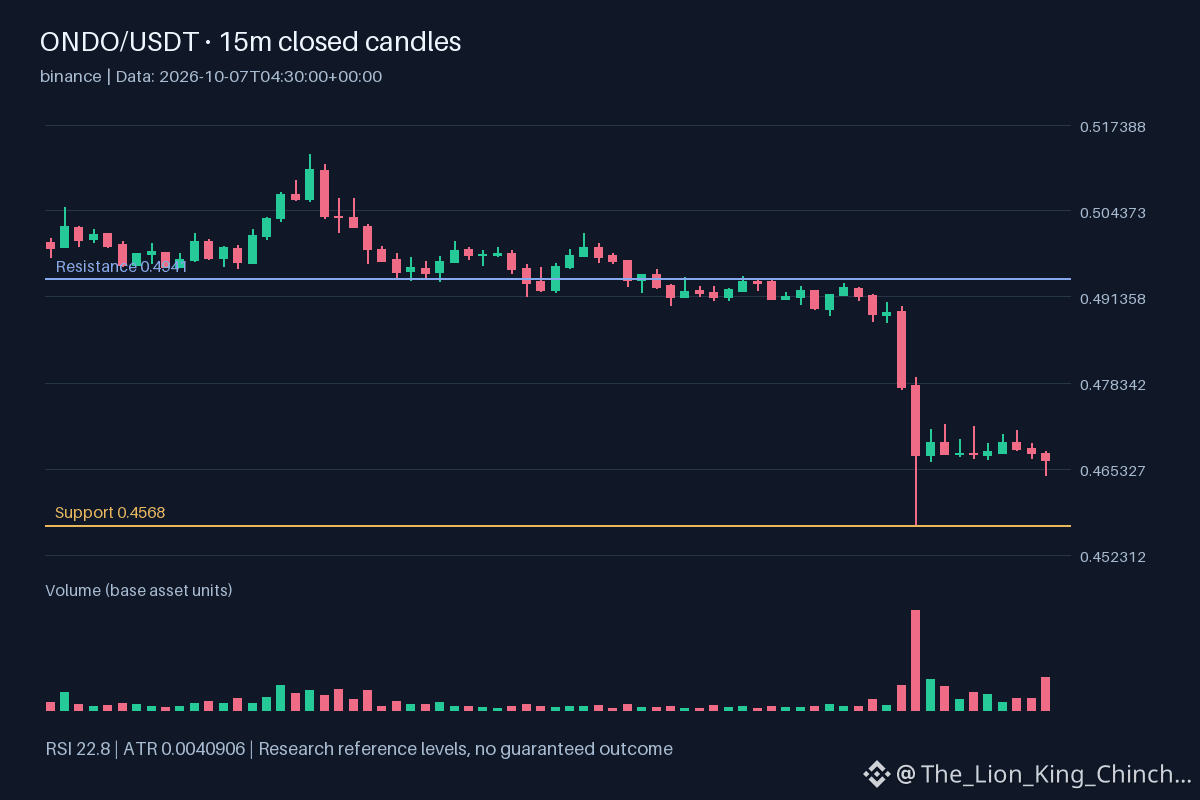
In market analysis, a fundamental tension exists between chasing immediate price momentum and waiting for high-quality entries. For $ONDO, current activity shows volume is 2.21512 relative to the baseline, which often tempts participants to jump in immediately. However, the trade-off remains constant: chasing an asset as it moves often leads to poor risk-adjusted returns, while waiting for a pullback risks missing the move entirely. Consider a thought experiment where price moves significantly away from the 0.476385 or the 0.487486. If a trader chases, they are essentially betting that the current acceleration will continue without a retest. Conversely, waiting for a pullback toward the 0.4568 level might result in seeing the move occur without being part of it. The key is understanding that waiting acts as a filter for conviction rather than just a strategy for better price. When price trades below the 0.485237, the market structure suggests a cautious approach is warranted. If the assumption of momentum fails, the inability to define a tight invalidation point becomes the primary risk. A practical way to reassess this is to establish a decision checklist. Ask if the entry allows for a stop distance that makes logical sense relative to the 0.0040906. If the stop must be placed too far away due to volatility, the entry quality is inherently compromised. Ultimately, recognizing that you cannot capture every single move is the first step toward better risk management. Focus on defining failure conditions before considering the potential upside ⚖️.
Probabilistic market research, not a recommendation or guaranteed return.
Which matters more to you: seeing the opportunity or defining its failure?
#ONDO
In market analysis, a fundamental tension exists between chasing immediate price momentum and waiting for high-quality entries. For $ONDO, current activity shows volume is 2.21512 relative to the baseline, which often tempts participants to jump in immediately. However, the trade-off remains constant: chasing an asset as it moves often leads to poor risk-adjusted returns, while waiting for a pullback risks missing the move entirely. Consider a thought experiment where price moves significantly away from the 0.476385 or the 0.487486. If a trader chases, they are essentially betting that the current acceleration will continue without a retest. Conversely, waiting for a pullback toward the 0.4568 level might result in seeing the move occur without being part of it. The key is understanding that waiting acts as a filter for conviction rather than just a strategy for better price. When price trades below the 0.485237, the market structure suggests a cautious approach is warranted. If the assumption of momentum fails, the inability to define a tight invalidation point becomes the primary risk. A practical way to reassess this is to establish a decision checklist. Ask if the entry allows for a stop distance that makes logical sense relative to the 0.0040906. If the stop must be placed too far away due to volatility, the entry quality is inherently compromised. Ultimately, recognizing that you cannot capture every single move is the first step toward better risk management. Focus on defining failure conditions before considering the potential upside ⚖️.
Probabilistic market research, not a recommendation or guaranteed return.
Which matters more to you: seeing the opportunity or defining its failure?
#ONDO