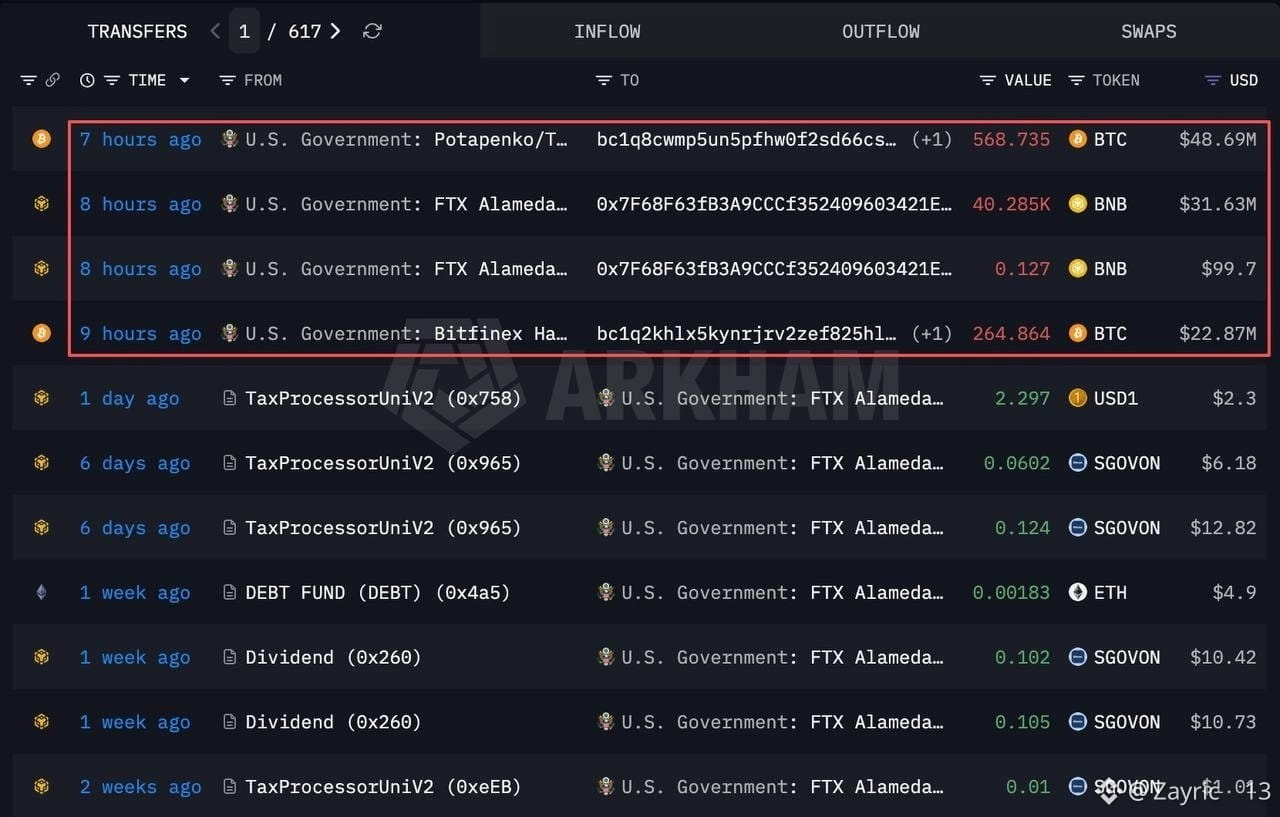

🚨 U.S. government-linked wallets just moved 833.6 $BTC worth roughly $71.56M into Coinbase Prime, alongside 40,285 $BNB worth about $31.63M. That’s over $103M in crypto moved in one batch — and naturally, the first assumption is “they’re selling.”
Here’s the part that matters: a transfer into Coinbase Prime is not the same thing as a confirmed market sale. Coinbase Prime provides institutional custody and trading services, and government-linked wallets have used it to handle seized assets before. The BTC appears to have come from government-controlled forfeiture wallets, while the 40,285 BNB was moved through several transactions and is currently sitting at another address rather than Coinbase Prime.
So yes, $71.56M of BTC entering an institutional platform can create sell-pressure concerns. But on-chain data alone cannot tell us whether this is liquidation, custody management, preparation for a future transaction, or simply another administrative movement. The more meaningful signal is what happens next: whether the BTC is actually sold, moved to trading venues, or remains under government custody.
Government wallets still reportedly hold roughly $28B in crypto, including around 324,000 BTC. That makes this $103M transfer notable, but hardly enough by itself to prove a broader distribution event.
The real question isn’t “Did the government move $103M?”
It’s: Did the government actually sell it — or did everyone just mistake custody movement for market supply?
Here’s the part that matters: a transfer into Coinbase Prime is not the same thing as a confirmed market sale. Coinbase Prime provides institutional custody and trading services, and government-linked wallets have used it to handle seized assets before. The BTC appears to have come from government-controlled forfeiture wallets, while the 40,285 BNB was moved through several transactions and is currently sitting at another address rather than Coinbase Prime.
So yes, $71.56M of BTC entering an institutional platform can create sell-pressure concerns. But on-chain data alone cannot tell us whether this is liquidation, custody management, preparation for a future transaction, or simply another administrative movement. The more meaningful signal is what happens next: whether the BTC is actually sold, moved to trading venues, or remains under government custody.
Government wallets still reportedly hold roughly $28B in crypto, including around 324,000 BTC. That makes this $103M transfer notable, but hardly enough by itself to prove a broader distribution event.
The real question isn’t “Did the government move $103M?”
It’s: Did the government actually sell it — or did everyone just mistake custody movement for market supply?