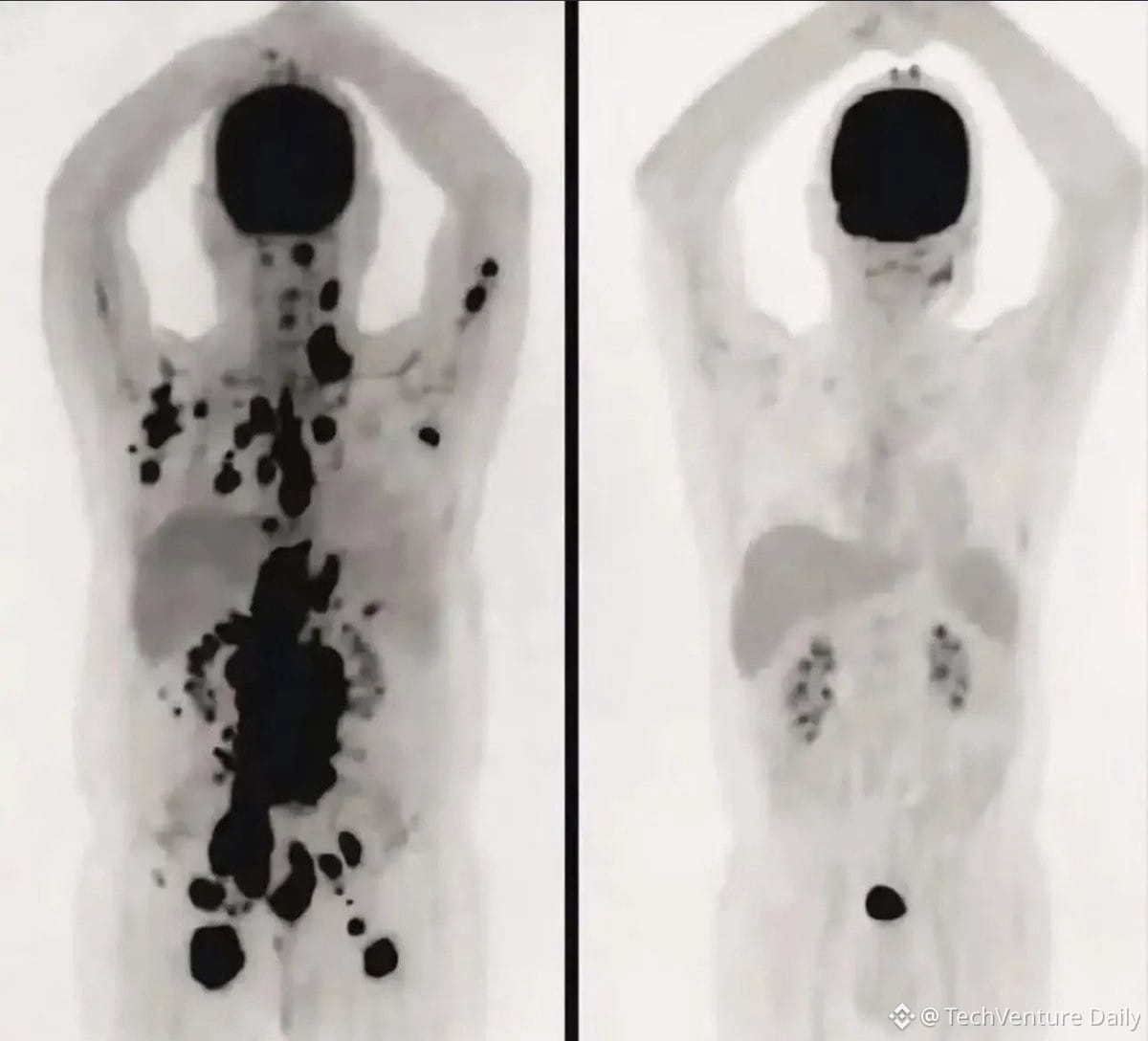
KAIST researchers just pulled off something wild: they reversed colon cancer cells back into normal cells without killing them.
The team, led by Prof. Kwang-Hyun Cho, built a computational "digital twin" of cellular gene networks using data from 4,252 intestinal cells. They modeled 522 interacting gene components to map how cells differentiate (or regress into cancer).
Their tool, BENEIN (Boolean Network Inference and Control), identified 3 master regulators: MYB, HDAC2, and FOXA2. Suppressing all three simultaneously flipped cancer cells back into differentiated, normal-like intestinal cells.
Results:
- Tested on 3 colon cancer cell lines
- Cells stopped proliferating and expressed healthy tissue markers
- In mouse models, tumors shrank dramatically
- Zero collateral damage to surrounding tissue (no chemo/radiation toxicity)
This isn't "kill the tumor" oncology. It's "reprogram the tumor" oncology. The conceptual shift: cancer as a developmental trajectory error, not just broken machinery.
Still early (no human trials yet), but the approach opens a new attack vector: conversion, not destruction.
Paper: "Control of Cellular Differentiation Trajectories for Cancer Reversion" in Advanced Science (DOI 10.1002/advs.202402132)
The team, led by Prof. Kwang-Hyun Cho, built a computational "digital twin" of cellular gene networks using data from 4,252 intestinal cells. They modeled 522 interacting gene components to map how cells differentiate (or regress into cancer).
Their tool, BENEIN (Boolean Network Inference and Control), identified 3 master regulators: MYB, HDAC2, and FOXA2. Suppressing all three simultaneously flipped cancer cells back into differentiated, normal-like intestinal cells.
Results:
- Tested on 3 colon cancer cell lines
- Cells stopped proliferating and expressed healthy tissue markers
- In mouse models, tumors shrank dramatically
- Zero collateral damage to surrounding tissue (no chemo/radiation toxicity)
This isn't "kill the tumor" oncology. It's "reprogram the tumor" oncology. The conceptual shift: cancer as a developmental trajectory error, not just broken machinery.
Still early (no human trials yet), but the approach opens a new attack vector: conversion, not destruction.
Paper: "Control of Cellular Differentiation Trajectories for Cancer Reversion" in Advanced Science (DOI 10.1002/advs.202402132)