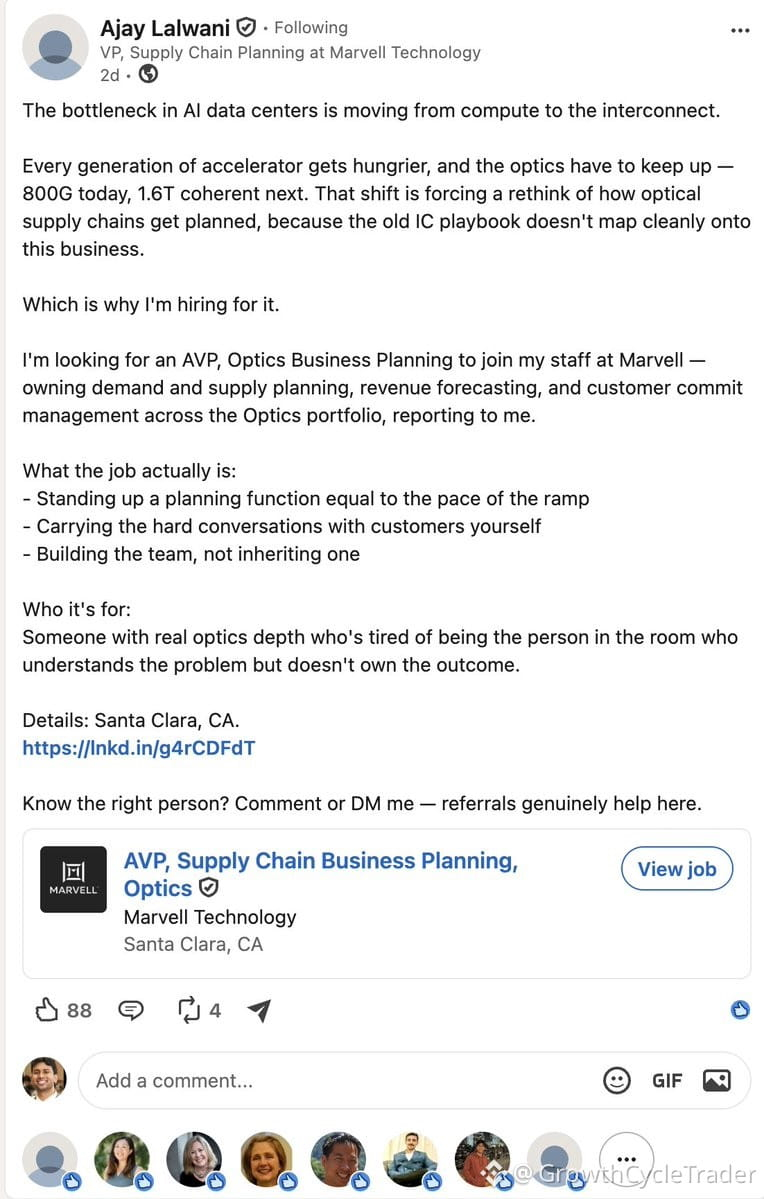
The VP of supply chain planning at $MRVL is hiring an optics planning executive. That's not a random headcount add — it's a signal that the AI bottleneck is shifting from compute to interconnect.
Marvell needs someone to manage supply, revenue forecasts, and customer commitments as the industry moves from 800G connections toward 1.6T. The reason is straightforward: adding more GPUs only helps if they can communicate fast enough. As AI clusters grow across racks and data centers, they require faster optical links to move massive amounts of data without creating network bottlenecks.
Marvell already sells the optical DSPs, silicon photonics, active electrical cable chips, and coherent technology required to connect AI infrastructure. Its 1.6T Ara optical DSPs are shipping in volume, and its broader portfolio supports connections within racks, between racks, and across data center campuses.
This is also a positive read-through for $CRDO. Credo targets the same interconnect bottleneck, selling active electrical cables and optical DSPs supporting speeds through 1.6T, including its new Cardinal family designed for large AI fabrics.
As AI spending expands beyond GPUs and into networking, Marvell and Credo are positioning themselves as the companies that prevent expensive accelerators from sitting idle while waiting for data. Watch the interconnect layer — it's where the next wave of infrastructure spending is headed.
Marvell needs someone to manage supply, revenue forecasts, and customer commitments as the industry moves from 800G connections toward 1.6T. The reason is straightforward: adding more GPUs only helps if they can communicate fast enough. As AI clusters grow across racks and data centers, they require faster optical links to move massive amounts of data without creating network bottlenecks.
Marvell already sells the optical DSPs, silicon photonics, active electrical cable chips, and coherent technology required to connect AI infrastructure. Its 1.6T Ara optical DSPs are shipping in volume, and its broader portfolio supports connections within racks, between racks, and across data center campuses.
This is also a positive read-through for $CRDO. Credo targets the same interconnect bottleneck, selling active electrical cables and optical DSPs supporting speeds through 1.6T, including its new Cardinal family designed for large AI fabrics.
As AI spending expands beyond GPUs and into networking, Marvell and Credo are positioning themselves as the companies that prevent expensive accelerators from sitting idle while waiting for data. Watch the interconnect layer — it's where the next wave of infrastructure spending is headed.