


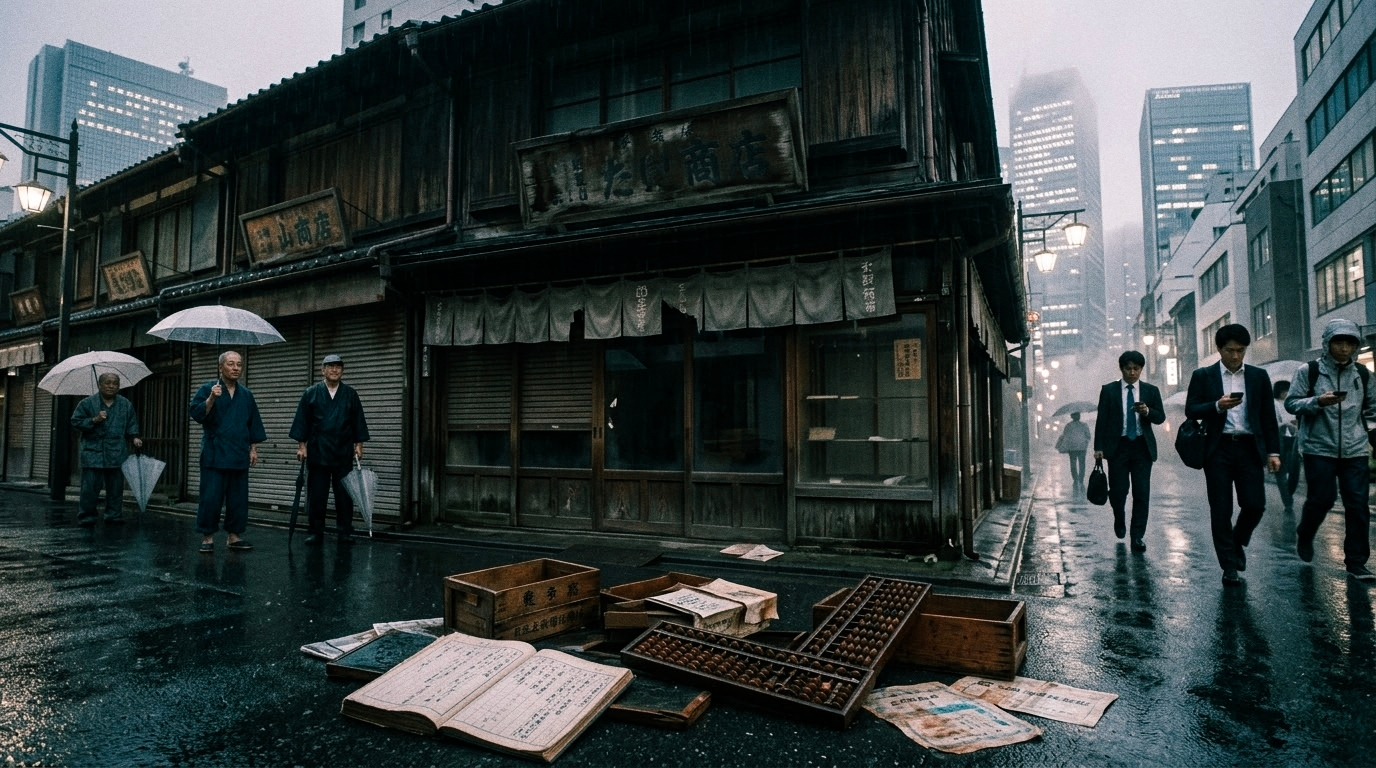
They survived wars.
They survived the collapse of Japan’s asset bubble.
They survived decades of deflation.
They survived generational change.
But 2026 is proving that even a 100-year legacy is not enough anymore.
According to Teikoku Databank, bankruptcies among Japanese companies with histories exceeding 100 years reached a record pace, with 112 cases in just the first eight months of 2026.
Let that number sink in.
These are not disposable startups. These are businesses that survived for a century or more — companies built through generations, deeply embedded in local communities, and historically supported by conservative ownership, accumulated capital, stable margins, and long-term thinking.
Now the economic environment is ripping that model apart.
THE PRESSURE IS COMING FROM EVERY DIRECTION.
💥 RISING COSTS
Price-related bankruptcies surged 23.8% to 556 cases in the first half of 2026.
💥 LABOR SHORTAGES
Labor-shortage-related bankruptcies jumped 12.4% to 227 cases.
💥 SUCCESSION CRISIS
Bankruptcies linked to the absence of a successor climbed 16.9% to 312 cases year-on-year in the first half of 2026.
And underneath all of this sits Japan’s brutal demographic reality:
Fewer births.
More elderly people.
Fewer workers.
A shrinking domestic market.
For decades, Japan’s domestic market was the dependable engine. Now that engine is losing size.
And small, domestically focused companies are getting squeezed hardest because they often lack the pricing power necessary to pass higher costs onto customers.
Inflation may finally allow Japanese companies to raise prices more than they could during the deflation era — but that does NOT mean everyone has enough pricing power to survive.
Raw materials rise.
Labor costs rise.
Energy costs rise.
Interest rates matter.
Tariffs matter.
Geopolitical risks matter.
But customers still have limits.
That is a fucking nightmare for a company living on thin margins.
Look at Sube Shoten, a tofu manufacturer founded in 1877, during Japan’s Meiji era.
After nearly 150 years, the company reportedly halted operations in May 2026 and began preparing for bankruptcy as weak profit margins collided with soaring raw-material costs.
And then there is Kadoya Sesame Mills, founded in 1858.
It survived wars, Japan’s transformation, and the spectacular rise and collapse of the country’s asset bubble.
Yet now Kadoya is preparing to go private through a tender offer backed by Japanese private-equity firm Integral, amid rising raw-material costs and growing geopolitical risks.
This is the part people miss.
Going private isn't automatically failure.
For some century-old businesses, it may be a strategic reset — a way to restructure ownership, invest, adapt operations, and pursue growth away from the short-term pressures of public markets.
But the broader trend is impossible to ignore.
Japan’s legendary corporate durability is being tested by a completely different enemy:
demographics + inflation + labor scarcity + shrinking demand + succession problems.
The old Japanese model was built around endurance.
The new environment demands adaptation.
And adaptation is fucking expensive.
Many of these companies accumulated strong balance sheets and stable profits over generations. They built businesses designed to survive decades, not chase explosive growth.
But now they face a future they cannot easily forecast.
As Oxford Economics’ Shigeto Nagai puts it, many long-established companies are increasingly worried that they cannot maintain high profitability over the long term — and that profits will gradually deteriorate.
That fear changes everything.
Owners are reconsidering:
Who owns the company?
Who succeeds the founder?
Should the company remain private?
Should it sell?
Should it merge?
Should it expand overseas?
Should it restructure?
Meanwhile, a weaker yen, corporate-governance reforms, activist pressure, inflation, tariffs, labor costs and interest rates are all forcing boards and owners to rethink decisions that previous generations could postpone.
And overseas expansion is no magic solution either.
A company that spent 100 years mastering Japan cannot simply wake up one morning and become a global corporation.
There is no fucking “one-size-fits-all” answer.
That is why 2026 matters.
This isn't simply a story about old companies dying.
It is a story about an economic system being forced to evolve.
112 century-old companies gone bankrupt in just eight months.
556 cost-driven bankruptcies in six months.
227 labor-shortage-related bankruptcies.
312 bankruptcies linked to succession problems.
Those aren't random numbers.
They are warning lights.
Japan spent generations building businesses designed to survive almost anything.
Now those businesses are discovering the hard truth:
A 100-year history can protect a company from the past.
It cannot guarantee survival in the future.
🇯🇵 Japan's next economic battle isn't simply about growth.
It's about whether its oldest institutions can reinvent themselves before demographics, costs, labor shortages and a shrinking domestic market fucking bury them.
LEGACY IS NOT IMMUNITY.
2026 IS THE WAKE-UP CALL.