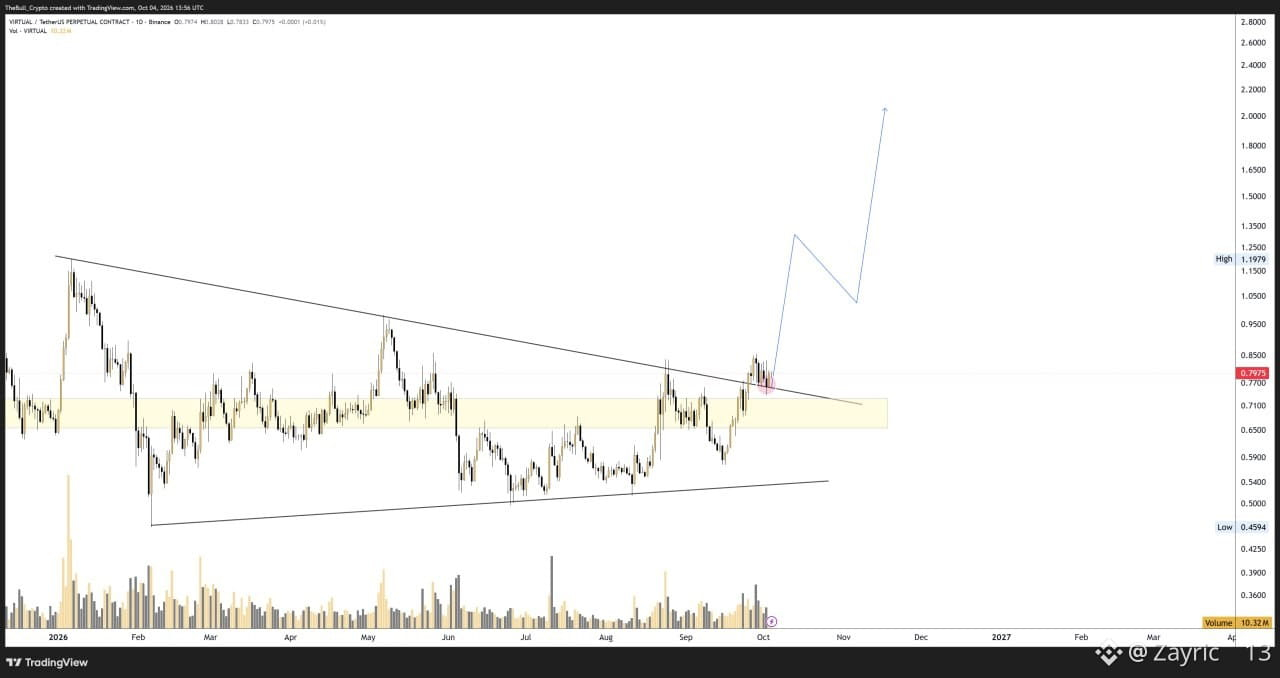

$VIRTUAL is currently sitting around $0.79 with roughly 658.39M tokens in circulation as of October 4, 2026. That’s a fairly large circulating base for a token whose core pitch is building an economy around autonomous AI agents.
Here’s the part that matters if you’re looking at VIRTUAL through on-chain numbers: holder counts are much easier to misread than they look. VIRTUAL is not confined to a single ledger — it exists across Ethereum, Base, Solana and newer deployments including Robinhood Chain — so an address count from one explorer is not a clean measurement of total ownership or adoption. Cross-chain representations, exchange wallets, smart contracts, custodians and protocol-controlled addresses can all distort what “holder growth” actually means. Public rich-list data also shows why raw address balances need context: large addresses can represent exchanges, contracts or reserves rather than individual users.
The more useful number here is circulating supply. Current trackers put it around 658.39M VIRTUAL against a 1B maximum supply, while Tokenomist reports the token as fully unlocked. That gives you a much cleaner view of the actual supply available to the market than simply counting wallets.
I can’t confirm the cause of any holder-count movement from on-chain data alone. But when a multi-chain asset is involved, why treat the number of addresses as adoption before asking what those addresses actually represent?
Here’s the part that matters if you’re looking at VIRTUAL through on-chain numbers: holder counts are much easier to misread than they look. VIRTUAL is not confined to a single ledger — it exists across Ethereum, Base, Solana and newer deployments including Robinhood Chain — so an address count from one explorer is not a clean measurement of total ownership or adoption. Cross-chain representations, exchange wallets, smart contracts, custodians and protocol-controlled addresses can all distort what “holder growth” actually means. Public rich-list data also shows why raw address balances need context: large addresses can represent exchanges, contracts or reserves rather than individual users.
The more useful number here is circulating supply. Current trackers put it around 658.39M VIRTUAL against a 1B maximum supply, while Tokenomist reports the token as fully unlocked. That gives you a much cleaner view of the actual supply available to the market than simply counting wallets.
I can’t confirm the cause of any holder-count movement from on-chain data alone. But when a multi-chain asset is involved, why treat the number of addresses as adoption before asking what those addresses actually represent?