

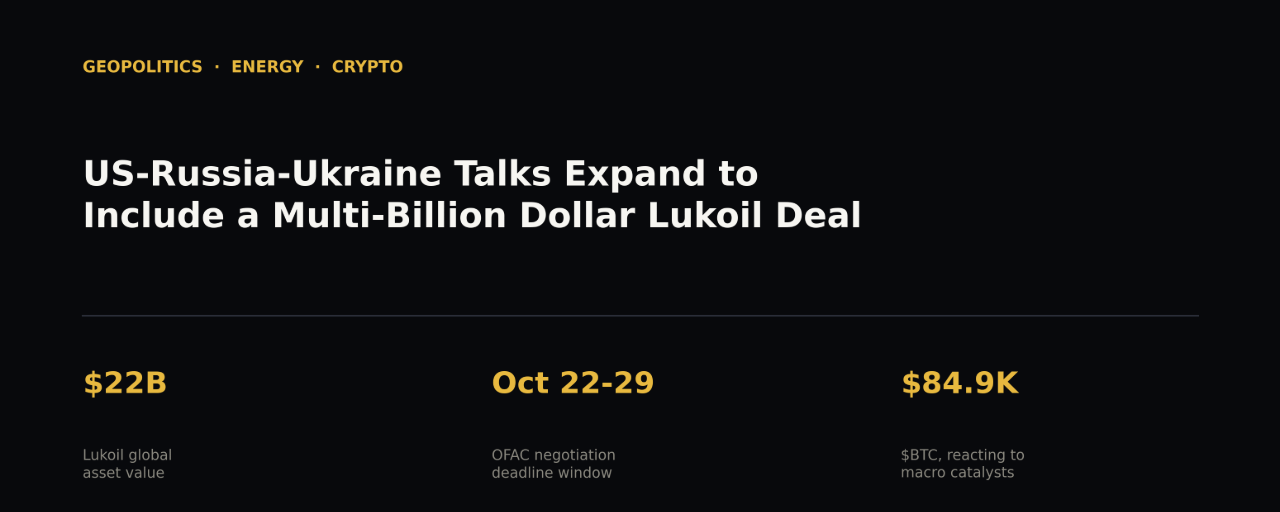

Fresh geopolitical developments are putting energy markets and global risk assets back in focus — and this time, the story has a genuine crypto connection most coverage is missing.
What's Actually Happening
According to a New York Times report (Oct 3-4, 2026), peace negotiations between the Trump administration and Russia over the Ukraine war have expanded to include a potential multi-billion-dollar deal involving Lukoil's international assets — oil fields, refineries, and gas stations across the globe, including major refineries in the Netherlands, Bulgaria, and Romania.
US special envoys Steve Witkoff and Jared Kushner reportedly discussed the deal directly with Vladimir Putin. The buyer consortium includes American investor Todd Boehly and Middle Eastern business groups connected to the negotiators — and notably, one investor in the deal is also a co-owner of World Liberty, the Trump family's crypto venture. That's a direct link between this geopolitical story and the crypto industry that most mainstream coverage hasn't connected.
Lukoil — Russia's second-largest oil producer, accounting for roughly 2% of global oil output — was sanctioned by the Trump administration in October 2025 to pressure Moscow toward peace talks. The U.S. Treasury's OFAC has since extended a window allowing negotiations on the sale of Lukoil's foreign assets, with the current deadline set around October 22-29, 2026. If the deal clears U.S. approval, sanctions on these specific assets would lift, immediately boosting their market value.
Important caveat: The deal's final structure, value, and terms remain undetermined — this is a developing negotiation, not a signed agreement.
Why Markets Care
🛢️ Oil & Inflation
Reduced geopolitical and sanctions-related pressure on a producer responsible for 2% of global output could ease energy-market risk. If oil prices cool as a result, that reduces one of the stickier inflation inputs central banks have been fighting all year.
💵 Global Liquidity
A decline in geopolitical uncertainty tends to improve broad market sentiment and encourage risk-taking — the same dynamic we've seen play out repeatedly this year around Fed decisions and other macro catalysts.
₿ Crypto Risk Appetite
If macro pressure and energy-driven inflation genuinely cool, risk assets — $BTC (currently ~$84,876), $ETH, and major altcoins — could see renewed attention. This follows a week where BTC already showed how sensitive it is to macro catalysts, rallying to $87K on the NFP report before rejecting that level entirely.
Key Things to Watch
📊 Crude oil and energy prices in the coming days
📊 Upcoming inflation data releases
📊 Central bank rate expectations
📊 Global capital flow shifts
📊 BTC and altcoin momentum around the Oct 22-29 OFAC deadline
ZEC is also worth watching here — privacy coins have shown outsized sensitivity to macro and regulatory narrative shifts this year, and crypto traders may react disproportionately to this story given the World Liberty connection.
$NVDA and broader equity markets could also stay sensitive to any major shift in geopolitical risk, given how tightly AI/tech valuations have traded with macro sentiment this year.
The Open Question
Do you think further de-escalation could improve sentiment across crypto and global markets — or is it still too early to get bullish on a deal that hasn't even been finalized?
DYOR • Manage Risk • NFA. Not financial advice — market awareness only. Data as of Oct 4, 2026.
$BTC $ETH $NVDA
#Bitcoin #Crypto #Geopolitics #ZEC