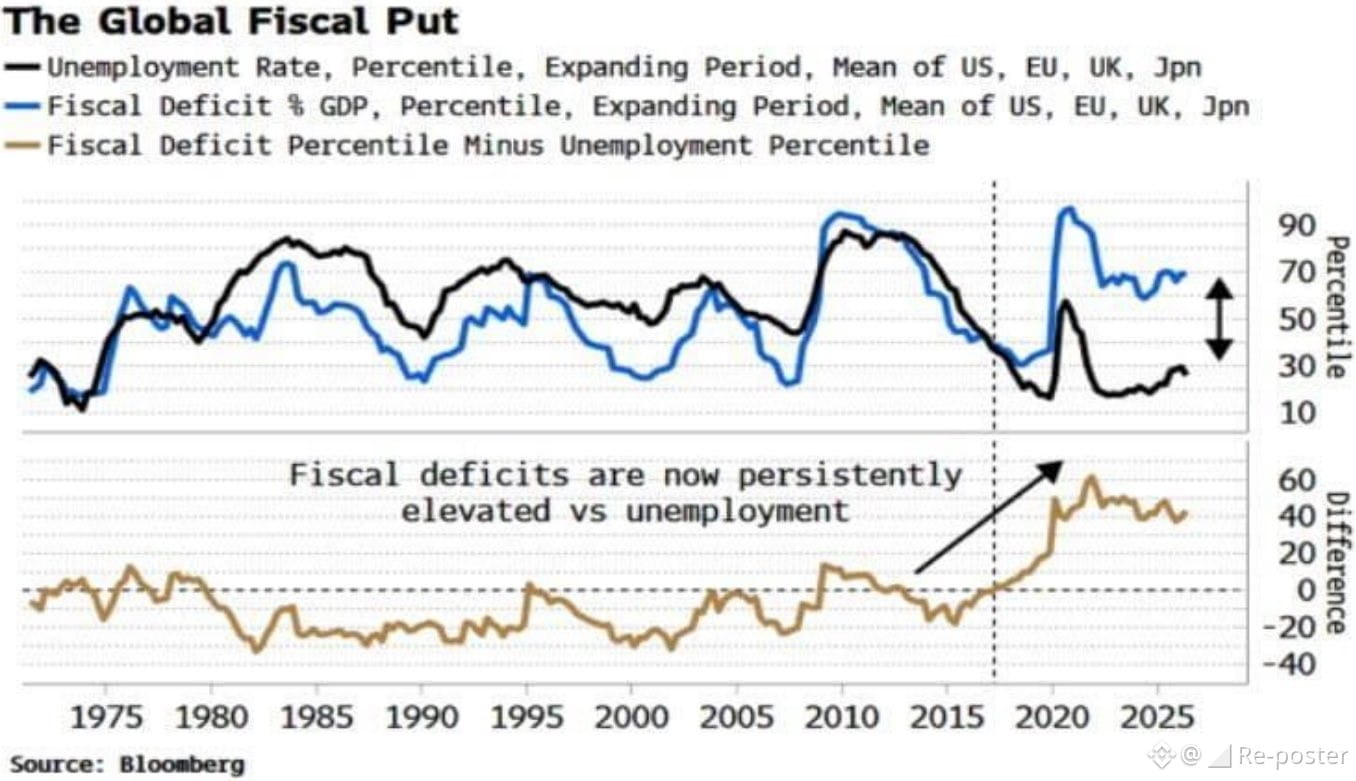
Fiscal deficits decoupled from unemployment in 2016; pro-cyclical spending now keeps inflation structurally above target
Interesting take from Simon White at Bloomberg Macro. He puts a precise date on when the fiscal regime broke: 2016, when budget deficits began meaningfully diverging from unemployment rates across the US, EU, UK and Japan.
Before that, governments ran deficits when economies were weak and pulled back when they recovered. That relationship collapsed, and it hasn't come back.
The chart shows fiscal deficit percentile minus unemployment percentile for a mean of the four major Western blocs across expanding periods.
For the 40 years before 2016, that spread oscillated around zero. Since then it has stayed persistently elevated, meaning governments kept spending even as labor markets tightened.
The pandemic turbocharged it further.
Interesting take from Simon White at Bloomberg Macro. He puts a precise date on when the fiscal regime broke: 2016, when budget deficits began meaningfully diverging from unemployment rates across the US, EU, UK and Japan.
Before that, governments ran deficits when economies were weak and pulled back when they recovered. That relationship collapsed, and it hasn't come back.
The chart shows fiscal deficit percentile minus unemployment percentile for a mean of the four major Western blocs across expanding periods.
For the 40 years before 2016, that spread oscillated around zero. Since then it has stayed persistently elevated, meaning governments kept spending even as labor markets tightened.
The pandemic turbocharged it further.