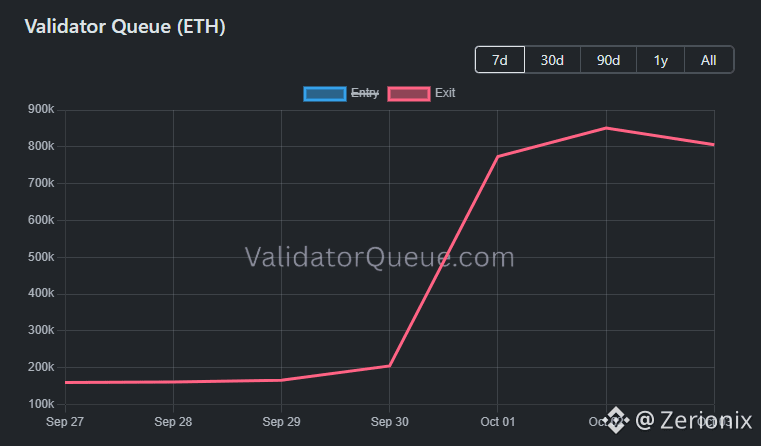
Ethereum’s exit queue has surged into the hundreds of thousands of ETH, with current data showing roughly 808,000 ETH waiting to exit.
The timing is especially interesting because the spike appears closely connected to MetaMask’s decision to exit validators following its recent staking infrastructure security incident. Reports estimate roughly 523,000 ETH was tied to affected validators, although those figures have not been fully confirmed by MetaMask.
So I wouldn't read the 392% increase as “Ethereum stakers suddenly want to sell.”
A large portion appears to be a structural/security-related exit rather than thousands of independent holders abandoning ETH.
But there is still an interesting market implication.
When hundreds of thousands of ETH enter the exit process, that ETH isn't immediately available to sell. Ethereum's protocol limits how quickly validators can exit, meaning the queue itself creates a time delay before the coins become liquid.
The bigger question is what happens after those withdrawals become available.
If the ETH gets restaked or simply moved between staking providers, the impact on liquid supply could remain limited.
If a meaningful portion eventually reaches exchanges, then the market has to absorb additional potential sell-side supply.
So the 392% number looks dramatic.
But the composition of that queue matters far more than the percentage increase itself.
$ETH #BTC Price Analysis# #Altcoin Season#
The timing is especially interesting because the spike appears closely connected to MetaMask’s decision to exit validators following its recent staking infrastructure security incident. Reports estimate roughly 523,000 ETH was tied to affected validators, although those figures have not been fully confirmed by MetaMask.
So I wouldn't read the 392% increase as “Ethereum stakers suddenly want to sell.”
A large portion appears to be a structural/security-related exit rather than thousands of independent holders abandoning ETH.
But there is still an interesting market implication.
When hundreds of thousands of ETH enter the exit process, that ETH isn't immediately available to sell. Ethereum's protocol limits how quickly validators can exit, meaning the queue itself creates a time delay before the coins become liquid.
The bigger question is what happens after those withdrawals become available.
If the ETH gets restaked or simply moved between staking providers, the impact on liquid supply could remain limited.
If a meaningful portion eventually reaches exchanges, then the market has to absorb additional potential sell-side supply.
So the 392% number looks dramatic.
But the composition of that queue matters far more than the percentage increase itself.
$ETH #BTC Price Analysis# #Altcoin Season#