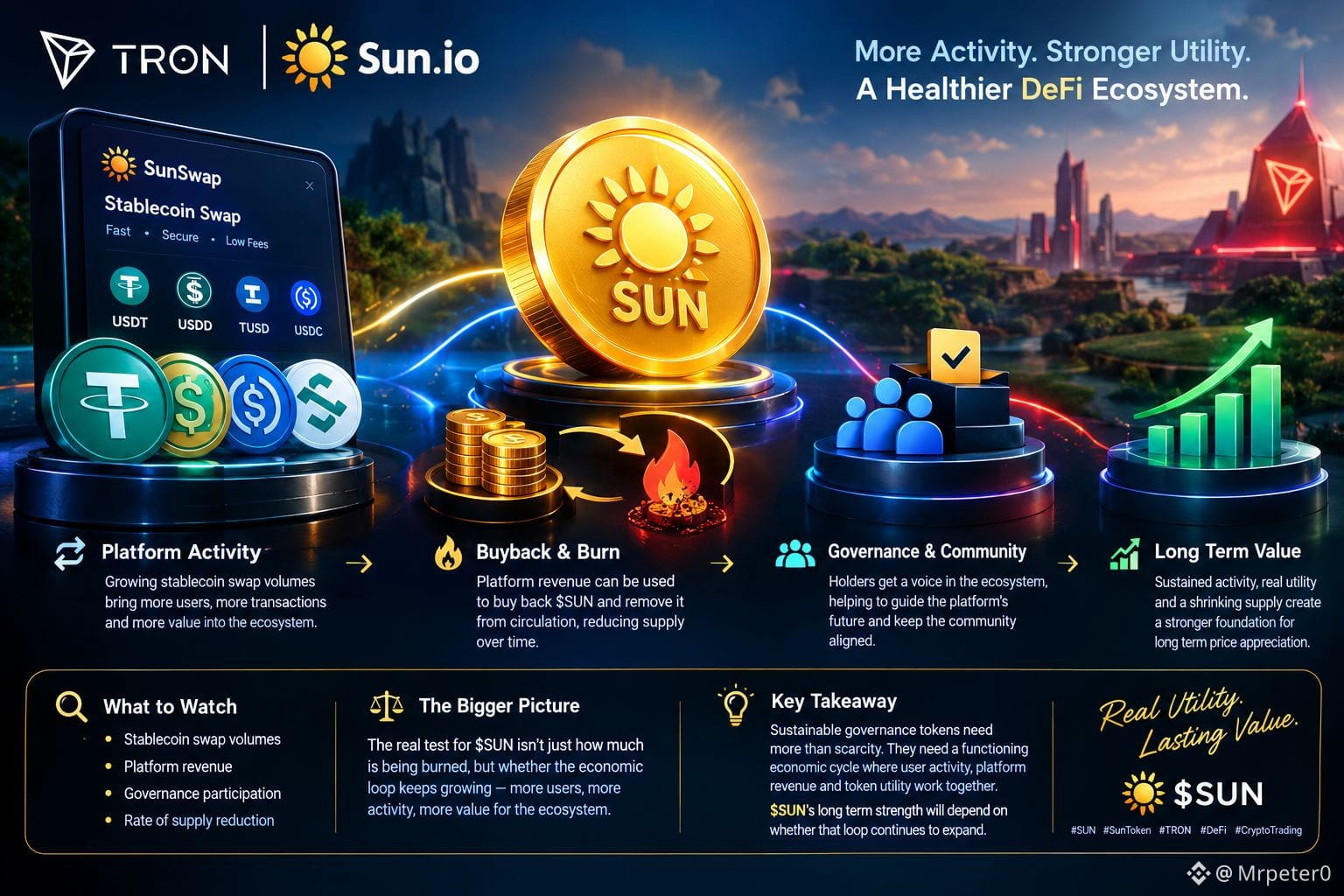
$SUN provides an interesting case through its connection with the TRON DeFi ecosystem. As Sun.io expands stablecoin swap activity and develops its community governance mechanisms, the role of the token becomes increasingly tied to the economic activity taking place around the platform. That makes its tokenomics worth examining beyond short term market movements.
The key development here is the combination of platform usage, governance utility, and the buyback and burn model. If platform revenue is being connected to token buybacks and those tokens are subsequently removed from circulation, the mechanism creates a direct relationship between ecosystem activity and changes in supply.
But the numbers need to be interpreted carefully. A reduction in circulating supply does not automatically translate into long term price appreciation. The effect depends on whether platform activity remains strong, whether revenue is sustainable, and whether demand for the token continues to develop alongside the reduction in supply.
This is also where comparing different DeFi hubs becomes useful. Governance tokens can look similar on the surface, but their sustainability depends heavily on how closely token utility is connected to actual platform usage
For $SUN, the important metric to watch is therefore not just the amount of tokens being burned. It is the relationship between stablecoin swap volumes, platform revenue, governance participation, and the rate at which supply is being reduced. Looking at those factors together provides a much clearer picture of whether the tokenomics are creating durable value.
My view is that sustainable DeFi governance tokens need more than scarcity. They need a functioning economic loop where users generate activity, the platform captures value, and the token has a meaningful role in that system. $SUN is an interesting case because its long term strength will ultimately depend on whether that loop continues to expand rather than simply becoming more efficient at reducing supply.
@Justin Sun孙宇晨 @OfficialSUNio #TRONEcoStar
The key development here is the combination of platform usage, governance utility, and the buyback and burn model. If platform revenue is being connected to token buybacks and those tokens are subsequently removed from circulation, the mechanism creates a direct relationship between ecosystem activity and changes in supply.
But the numbers need to be interpreted carefully. A reduction in circulating supply does not automatically translate into long term price appreciation. The effect depends on whether platform activity remains strong, whether revenue is sustainable, and whether demand for the token continues to develop alongside the reduction in supply.
This is also where comparing different DeFi hubs becomes useful. Governance tokens can look similar on the surface, but their sustainability depends heavily on how closely token utility is connected to actual platform usage
For $SUN, the important metric to watch is therefore not just the amount of tokens being burned. It is the relationship between stablecoin swap volumes, platform revenue, governance participation, and the rate at which supply is being reduced. Looking at those factors together provides a much clearer picture of whether the tokenomics are creating durable value.
My view is that sustainable DeFi governance tokens need more than scarcity. They need a functioning economic loop where users generate activity, the platform captures value, and the token has a meaningful role in that system. $SUN is an interesting case because its long term strength will ultimately depend on whether that loop continues to expand rather than simply becoming more efficient at reducing supply.
@Justin Sun孙宇晨 @OfficialSUNio #TRONEcoStar