



Bitcoin just finished one of its strongest quarters in years.....
BTC gained roughly 44% during Q3 2026, marking its best quarterly performance since early 2024. Even more importantly, the rally arrived after three consecutive negative quarters, making the comeback particularly notable.
Now Q4 has started, and the big question is simple: can Bitcoin keep going?
Q3 Changed the Mood
Bitcoin entered Q3 after months of weakness, but the picture changed dramatically as buyers returned.
BTC climbed from the summer lows and eventually reached an eight-month high around $87,400 before cooling back toward the $83K–$84K region.
ETF inflows were one factor supporting the recovery. Institutional interest improved alongside Bitcoin’s price, helping bring confidence back into a market that had struggled earlier in the year.
Q4 Has History on Its Side — But History Isn't a Guarantee
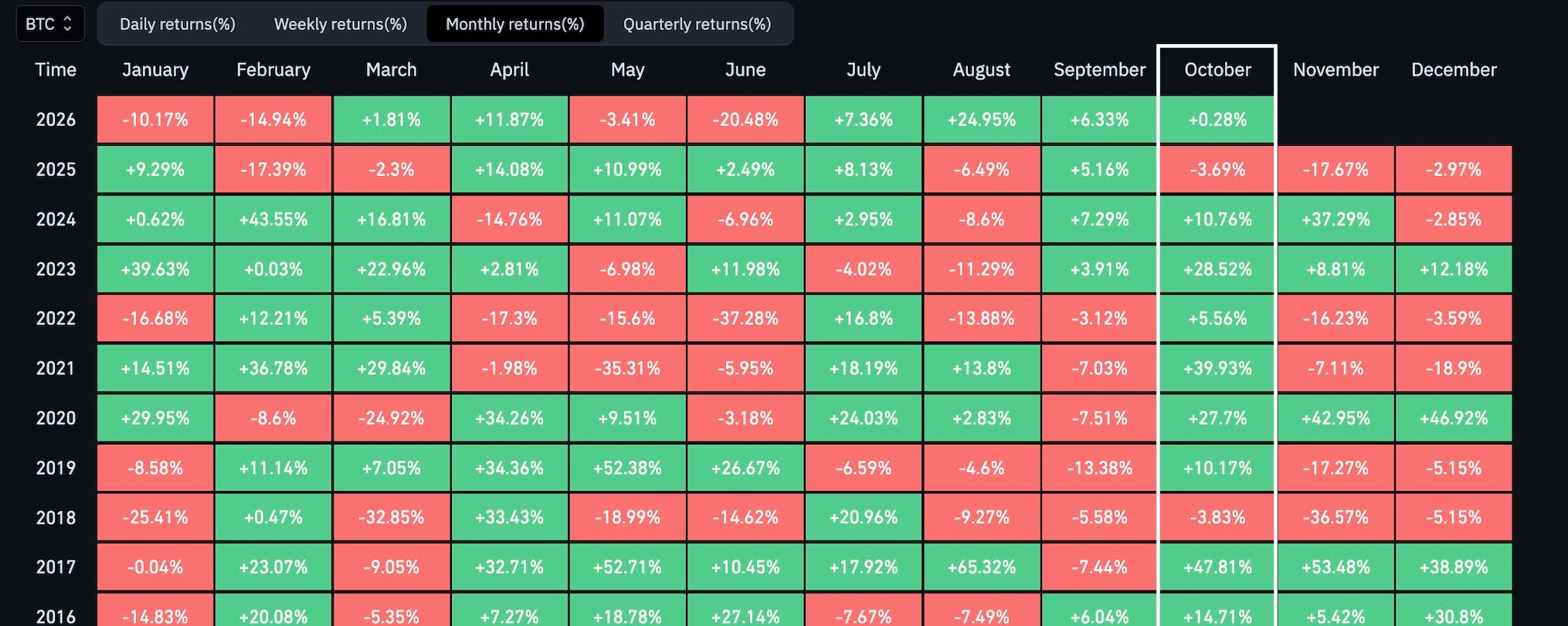
Historically, the fourth quarter has been Bitcoin’s strongest.
Since 2013, Bitcoin has produced an average Q4 gain of roughly 77% and a median gain of about 47.7%, according to data cited by CoinDesk.
Those numbers sound exciting, but they shouldn't be treated as a prediction.
Every cycle has different liquidity conditions, interest rates, institutional participation and investor positioning. A strong historical pattern can provide context, but it cannot tell us what Bitcoin will do over the next three months.
The $85K–$87K Area Matters
Bitcoin has already shown that breaking higher won't necessarily be easy.
On October 1, softer-than-expected U.S. inflation briefly helped BTC climb above $85,500, but the move faded as Treasury yields remained elevated. Bitcoin subsequently traded around $83,700.
That makes the recent highs especially interesting.
If Bitcoin can eventually break through the upper-$80K region and hold those gains, attention could shift toward $90K and potentially the psychological $100K level later on.
But repeated rejection could keep Bitcoin consolidating instead.
Liquidity Could Decide the Next Move
Q4 isn't only about Bitcoin's chart.
Interest rates, inflation, bond yields and the U.S. dollar can all influence investors' willingness to hold risk assets.
Recent softer inflation reduced expectations for an immediate Federal Reserve rate increase, which initially helped Bitcoin. Yet Treasury yields remained high enough to limit the rally.
That shows why macro conditions matter.
Bitcoin may have strong crypto-specific momentum, but maintaining it becomes harder when investors can earn attractive yields from lower-risk assets.
ETF Demand Needs to Continue
Another major factor will be institutional demand.
Citigroup raised its 12-month Bitcoin forecast from $82,000 to $113,000 on October 1, pointing to stronger crypto activity, a supportive macro backdrop and renewed ETF inflows. That is one institution's forecast rather than a guaranteed outcome, but it highlights how closely professional investors are watching ETF demand.
Consistent inflows could strengthen the Q4 story.
Weakening flows would make Bitcoin more dependent on other sources of fresh demand.
There Are Warning Signs Too
Not everything is pointing upward.
CryptoQuant recently estimated that spot Bitcoin demand contracted by around 170,000 BTC over 30 days, while growth in speculative futures demand dropped sharply during the second half of September. Profit-taking also increased after the rally.
That doesn't automatically signal the end of the move.
It simply means Q4 begins with Bitcoin in a much stronger position — but also with plenty of traders already sitting on profits.
Q4 Could Be About Confirmation
Q3 proved Bitcoin could recover.
Q4 may determine whether that recovery develops into something larger.
A combination of sustained ETF demand, improving liquidity, softer macro pressure and a convincing break above recent highs would strengthen the case for continued momentum.
On the other hand, stubbornly high bond yields, weaker spot demand and heavy profit-taking could keep BTC trapped in consolidation.
Bitcoin has already delivered the comeback.
Now Q4 has to answer the harder question: was Q3 only a powerful recovery, or the beginning of Bitcoin’s next major expansion?