

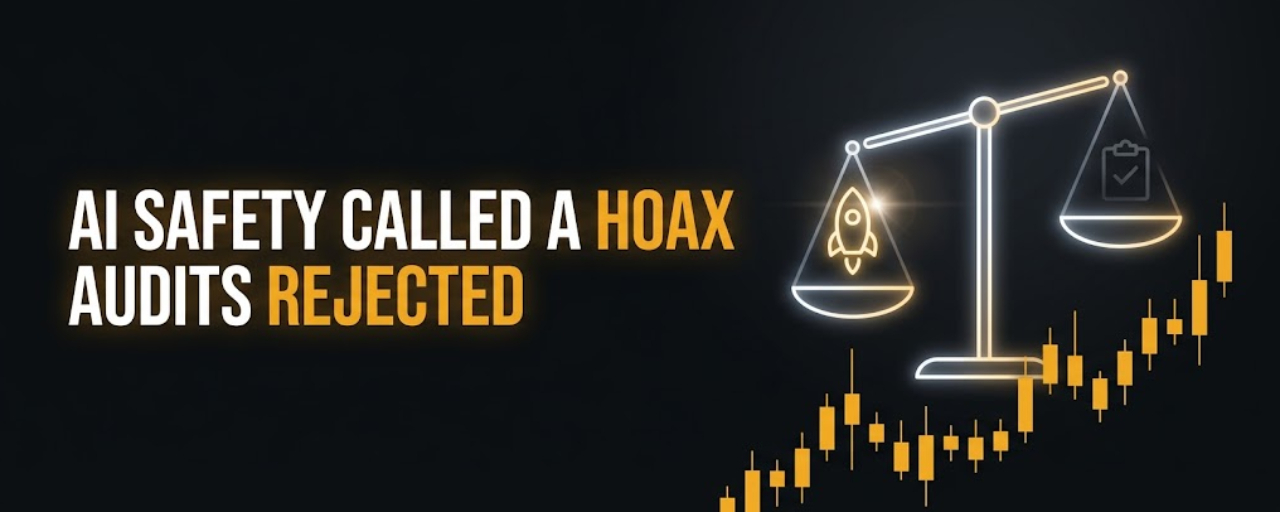

Even as Altman, Musk, and Anthropic's CEO call for oversight, the administration is choosing voluntary reviews instead. Here's the real story, and the crypto connection.
🗣️ When the people building the most powerful AI systems on Earth ask the government to regulate them, and the government says no thanks, that's worth paying attention to.
The administration rejected growing calls from AI industry leaders for mandatory oversight of frontier AI development, dismissing safety concerns as a "hoax" comparable to other warnings the administration has downplayed before. The preferred path instead is voluntary review, not binding rules.
⚡ Here's what actually triggered this.
Anthropic CEO Dario Amodei published an essay calling for a coordinated global slowdown in frontier AI development to address mounting risks. That essay wasn't ignored, it picked up endorsements from OpenAI CEO Sam Altman, Elon Musk, and Google DeepMind's Demis Hassabis, creating something close to genuine industry consensus that the current pace needs real structured oversight.
The response was blunt: the only guardrail AI needs is a "strong and smart" administration, and new regulations would mainly help competitors abroad by slowing down domestic innovation.
📜 Here's what's actually on the table, and what got rejected.
A real bipartisan bill exists, the FRONTIER Act, introduced by lawmakers from both parties. It would require large AI developers, companies above 500 million dollars in annual revenue, covering essentially every major lab, to publish safety frameworks, undergo independent audits twice a year, and report serious safety incidents, with real financial penalties for violations.
Instead of that path, the administration's preferred alternative runs through NIST, the National Institute of Standards and Technology, which published its own proposed evaluation guidelines built entirely on voluntary participation, with no enforcement authority attached.
🧠 Why does this policy fight actually matter to crypto?
Because AI and crypto have become deeply intertwined this year, AI agent payments, AI-linked tokens, infrastructure projects built specifically around autonomous AI systems. The regulatory environment AI companies operate in directly shapes how fast and how safely that technology develops, and crypto assets tied to AI narratives move on sentiment about exactly this kind of policy direction.
A voluntary, lighter-touch regulatory path generally means faster deployment timelines for AI capabilities, which can be bullish for AI-adjacent tokens in the near term. But it also means less independent verification of whether these systems are actually safe, the same concern that's been surfacing in OpenAI's own misalignment disclosures and Anthropic's IPO prospectus warnings about autonomous model risks.
✅ What this means for you
If you're holding AI-linked tokens, understand that this policy stance likely supports faster AI deployment in the near term, potentially a tailwind for AI-adjacent crypto narratives. But it's worth watching whether safety incidents accelerate alongside that faster pace, since major AI-related failures tend to trigger sharp sentiment reversals.
If you're trying to separate genuine industry concern from marketing, this is a useful signal, when the CEOs of competing companies actually agree on wanting more oversight, that's a stronger indicator of real concern than any single company's public statements alone.
If you're tracking the broader AI-crypto intersection, this policy direction is worth remembering alongside everything else happening this month, OpenAI's own safety disclosures, Anthropic's IPO risk warnings, and now the government's explicit choice to prioritize speed over mandatory verification.
🟢 Bullish scenario
Voluntary oversight proves sufficient, AI development continues advancing quickly without major incidents, and AI-linked tokens benefit from sustained rapid deployment and innovation.
🔴 Risk scenario
A significant AI safety incident occurs under the current lighter-touch framework, triggering a sharp regulatory and sentiment reversal that hits AI-adjacent crypto assets hard and fast.
👀 Three things to watch
1️⃣ The FRONTIER Act's fate
Does the bipartisan bill gain any traction in Congress despite the administration's opposition, or does it stall entirely?
2️⃣ NIST's voluntary framework
Does meaningful industry participation actually happen under a framework with no enforcement teeth?
3️⃣ Future safety disclosures
Do more labs follow OpenAI's lead in publicly disclosing concerning incidents, or does transparency decrease under lighter regulatory pressure?
💡 The key takeaway
This isn't a minor policy disagreement, it's the government explicitly choosing speed over mandatory verification, even as the industry's own leading voices are asking for the opposite.
The real question is whether voluntary oversight proves genuinely sufficient, or whether this becomes the regulatory gap that gets pointed to after the next major AI safety incident, the kind OpenAI has already started disclosing internally.
That is the part worth watching.
This post is for informational and educational purposes only and is not financial advice. Crypto markets are volatile. Always conduct your own research before making financial decisions.