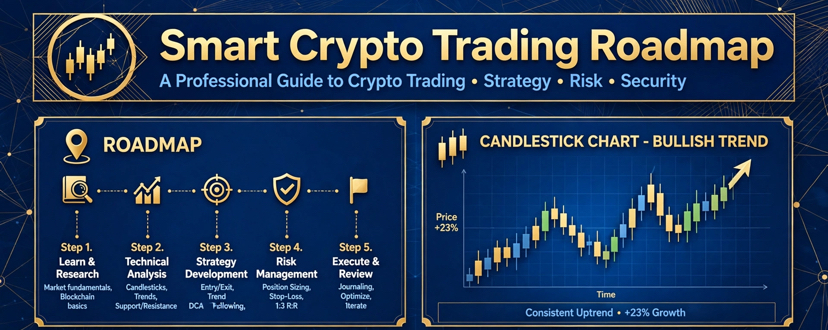

Steps to Trade Cryptocurrencies Correctly
Cryptocurrency trading is not random gambling, but an investment process with clear rules. Most of the losses beginners suffer are not caused by the market, but by the lack of a plan. Here are the practical steps to trade professionally.
1. Education and Understanding the Market Before Injecting Any Capital
Do not start trading while you cannot differentiate between a coin like Bitcoin $BTC and a project coin like $NMR . You must understand three types of analysis:
- Fundamental Analysis: Studying the project itself. Who is the team? What problem does it solve? Does it have real partnerships?
- Example: When you want to buy a coin like Numeraire, fundamental analysis makes you look for the fact that the project is backed by JPMorgan and manages $700 million, not just a meme coin with no utility.
- Technical Analysis: Reading charts and indicators like RSI and Moving Average.
- Market Sentiment Analysis: Following news and liquidity.
2. Choosing a Secure Exchange and Wallet
The biggest mistake is leaving your coins on untrusted platforms. Follow this division:
- For fast trading: Use major licensed centralized platforms like Binance, Coinbase, or Kraken.
- For long-term storage: Move your coins to a Cold Wallet like Ledger or Trezor.
Practical example: A trader bought $1000 worth of $ETH and left it on a small unknown exchange, the exchange shut down and his money disappeared. If he had moved it to his own wallet, he would have been safe.
3. Setting a Written Trading Plan and Money Management
Do not enter any trade without pre-defining three numbers:
- Entry Point: The price at which you will buy.
- Stop Loss Point: The price at which you will exit if the market reverses. The golden rule is to risk no more than 1% to 2% of your capital in a single trade.
- Take Profit Point: The price at which you will sell.
Example: Your capital is $10,000. You decide to buy SOL at $150. You set the stop loss at $140 (a $10 loss per coin), and take profit at $180. This way the risk-to-reward ratio is 3 to 1. Even if you lose 5 trades and win only 3, you will still be profitable.
4. Applying a Clear Strategy and Not Switching Between Them
Choose one strategy and stick to it for at least 3 months:
- Scalping: Fast trades for minutes aiming for 1% to 3%.
- Swing Trading: Holding the coin for days to weeks to benefit from an uptrend. Example: Buying a coin after a 30% correction and waiting for a 50% rebound.
- Long-term Investing HODL: Buying core coins like BTC and ETH and storing them for years regardless of short-term volatility.
5. Controlling Emotions and Documenting Everything
The two arch-enemies of a trader are greed and fear. When the market rises 20% he gets greedy and buys at the top, and when it drops 20% he gets scared and sells at the bottom.
The solution is a Trading Journal. Record in it:
The date of the trade, coin name, reason for entry, entry and exit price, and profit or loss.
After a month of logging, you will discover for example: that 80% of your losses come from trading meme coins after seeing posts on Twitter, while your profits come from trading strong project coins.