$POL Polygon Raises Staking Rewards to 7.7%, "Pumping" 27.3M POL to Retain Holders
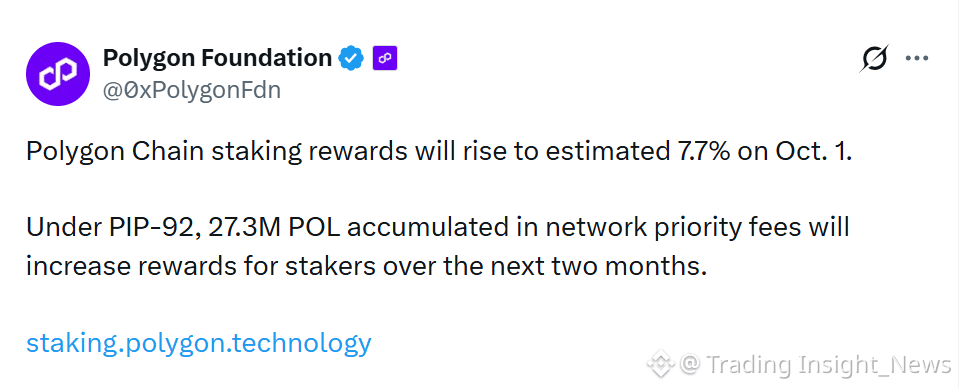
Polygon Foundation just announced staking rewards on Polygon Chain will be raised to 7.7% on October 1.
The specifics:
Under PIP-92, 27.3M POL from accumulated priority fees will be used over the next 2 months to boost staking rewards
A direct move to improve yield for POL holders
This is a notable move, and it tells a bigger story about the battle for staking capital.
In a sideways market, staking yield becomes a key competitive factor. If holders aren't satisfied with yields, they can stake elsewhere or worse, sell.
Using 27.3M POL from priority fees to boost staking rewards is a clever use of network revenue. Instead of letting fees sit in the treasury, they're redistributed to those securing the network.
But the real question is: is 7.7% competitive enough?
Compared to other L1/L2 networks, 7.7% is attractive but not groundbreaking. What stands out is that this funding lasts only 2 months. After that, yields could revert unless new revenue emerges.
This may be a short-term move to stabilize holder sentiment, but it doesn't solve the long-term issue: how do you retain users when the market has no momentum?
What do you think will higher staking rewards be enough to keep POL holders, or is it just a temporary fix?
News is for reference, not investment advice. Please read carefully before making a decision.
Polygon Foundation just announced staking rewards on Polygon Chain will be raised to 7.7% on October 1.
The specifics:
Under PIP-92, 27.3M POL from accumulated priority fees will be used over the next 2 months to boost staking rewards
A direct move to improve yield for POL holders
This is a notable move, and it tells a bigger story about the battle for staking capital.
In a sideways market, staking yield becomes a key competitive factor. If holders aren't satisfied with yields, they can stake elsewhere or worse, sell.
Using 27.3M POL from priority fees to boost staking rewards is a clever use of network revenue. Instead of letting fees sit in the treasury, they're redistributed to those securing the network.
But the real question is: is 7.7% competitive enough?
Compared to other L1/L2 networks, 7.7% is attractive but not groundbreaking. What stands out is that this funding lasts only 2 months. After that, yields could revert unless new revenue emerges.
This may be a short-term move to stabilize holder sentiment, but it doesn't solve the long-term issue: how do you retain users when the market has no momentum?
What do you think will higher staking rewards be enough to keep POL holders, or is it just a temporary fix?
News is for reference, not investment advice. Please read carefully before making a decision.